
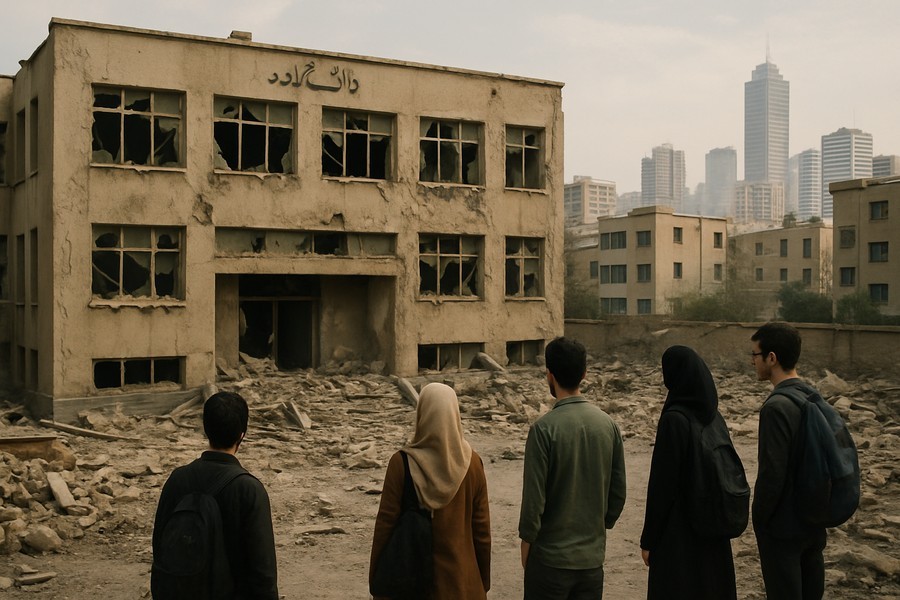
Escalation of Conflict Results in Attacks on Educational Institutions
Iran's national educational system has taken a hit due to the ongoing conflict with the US and Israel. Over thirty universities across the nation have reported direct attacks, causing severe disruption to the education and research sectors.
Key educational infrastructure and non-military sites have been caught in the crossfire, resulting in millions of students being denied access to education. A prominent university in Tehran, for instance, suffered significant damage due to a joint US-Israeli strike.
Iran has asserted that these attacks on its academic institutions aim to break down its scientific and cultural foundations. Conversely, Israel has framed these assaults as a broader strategy to weaken Iran's nuclear program, while the US claims that it does not knowingly target civilians.
Threats of Retaliation
In response to these attacks, Tehran has issued threats to target American and Israeli-affiliated universities in the region. Furthermore, the US has hinted at the possibility of reopening the Strait of Hormuz, marking a significant shift in its stance after previously insisting that other countries were responsible for securing the waterway.
Shipping Through the Strait of Hormuz
Despite the effective blockade, some vessels have managed to navigate through the waterway. Notably, two Turkish-owned ships successfully crossed the strait, with no Turkish-flagged vessels currently stranded in the Persian Gulf. Several other ships associated with China, Iran, and India have also managed to transit safely.
Furthermore, three Omani vessels managed to exit via a corridor closer to Oman, avoiding the Iran-approved corridor. A French-owned container ship also successfully navigated through the strait using the Iran-approved corridor, marking the first time a French-owned vessel has used this transit detour.
Pakistan is currently exploring the option of assisting other nations' vessels to transit safely, potentially by registering them under 'flags of convenience.' Iran is permitting Pakistan to transit 20 vessels under the Pakistani flag. However, as Pakistan does not currently have many ships trapped, it may secure passage for other vessels potentially linked to China.
Search for Missing Crew Member Continues
Following the downing of two US aircraft in the Middle East, both the US and Iran are searching for a service member who was onboard one of the planes. US forces have initiated search and rescue operations for a downed F-15 fighter jet. While one crew member has been rescued and is receiving medical attention, the status of the other remains unknown.
An A-10 Thunderbolt II was also hit by Iran, forcing the pilot to eject. However, the pilot managed to guide the plane out of Iranian territory before ejecting and was later rescued.
Despite these incidents, the US President has assured that these events will not impact any negotiations with Iran. Israel has also postponed some of its planned strikes in Iran to avoid interfering with search and rescue efforts for the downed fighter jet's crew members.
Ongoing Conflict in the Region
The regional conflict continues unabated, with a projectile striking the perimeter of Iran's Bushehr nuclear power plant, resulting in one casualty. Furthermore, multiple petrochemical company facilities in southwestern Iran's Khuzestan Province have sustained damage from aerial attacks.
The UN Security Council has delayed a vote on a resolution to secure transit passage in the Strait of Hormuz. This resolution, if adopted, would authorise countries to use "all defensive means necessary" to secure transit passage through the Strait of Hormuz, effectively authorising naval action in the strait.
Impact of War on Iranian Governance
Political scientists and analysts argue that the war has only strengthened the hardline military factions within the complex system of Iranian governance and amplified anti-American sentiment. As such, the current regime is expected to further suppress internal dissent. Experts warn that this is a wounded regime, and if it survives, it is unlikely to concede to its population anytime soon.