
Ancient Star's Supernova Explosion Traced Back by Scientists
An ancient star in a neighboring galaxy exploded into a supernova about forty million years ago, releasing a burst of light that only recently reached our planet. The eye-catching light was picked up by automated space technology, directing astronomers around the globe to focus their attention and resources on this newly discovered supernova, known as 2025pht. But, instead of simply observing this celestial firework, a group of scientists delved deeper into the records, hoping to identify the exact star that had erupted. Their efforts paid off.
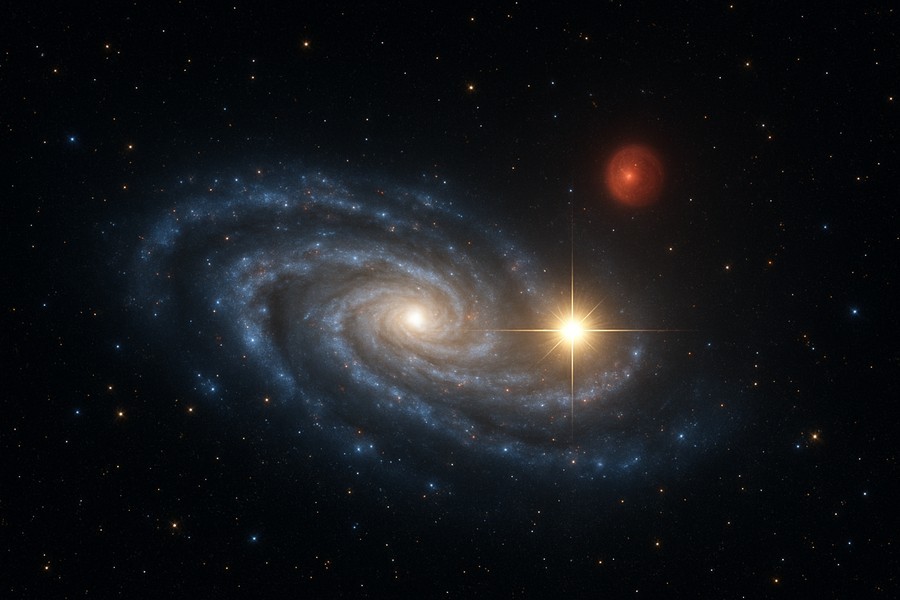
Photographs of the galaxy NGC 1637 taken by a high-powered space telescope revealed a single red supergiant star right where the supernova now illuminates. This marks the first time a supernova's progenitor, or parent star, has been detected by this telescope. The findings were reported in a well-respected scientific journal.
The Mystery of the Disappearing Red Supergiants
By meticulously comparing images of NGC 1637 captured by two different space telescopes, the team was able to pinpoint the progenitor star in pictures taken by two instruments on board the telescope in 2024. The star appeared unusually red – a sign that it was enveloped by dust that filtered out shorter, bluer wavelengths of light.
“This is the reddest, dustiest red supergiant we've ever seen explode into a supernova,” said a PhD candidate at Northwestern University, who also co-authored the paper.
This overabundance of dust might shed light on a persistent mystery in astronomy, often referred to as the case of the disappearing red supergiants. Astronomers typically anticipate the most massive stars that explode as supernovas to also be the brightest and most luminous. Consequently, they should stand out in pre-supernova images. However, reality hasn't always matched expectations.
One plausible explanation is that the most massive aging stars are also the dustiest. If they're shrouded in copious amounts of dust, their light could be dimmed to the point of becoming invisible. The telescope's observations of supernova 2025pht support this theory.
“I've been advocating for this interpretation, but even I wasn't prepared for the extreme dustiness of supernova 2025pht. It could explain why these more massive supergiants are so hard to spot since they tend to be dustier,” said the lead author from Northwestern University.
Carbon-Rich Dust and Future Predictions
The research team was not only taken aback by the quantity of dust, but also its composition. Computer models applied to the telescope's observations suggest that the dust is likely carbon-rich, contrary to the expected silicate-rich composition. The scientists posit that this carbon may have been brought up from the star's core just before it exploded.
“Having observations in the mid-infrared was crucial in determining the type of dust we were seeing,” said the PhD candidate.
The team is now on the hunt for similar red supergiants that could potentially explode as supernovas in the future. The upcoming launch of another space telescope could aid in this search. This new telescope will have the resolution, sensitivity, and infrared wavelength coverage to not only detect these stars but also potentially observe their variability as they release large quantities of dust near the end of their lives.
This top-tier space telescope is the world’s leading space science observatory, tasked with unravelling mysteries in our solar system, peering beyond to distant worlds around other stars, and probing the enigmatic structures and origins of our universe and our place within it. The telescope is part of an international program involving several space agencies.