
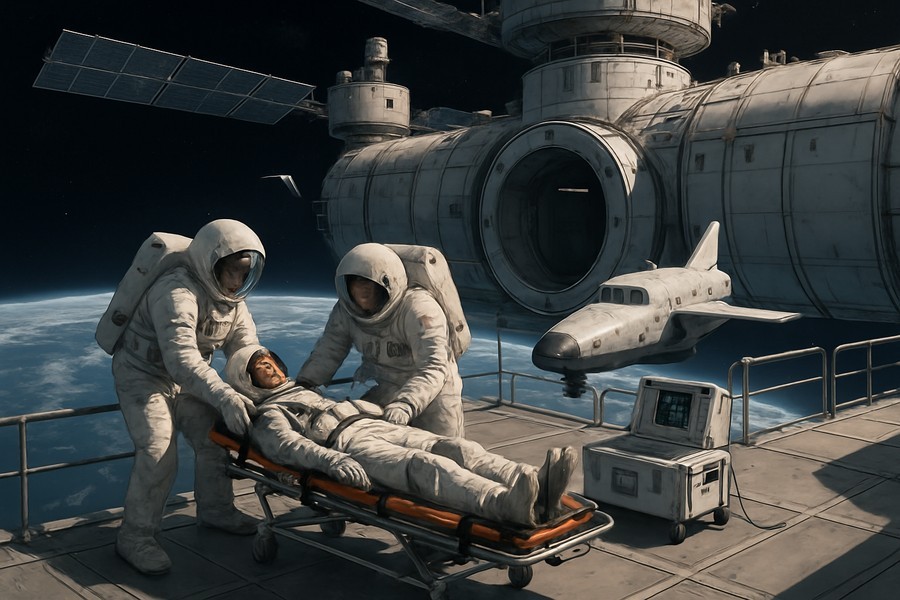
Unpacking the Implications of the First Emergency Medical Evacuation from Space
For the first time in a quarter-century of uninterrupted manned missions, a medical emergency has prompted the evacuation of an astronaut from the world's space station. The Crew-11 mission concluded early due to a health incident, with the four astronauts brought back home safely. The details of the incident haven't been disclosed to respect the privacy of the affected astronaut.
While this event is unusual, it spotlights a critical question: How do astronauts maintain their health in space, and why is this early evacuation so rare?
Healthcare in the Cosmos
Astronauts are chosen after a thorough medical examination. They're tested for health conditions that could worsen in a weightless environment, assessed for mental toughness, and monitored throughout their careers.
Although predictions indicate a medical emergency could occur every three years on the space station, serious health problems are incredibly uncommon. The space station has a robust healthcare system on board and back on Earth. Each crew has a designated Crew Medical Officer, sometimes a certified physician, or someone extensively trained in space medicine procedures. These professionals can perform basic examinations, administer medications, and carry out remote consultations with specialists on Earth.
Common Health Issues in Space
A 2015 study found that medication use on the space station was relatively minimal, with astronauts taking approximately ten doses of over-the-counter medication per week. Most of these medicines are used to manage common conditions like:
- Skin Irritation: The most frequently reported medical issue in space is skin irritation. Space-related skin problems like dry skin, rashes, allergic reactions, and delayed wound healing occur at rates 25 times higher than on Earth. The cold, dry, low-humidity environment of the spacecraft worsens these problems, and hygiene is limited to wet wipes and rinse-less products for months.
- Congestion and Headaches: Most astronauts experience congestion and headaches, especially early in a mission. Without gravity to pull fluids downward, blood shifts toward the head, causing a swollen face and blocked nose, which astronauts call "space sniffles." This can trigger headaches, reduced appetite, and poor sleep.
- Sleep Disruption: Disrupted sleep is common. The space station orbits Earth every 90 minutes, causing 16 sunrises and sunsets in 24 hours, which disrupts circadian rhythms. This, coupled with equipment noise, limited personal space, and the stress of spaceflight, results in astronauts typically getting one to two hours less sleep per night than on Earth.
- Musculoskeletal Injuries: Injuries to the musculoskeletal system are surprisingly common. A study catalogued 219 in-flight injuries across the US space program, with an incidence of roughly 0.02 per flight day. Hand injuries were the most frequent, mostly minor cuts from moving between modules or handling equipment. Exercise, ironically designed to protect astronauts' bones and muscles, is now the leading source of injuries on the space station.
Exercise in Space
Astronauts exercise for around two hours each day to fight bone and muscle loss and cardiovascular deconditioning in microgravity. Without the constant load of gravity, bones can lose about 1% of their density per month, especially in the legs, hips, and spine.
However, this essential countermeasure carries its own risks. Spacewalks present additional hazards – often caused by spacesuit components.
Unique Health Challenges in Space
Some health issues are unique to spaceflight. Spaceflight Associated Neuro-ocular Syndrome (SANS) affects up to 70% of astronauts on long-duration missions. The fluid shift towards the head changes pressure in the eye, leading to optic nerve flattening and vision changes that can persist for years after returning to Earth.
In an instance reported in 2020, a blood clot was discovered in an astronaut's jugular vein during a routine research ultrasound. The astronaut had no symptoms; the clot was found by chance. Doctors on Earth guided treatment over more than 90 days, with blood thinners administered, additional medication sent on a resupply vessel, and the astronaut performed their own ultrasound scans with radiologists directing from hundreds of kilometers below. They completed their mission and returned safely without any health consequences.
The Future of Healthcare in Space
The Crew-11 evacuation demonstrates that space agencies prioritize crew safety above all else. As missions move beyond low Earth orbit into deep space, new approaches to medical care will be needed – potentially using AI to assist crew medical officers.
The fact that this is the first expedited medical evacuation in 25 years underscores how effectively space medicine has developed. But it also reminds us that space is inherently challenging for human biology, and sometimes, there's no better place than home.