
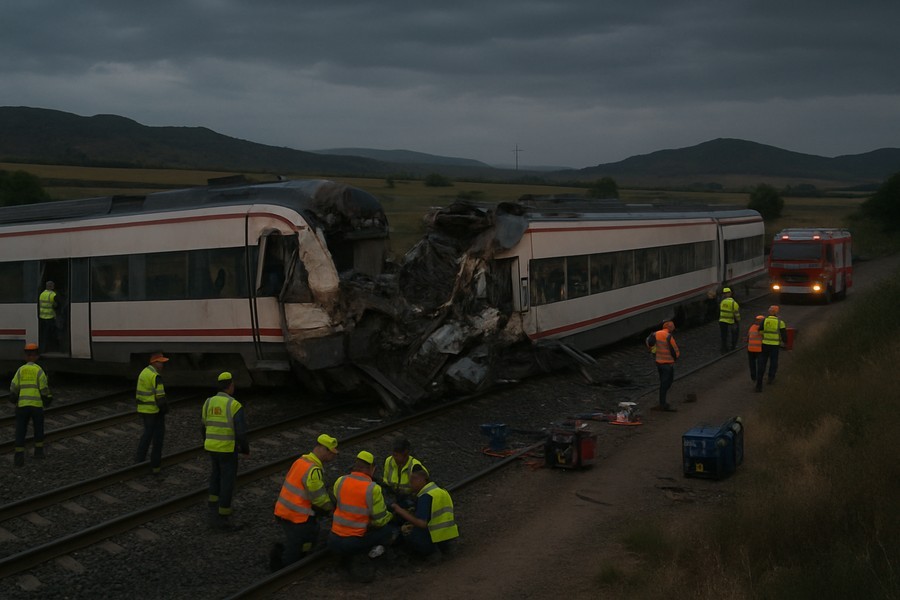
Understanding Spain's Most Devastating Train Collision in Recent Years
A tragic train collision in southern Spain has resulted in the loss of at least 39 lives and left many others injured. The calamity, which happened near the city of Córdoba, is the worst railway accident the country has seen in over 10 years.
The Prime Minister of Spain is set to visit the crash site where rescue operations are still in progress. Let's delve into what's known about this catastrophic event.
Details of the Collision
The deadly incident occurred in the evening, roughly an hour after one of the trains left a southern city for the capital Madrid. The train was derailed and veered onto the opposite track, according to the operator's statement.
Unfortunately, an oncoming train, heading from Madrid to Huelva in the south, was forced against an embankment next to the track. The Transport Minister of Spain confirmed these details, adding that the brunt of the casualties occurred in the front carriages of the train bound for Huelva.
The Cause of the Crash Remains Unclear
The reason behind the derailment is still a mystery. An official investigation is underway but it may take at least a month to uncover the real cause of the accident. The Transport Minister referred to the crash as "extraordinarily unusual", asserting that all railway professionals consulted are confounded by the circumstances of the accident.
The head of the nation's rail operator stressed that he had ruled out the possibility of the catastrophe resulting from either excessive speed or human error. He insisted that even if an error had occurred, the train's in-built safety systems would have corrected it. Both trains were reportedly operating within the speed limit at the time of the collision, leading him to suggest that a mechanical malfunction or an infrastructure issue could be the more probable cause.
Rescue Efforts Continue
About 400 individuals, both passengers and crew, were onboard the two trains at the time of the crash. It's unclear if there are people still trapped inside the carriages, but rescue teams remain at the scene. The head of the local fire department described the situation as challenging, with twisted metal complicating the rescue efforts.
The regional government's president stated that they are awaiting heavy machinery to lift parts of the second train, which bore the worst of the collision. Until the wagons are cleared from the tracks, emergency services can't begin the process of searching for and identifying any remaining victims.
Identifying the Victims
While the 39 victims of the collision haven't been identified, the Transport Minister confirmed that the casualty count is not yet final. At present, 112 individuals have received medical attention, with 43 still hospitalized. The injured include four minors, one of whom is in intensive care, and twelve adults also in intensive care.
Survivors Share Their Experiences
Survivors from the Madrid-bound train likened the moment of collision to an "earthquake". They reported shattered windows, scattered luggage, and people being thrown to the floor. One passenger, who was in the first carriage, described a sudden sensation akin to an earthquake, followed by screams and calls for medical help.
Another passenger, who was in the fifth carriage of the same train, narrated how he began to "feel some banging" that gradually increased in intensity. He explained, "Another train passed us and everything started vibrating. There was a jolt behind us and the feeling that the whole train was going to fall apart."
