
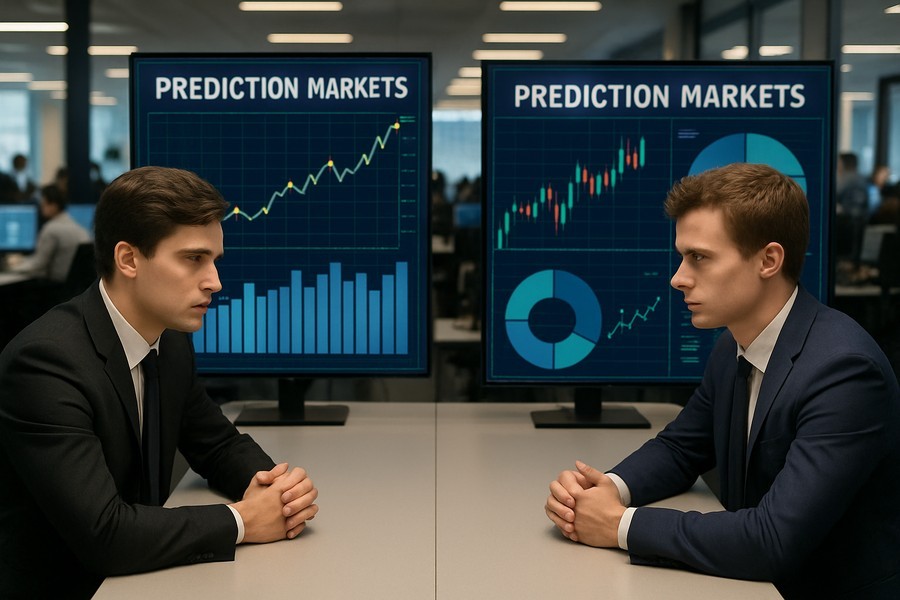
Rivalry Between Two Young Tycoons Fuels Growth of Prediction Markets
The world of prediction markets is buzzing, and it's all thanks to two young billionaires who can't stand each other. Their rivalry is fierce, and it's causing a stir in the industry. The two are in a race to lead the fastest-growing prediction market platform, but they have different strategies and ideas about how to get there.
A Battle of Wits and Words
The CEO of one company refuses to even utter the name of his competitor's platform. He insists that his company is not like the "unregulated and offshore prediction market" that many people mistake it for. This CEO sees distinguishing his company from the rival one as a battle, and he's always ready to take a shot.
Things heated up after the FBI raided the home of the rival CEO. In response, the first CEO's company partnered with influencers to spread memes ridiculing the raided CEO. The rivalry between the two is so intense, it's been likened to the historic face-off between NFL quarterbacks Tom Brady and Eli Manning. Just as that rivalry pushed Brady to greater heights, these two CEOs are pushing each other to the limits.
Behind the Scenes Drama
The other CEO has been more reserved in public about his competitor, but his frustration is apparent to those close to him. This CEO feels the competition is escalating, despite his attempts to keep a low profile. The feud has even reached the U.S. Patent and Trademark Office, where both companies have submitted applications for the title of "the world's largest prediction market."
The rivalry could shape the future of the industry, as each CEO offers different visions for the growth of prediction markets. Some believe these markets should fight for legal recognition, while others suggest they should attempt to avoid U.S. regulations, much like the cryptocurrency industry has done.
Exploding Growth in Prediction Markets
The feud comes in the midst of a boom in the prediction market industry. These platforms have seen huge growth recently, with billions of dollars wagered weekly on a wide range of topics - from who will win the Oscars, to the timing of political events, and even when a civil war could break out.
Millions of people are turning to these sites to try their luck, despite the ethical and legal questions surrounding the industry. While new competitors are entering the market, two companies dominate it: the ones led by our feuding billionaires.
The Paths to Success
Both CEOs are in their twenties and believe that the "wisdom of the crowd" approach of prediction markets can reveal truths faster and more accurately than traditional methods. But their paths to success are starkly different.
One CEO, an MIT graduate with Wall Street experience, believes that winning over the federal government is key to mass adoption of prediction markets. His approach is to actively seek regulation and work within established legal frameworks. He doesn't want to build a company that's plagued with problems as it grows.
The other CEO, a college dropout who gained experience trading cryptocurrencies, believes in a more aggressive, less regulatory approach. His strategy is to expand quickly, disregarding the potential legal consequences. However, his approach has had its complications, including an FBI raid related to a money-laundering investigation.
Regulatory Wrangles
While the first company has spent years negotiating with regulators before launching, the second operates overseas and is accessible in the U.S. through a virtual private network. This company is willing to push the envelope, even allowing bettors to wager money on when a nuclear bomb would detonate - a feature it later removed due to public backlash.
Despite the differences in approach, both companies have powerful allies. Both have the backing of influential figures, including the president's son, who advises both companies and has invested millions of dollars into the second company.
One-Upmanship in the Industry
As the competition heats up, both companies are looking for ways to outdo each other. Recent moves include a media partnership by one company, and a deal with a major publisher by the other. One company even gave out free groceries in New York City, to which the rival company responded by opening a free grocery store in Manhattan.
The rivalry reached a new level when one of the companies announced the formation of a trade group to promote the development of the industry. The group aims to establish clear, fair rules for prediction markets, making them accessible and trustworthy for everyone. Noticeably absent from the coalition is the other company, further highlighting the bitter rivalry between the two.