
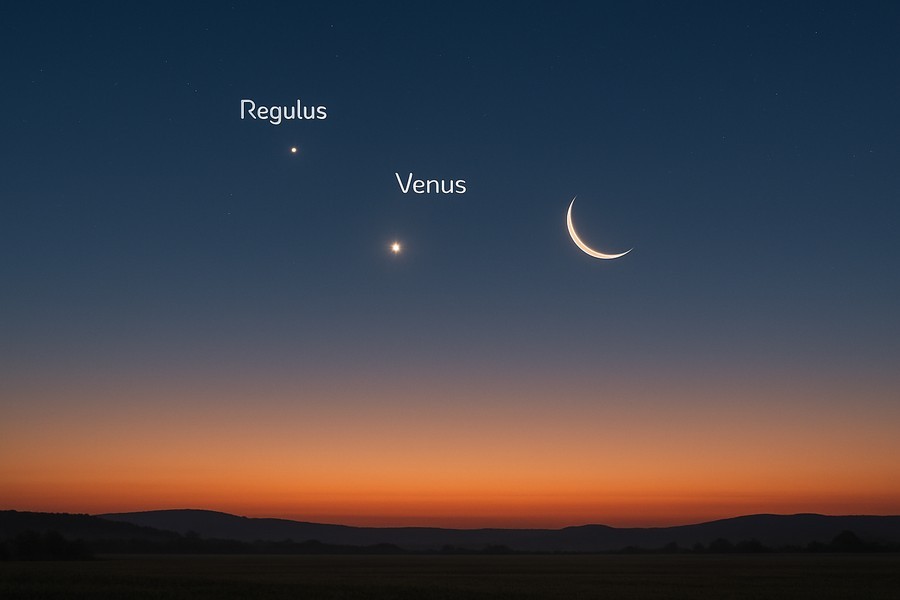
A Unique Celestial Phenomenon: The 'Smiling' Triple Conjunction
Have you ever looked up at the sky and felt like it's smiling back at you? Well, if the weather permits, you might be able to experience this feeling firsthand on an upcoming Friday. The sliver of a moon, Venus, and Regulus are going to be huddled together in the eastern sky at dawn, creating a unique spectacle.
The Intricate Dance of Celestial Bodies
This celestial event is not a simple one and is considered one of the most exciting conjunctions of the year. Here's what you need to know about the participants of this cosmic ballet: The Moon will be a thin 5% illuminated crescent, 27 degrees west of the Sun. Venus, a radiant body that has dominated our dawn sky for most of the year, will be 89% illuminated. And finally, Regulus, the brightest star in the Leo constellation, will complete the trio.
Although these celestial bodies appear close in the sky, they are actually quite distant from each other. The moon is the closest at 385,000 kilometers (1.3 light-seconds) away, Venus is just over 12 light-minutes distant, and Regulus is a whopping 78 light-years away. This positioning creates a 'smiling' effect, with Regulus and Venus acting as the eyes and the Moon as the smile.
The Moon's Dance with Venus and Regulus
These celestial bodies do not just create a pretty picture, they also provide their own interesting events. For example, the Moon will pass in front of Regulus, an event known as an occultation, for some remote areas in northern Siberia. This is the beginning of a series of such events that will continue until January 24th, 2027.
The occultation of Venus by the Moon is likely to be the most intriguing part of this event. The extreme northwestern Canadian Arctic will witness the event under dark skies, while the North Atlantic and all of continental Europe down into northern Africa will see the Moon occult Venus during daylight.
If you are not in these areas, you can still try to spot Venus near the thin crescent Moon during the day. The best way to do this is to follow the pair as they rise after sunrise. But remember to keep the Sun safely blocked from view when attempting this.
The Rare Double Occultation
This event also includes a rare double occultation. However, it is unlikely that anyone will observe this since it will occur under bright twilight skies in a remote area north of Dudinka, Russia. If anyone were to witness this, they would see both Venus and Regulus move through the lunar terrain, which would be an amazing sight indeed.
How Rare Is This Phenomenon?
This type of tight grouping within a half-degree circle, which is about the size of the Moon, is quite rare. There are five naked-eye planets and four bright stars near the Moon's path that could potentially participate in such an event. However, for the 'smile' to form correctly, the Moon must be in a specific phase. These factors make such occurrences incredibly unique.
In fact, upon examination of celestial events up to the year 3000 AD, only 85 such events were found. Many of these events occur under daytime skies or near a Full Moon, and others are too close to the Sun to be observed. One of the best events of this kind happened on April 23rd, 1998, when the Moon occulted Venus and Jupiter as seen from Ascension Island in the South Atlantic.
The next occurrence isn't until October 15th, 2036, and it will involve Regulus and Saturn. In addition to these events, there is also a significant eclipse coming up soon. So, keep your eyes on the skies and enjoy the celestial wonders they hold. Maybe this is the universe's way of reminding us to smile.