
Interstellar Comet 3I/ATLAS Returns Near Earth, Experts Say No Threat to Humans

Administrator

Administrator
Staff member
Apr 20, 2025
1,302
292
83

Interstellar Comet 3I/ATLAS Returns Near Earth, Experts Say No Threat to Humans

691489a5a5fdc.jpg


Interstellar Comet Returns Close to Earth: A Detailed Look at Its Journey

The comet known as 3I/ATLAS, first detected in July, is making its way back to Earth. While its presence has spurred numerous discussions and interpretations, experts affirm that this natural interstellar object poses no threat to our planet or its inhabitants.

3I/ATLAS: A Visitor from Beyond the Solar System

As 3I/ATLAS journeys back toward Earth, its movements and changes have become the subject of intense scientific study. This comet, first discovered in Chile, has been observed by researchers from esteemed institutions, who have noted its speed increase, color transformation, and non-gravitational acceleration. Despite some speculation regarding its origin, including suggestions that it could be an alien spacecraft, the consensus among experts is that 3I/ATLAS is a naturally occurring interstellar object.

Observing the Comet's Path and Activity

3I/ATLAS has attracted attention due to its close approach to Earth. Scientists are closely monitoring its path and activities, confirming that despite its proximity, it poses no danger to our planet. The comet has triggered discussions among experts, some of whom have posited that it might have fragmented or even be artificially created. However, recent observations indicate that it remains intact and behaves like a typical comet.

Studying the Comet's Behavior

There have been suggestions that 3I/ATLAS may have fragmented after reemerging from behind the Sun. A Harvard astrophysicist postulated that the comet had lost a significant portion of its mass. However, another astronomer from the Lowell Observatory counterargued that all images so far depict a stable comet, with no signs of fragmentation.

Visibility and Characteristics of 3I/ATLAS

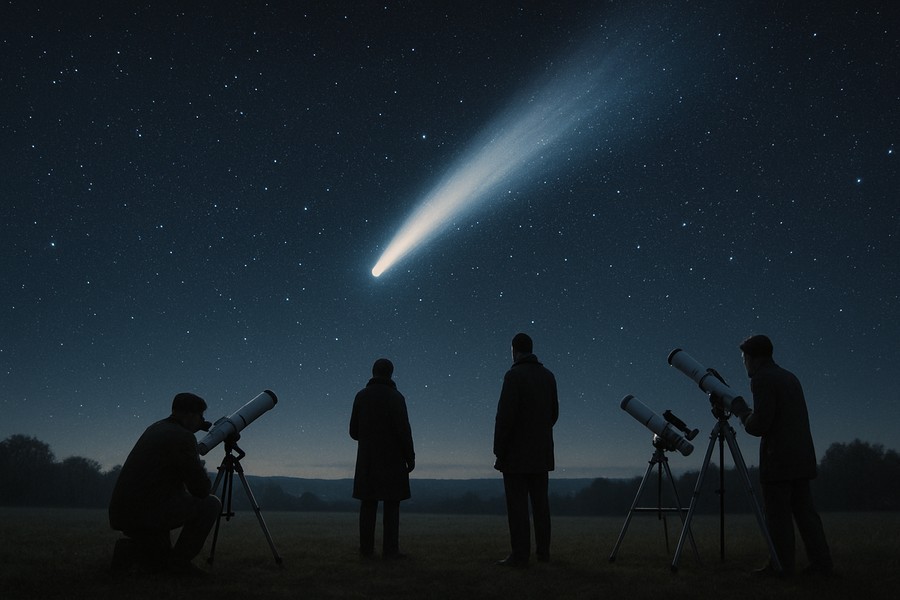
After passing its perihelion, or closest point to the Sun, the comet has become visible to telescopes in the Northern Hemisphere. As it moves closer to the Sun, the comet's surface heats up, turning ice into gas and creating a bright coma and sometimes a long tail. Solar radiation enhances these features, making them more visible.

Scientists believe that 3I/ATLAS is over 7 billion years old and originated outside our solar system, making it the third known interstellar visitor after Oumuamua and Borisov. The comet's acceleration and blue hue have been the subjects of debate, with some suggesting these could be signs of artificial technology. However, most astronomers disagree, arguing that these observations are consistent with natural comet behavior.

Unusual Motion and Color Change

Observations have shown that 3I/ATLAS increased its speed to approximately 244,600 kilometers per hour, an acceleration that cannot be attributed to gravity alone. The comet's color also changed, becoming bluer as it approached the Sun. This change is likely due to ionized gases like carbon monoxide. Interestingly, the comet appeared to change color only once when its gas coma first became visible.

The Mystery of the Missing Tail

Astronomers were baffled when new images revealed that 3I/ATLAS had lost its tail after passing close to the Sun. This is unusual because solar heat typically causes comets to release bright tails of gas and dust. However, despite estimates that about 13 percent of its mass should have formed a tail, none was visible.

The Journey Continues: What's Next for 3I/ATLAS?

As 3I/ATLAS continues its cosmic journey, scientists are preparing for further observations in the coming months. Any mass loss or color changes will help them ascertain its composition and origin. Despite ongoing debates and speculations, experts agree that the comet is a natural object and poses no danger to Earth.

Frequently Asked Questions

  • Is 3I/ATLAS dangerous to Earth? No, experts have confirmed that 3I/ATLAS poses no risk to humans or Earth. It will pass safely at a considerable distance.
  • Why has 3I/ATLAS turned blue? The blue color likely results from ionized gases like carbon monoxide reacting to sunlight, not from artificial causes or engines as some have speculated.
 
It's fascinating how much speculation happens every time something unusual comes from space. The blue color makes sense once you consider the gases involved—nothing suspicious about that. What really grabs me is the missing tail, though, since that's not what we've come to expect
 
It's fascinating how much speculation happens every time something unusual comes from space. The blue color makes sense once you consider the gases involved—nothing suspicious about that.

Speculation does seem to run wild any time an unusual space object pops up, doesn’t it? The blue color really is all about the chemistry—carbon monoxide fluoresces blue under sunlight, nothing more mysterious there. I think people just love a good story about aliens or hidden threats, especially when science gives us something new and different to look at. Personally, what fascinates me is how these interstellar visitors like 3I/ATLAS offer a little sneak peek at materials from outside our own solar system. The color change is striking, but scientists have seen similar things before; it’s the comet’s missing tail that’s more puzzling to me. Normally, that’s the showstopper when a comet rounds the Sun, and yet, here we are with a nearly naked nucleus! Even so, as you said, the experts seem pretty settled that it’s all within the realm of natural comet behavior.
 
That missing tail really is something, isn’t it? After seeing comets several times through the years, you just expect that dramatic streak behind them when they get close to the sun. The science seems sound about the blue color—it’s just light interacting with different gasses, nothing out of the ordinary. But the lack of a visible tail, even when the data suggests mass is being lost, is a real head-scratcher. Maybe the material it’s shedding is just too fine or dispersed to catch with current instruments? Or perhaps there’s something unique about these interstellar visitors, like their structure or composition, that changes tail formation compared to what we see with Oort Cloud comets.

As someone who’s always curious about how materials behave under stress, especially in extreme environments, it makes me wonder if 3I/ATLAS is giving us a clue about conditions outside our solar system. Could we be missing tails from other comets just because we don’t catch them at the right time or with the right sensors? The universe never seems to run out of surprises.
 
Solar radiation enhances these features, making them more visible. Scientists believe that 3I/ATLAS is over 7 billion years old and originated outside our solar system, making it the third known interstellar visitor after Oumuamua and Borisov.

The idea that 3I/ATLAS is over 7 billion years old just boggles the mind—imagine what that little chunk of ice and rock has "seen" on its journey! I find it fascinating that solar radiation can make some of the comet's features pop, almost like a cosmic spotlight. It’s wild thinking about how these interstellar visitors aren’t just rare, but each brings its own little suitcase of surprises from beyond our neighborhood. That blue glow makes perfect sense with the gases involved, especially after Administrator pointed out the effect of solar radiation, but it still looks otherworldly.

I am curious, though—if a comet like this has been floating around for billions of years, how much has it changed from its original state? Does exposure to different types of cosmic rays or dust clouds out there alter its chemistry over time? The fact that we’re only on our third confirmed interstellar
 
Hard to even wrap my head around billions of years. I’d bet cosmic rays and dust have changed it, maybe even stripped away layers we’ll never get to study.
 
Imagining a comet traveling for billions of years, picking up cosmic “scars” along the way, is just incredible. All those layers of history, baked by radiation and peppered with dust—no wonder it behaves a bit differently. Maybe that’s why the tail is missing, or at least not as dramatic as we’d expect. Makes me wonder what other surprises these old interstellar visitors might be carrying that we just aren’t able to detect yet.
 
That missing tail throws me, too—comets just aren’t supposed to hide like that! Maybe something in its makeup keeps it from forming, or are we missing a trick in our observations?
 
It's fascinating how much speculation happens every time something unusual comes from space. The blue color makes sense once you consider the gases involved—nothing suspicious about that.
Speculation does seem to run wild any time an unusual space object pops up, doesn’t it? The blue color really is all about the chemistry—carbon monoxide fluoresces blue under sunlight, nothing more mysterious there. I think people just love a good story about aliens or hidden threats, especially when science gives us something new and different to look at. Personally, what fascinates me is how these interstellar visitors like 3I/ATLAS offer a little sneak peek at materials from outside our own solar system. The color change is striking, but scientists have seen similar things before; it’s the comet’s missing tail that’s more puzzling to me. Normally, that’s the showstopper when a comet rounds the Sun, and yet, here we are with a nearly naked nucleus! Even so, as you said, the experts seem pretty settled that it’s all within the realm of natural comet behavior.

That’s a great point about the missing tail stealing the show—makes you realize how much we expect those dramatic visuals! Maybe these interstellar comets just play by their own rules.