
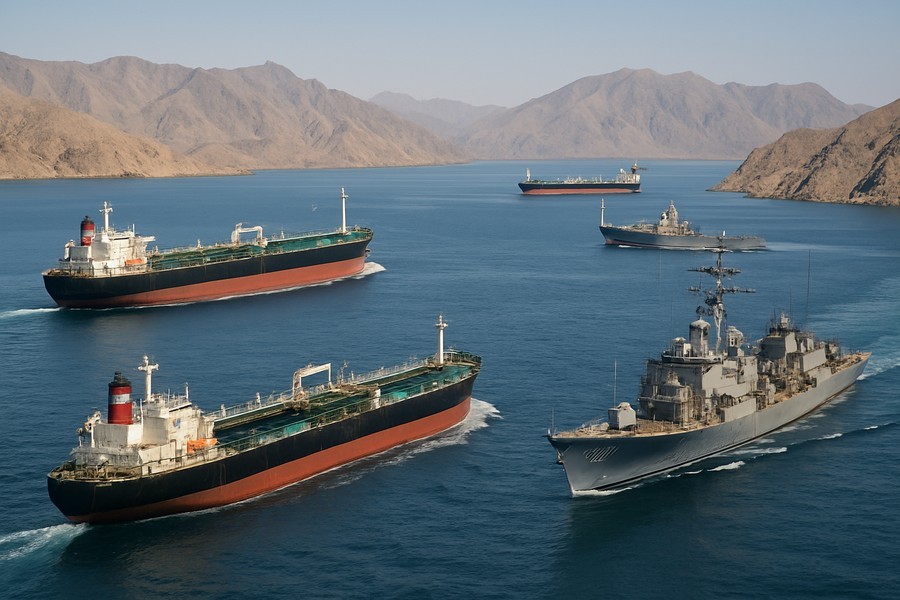
Could a Shutdown of Hormuz Push Oil Prices to $100?
The recent military strikes by the United States on Iran have generated concerns about a potential disruption in the supply of oil. These fears stem from the possibility of disturbances to the flow of oil through the Strait of Hormuz.
The immediate response to the strikes is likely to be a sudden increase in oil prices. However, the more significant question is whether these tensions could lead to a long-term halt in the exports of Gulf oil.
It appears we might be heading towards an open military conflict between the U.S. and Iran. The path such a conflict might take is impossible to predict. If the situation continues to escalate, and if Iran and its allies retaliate in full force, the oil industry could face its worst-case scenario. This could mean a significant disruption in the Middle East's oil flows, unless the U.S. can neutralize Iran's naval and military forces, and make sure tankers can move freely through the Strait of Hormuz.
The Importance of the Strait of Hormuz
With the rising tensions, the world's eyes are on the Strait of Hormuz. Any disruption here would have immediate and far-reaching effects on global oil and LNG flows.
Located between Oman and Iran, the Strait of Hormuz is a vital passageway, and a potential bottleneck, for crude oil. As of 2025, about 13 million barrels per day pass through it, making up roughly 31% of all seaborne oil flows.
The Strait of Hormuz is the link that connects major Gulf producers, including Saudi Arabia, Iran, Iraq, and the United Arab Emirates, to the Gulf of Oman and the Arabian Sea. Commercial vessels in the area have received radio warnings from Iran's Revolutionary Guards, stating that "no ship is allowed to pass the Strait of Hormuz." However, there has been no official confirmation from Tehran regarding any directive to close the waterway.
Escalating Tensions and Potential Consequences
There are early signs of a broader-scale attack on Iran, which could result in counterattacks and potentially involve multiple Gulf countries. Over the years, Iran has threatened to block the narrow passage in response to attacks against it.
Industry experts have been advising their clients for weeks that there is a 75% probability of a conflict. This is a serious concern for oil and gas markets worldwide, considering their dependence on Hormuz for production and flow.
However, the crucial factor is the duration of the conflict. Any spike in oil and LNG prices will depend on how long and to what extent Gulf production and flows are disrupted.
The Worst-Case Scenario: Oil Prices in Triple Digits
Analysts believe that potential scenarios range from minor disruptions to Iranian exports to a total blockade of Hormuz. The worst-case scenario is not only the loss of Iranian oil, but a broader disruption to shipping through the strait.
If Iran feels threatened to the point of existential crisis, blocking the Strait of Hormuz cannot be ruled out. However, it is expected that the U.S. and its allies would deploy military escorts to safeguard shipping lanes.
If Iran does manage to close the Strait, the global oil markets could face a severe crisis. This could lead to a situation three times worse than the Arab oil embargo and Iranian revolution in the 1970s. It could drive oil prices into triple digits and cause LNG prices to reach record highs.
The attacks significantly increase the risk of an oil supply disruption in the region, even though Iranian oil facilities haven't been directly targeted so far. The worst-case scenario is an attack on oil infrastructure in Saudi Arabia, followed by a complete closure of the Strait of Hormuz. The likelihood of this scenario is estimated to be about 33%, given the pressure Iran might be feeling.