
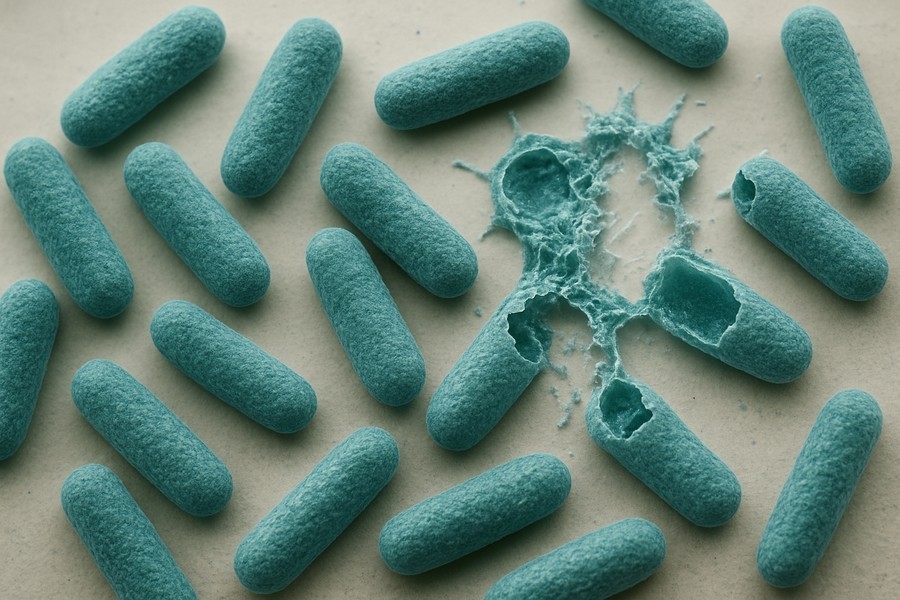
Unraveling the Ghost Cell Mystery: A Unique Immune System in Bacteria
Scientists have been trying to understand the mysterious phenomenon of 'ghost cells' in bacteria for quite some time. Ghost cells are the remnants of bacterial cells that have burst open, or 'lysed', and their contents released. Specifically, in the bacterium C. crescentus, a particular gene activation triggers the creation of these ghost cells.
What Triggers Ghost Cell Formation?
Under normal laboratory conditions, C. crescentus bacteria do not produce ghost cells. However, when the master repressor gene known as rogA is removed, the process is activated. This de-repression leads to the activation of a group of genes which control the expression of gene transfer agents (GTAs). GTAs, in turn, are responsible for the formation of ghost cells.
Studies have shown that a strain of C. crescentus that has the rogA gene deleted has a significantly higher proportion of ghost cells compared to the wild-type strain. On the other hand, if the GTA gene cluster is also removed from this modified strain, ghost cell formation is completely halted, confirming that the activation of GTAs plays a crucial role in this process.
How is the Process Monitored?
Researchers have developed a technique to monitor the entire process, from GTA activation to cell lysis. They used a fluorescent reporter which allows them to view the process at the cellular level. The presence of fluorescent cells indicates the activation of the GTA gene cluster. Time-lapse microscopy was used to capture the transition of a cell from a healthy state to a ghost cell. This transition involves the loss of cellular contents and a change in the cell's physical appearance.
The Role of LypABC in Cell Lysis
Investigations have revealed that a group of proteins called LypABC is essential for cell lysis to occur. These proteins were discovered using bioinformatics searches, and it was found that they have no homologues in the core GTA gene cluster or anywhere else in the C. crescentus genome.
Through further studies, it was found that LypABC proteins are not involved in the packaging of DNA into GTA particles, but they play a crucial role in cell lysis. Without these proteins, GTA particles are not released from the cells, and the cells do not undergo lysis, but they do die eventually. This suggests that LypABC proteins are required for the lysis of host cells, but not for the expression of GTA genes or the packaging of DNA.
Could LypABC Be an Anti-Phage Defense System?
Further studies suggest that the structure of LypABC is similar to an anti-phage defense system known as CARD–NLR. This system is known to sense phage invasions and activate a cell death mechanism, thus preventing the spread of the infection.
It has been found that LypABC proteins are essential for GTA-mediated cell lysis and consequent transfer of DNA to recipient cells. However, more research is required to fully understand the role of these proteins and their potential as anti-phage defense systems.
In summary, ghost cell formation in C. crescentus bacteria can be attributed to the activation of GTAs, and the LypABC proteins play a crucial role in this process. These findings mark a significant step forward in our understanding of bacterial immune systems and open up new avenues for future research.