
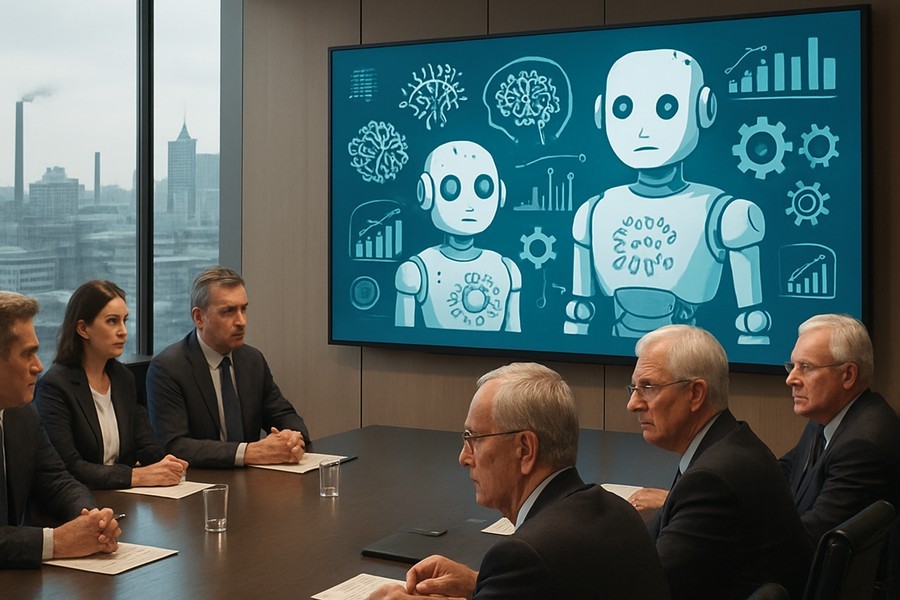
Senior Bank Executive Highlights the Threat of AI to Capitalism
A prominent banking executive has voiced concerns about the rise of artificial intelligence (AI) and robotics and their potential to disrupt the current capitalist system. The executive, who has extensive experience advising government officials during financial crises, believes that this emerging threat needs to be addressed by policymakers and business leaders.
"We have to remodel and reshape our system to accommodate this change, just as we did during the Industrial Revolution," he said. If we don't work out a way to make this change, we risk heading towards an authoritarian-style capitalist regime.
Impacts of Robotics on the Workforce
The executive explained the potential impacts of robotics on the workforce, emphasizing the risk to the middle class and suggesting a "productivity dividend" could be a solution. He pointed out that the first jobs to be hit are cognitive ones - those that require thinking, analyzing, and understanding. The people most affected are those who believed that a college degree or technical skills like coding would secure their future. Sectors like software, finance, media, and consultancy are already feeling the brunt of this disruption.
He further discussed the so-called K economy, referring to the increasing wealth gap between the top 10% of the population, who have a net worth of $2 million or more, and the bottom half of the population. The middle class, who have not yet been significantly affected, are likely to be the next victims of this wave of disruption.
Four Phases of AI
The executive identified four phases of AI: anticipation of gen AI, agentic AI, physical AI, and AGI or super-intelligence. The anticipation phase is characterized by knowing AI is coming. The agentic phase, which we are currently in, sees AI moving from analysis and research to taking action. Physical AI is the phase where AI and robotics are integrated at scale in manufacturing. The final phase, AGI, is where super-intelligence challenges the future of capitalism the most.
Policy Response to AI
According to the executive, traditional policy mechanisms like the Federal Reserve might increasingly struggle to influence the economy in the face of AI and robotics. He predicts that labor's value will decrease, limiting the central bank's response capabilities. This would shift the policy focus towards fiscal tax revenue, wealth distribution, social benefits, and social safety nets.
The Global Race in AI and Robotics
He also highlighted the competitive nature of technological advancement at a global level. He noted that many leaders in technology would prefer to slow down the pace of AI and robotics development, realizing that we are not ready for the changes. However, the necessity to keep up with other nations, particularly China, prevents this from happening.
Possible Policies to Counter the AI Threat
Considering possible policies to address this issue, the executive suggested a productivity dividend, a rebranding of the often-maligned concept of universal basic income. He argued for the need to experiment with this approach, starting at low levels to avoid negatively affecting work incentives and gradually phasing it in while observing the impact on the economy.
Funding the Productivity Dividend
When asked about funding such a program, he suggested a variety of ideas, ranging from taxing robots and AI to taxing assets or the wealthiest individuals. The specifics would depend on one's political orientation and the anticipated impact on the economy.
Why the Productivity Dividend Could Work
He explained that this approach could offer a form of mandatory wealth participation, whether through a sovereign wealth fund redistribution mechanism or a total redesign of the welfare system. He further suggested the need for a congressional commission, bringing together individuals from various political and professional backgrounds to study the issue and develop recommendations. This could provide a foundation for compromise and action, even if it takes a year or two to get there.
