
What the Tale of a Lonely Monkey Teaches Us About the Importance of Emotional Bonds
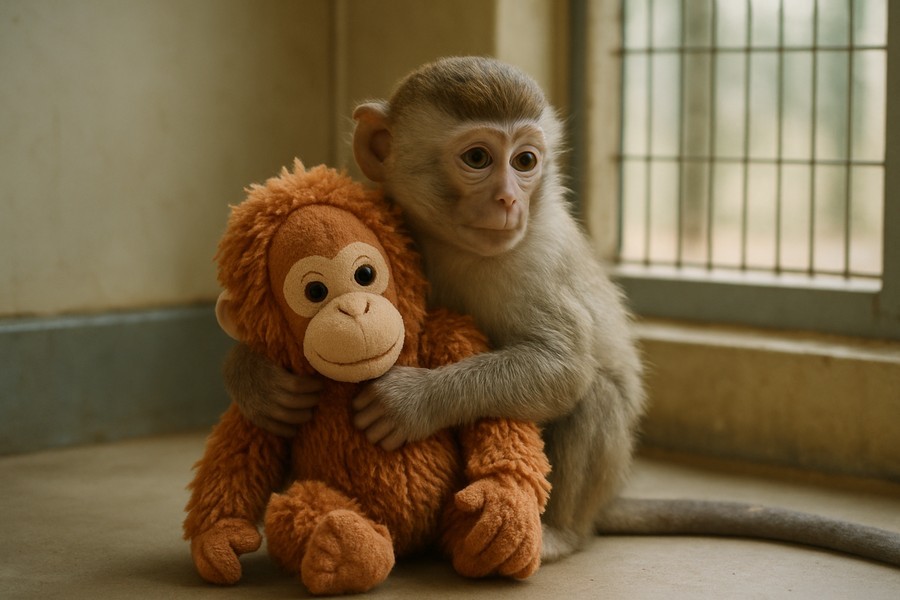
A small macaque monkey, left to fend for himself after his mother's abandonment and his tribe's rejection, has unintentionally become the star of a viral video. His caretakers at a zoo in Japan gave him a plush toy resembling an orangutan to serve as a substitute mother. This little monkey's determination to stay close to the inanimate toy is not just a tear-jerking internet spectacle. It also recalls a series of psychology experiments from the 1950s by a researcher in the United States, which laid the groundwork for our understanding of attachment theory today.
The Groundbreaking Experiments of the 1950s and Attachment Theory
The researcher's experiments involved isolating newborn rhesus monkeys from their mothers. These monkeys were then raised in an enclosure with two surrogate 'mothers'. One 'mother' was a wire cage in the shape of a monkey, equipped with a small feeder to provide nourishment. The other was a monkey-shaped doll wrapped in soft terry towelling. Although this doll was soft and comforting, it could not provide any sustenance.
The experiment was designed to challenge the prevailing behavioral theory of the time, which suggested that infants form attachments to the individuals who fulfill their biological needs, such as food and shelter. The researcher proposed an alternative theory, suggesting that babies also need care, affection, and gentleness to form attachments.
Contrary to what a behaviorist might expect, the infant monkeys did not spend all their time with the wire 'mother' that provided their sustenance. Instead, they spent significantly more time clinging to the soft 'mother' made of terry towelling. This experiment demonstrated the importance of emotional nourishment, care, and kindness in forming attachments. Given a choice, the researcher found, infants prefer emotional nourishment over physical sustenance.
The Impact on Modern Attachment Theory
The researcher's findings challenged the dominant behavioral theory of the time, which suggested that primates, including humans, function on a cycle of rewards and punishments, and form attachments to those who meet their physical needs such as hunger and thirst. The importance of emotional nourishment was not considered part of the behaviorist paradigm.
The researcher's experiments turned this theory on its head. The monkeys' preference for emotional nourishment, as represented by the soft, terry towel-wrapped 'mother', laid the foundation for the development of attachment theory. This theory posits that healthy child development is achieved when a child forms a secure attachment to its caregiver, which is achieved by the caregiver providing emotional nourishment, care, kindness, and attentiveness. In contrast, an insecure attachment forms when the caregiver is aloof, abusive, or neglectful.
Just like the rhesus monkeys, a human baby can be provided with all the physical nourishment they need, but without love and warmth, they won't form an attachment.
What Can We Learn from the Little Macaque Monkey?
The zookeepers weren't conducting an experiment, but the situation of the macaque monkey inadvertently mirrors the controlled experiments conducted by the researcher. His attachment to his plush toy companion echoes the behavior of the monkeys in the researcher's experiment. Although the zoo situation lacks a comparison to a harsh, physically nourishing option, it's apparent that what the little monkey sought was comfort and a sense of security, which the doll provided.
Ethical Considerations of the Experiments
Today, we acknowledge that primates, in some cases, have rights equivalent to human rights. By today's standards, the researcher's experiments would be considered cruel and unkind. We wouldn't separate a human baby from its mother to conduct such an experiment, so the same should apply to primates.
It's fascinating to see people captivated by this modern parallel to an experiment conducted over 70 years ago. The little macaque monkey is not just the internet's latest adorable animal sensation; he's a poignant reminder of the importance of emotional nourishment. Emotional security, love, and warmth are essential for our wellbeing and functioning, often more so than physical nourishment alone.