
Michigan Senate Rivals Clash Over Trump, Trust and the State’s Future
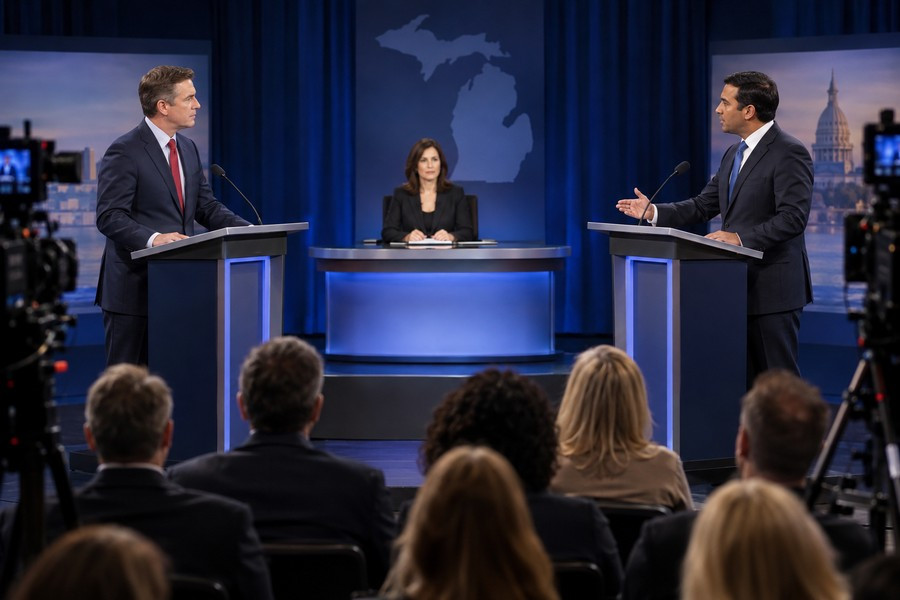
A second debate between Democratic nominee Abdul El-Sayed and Republican former Rep. Mike Rogers brought sharp disagreements but fewer heated moments than their first meeting. The candidates are competing for an open U.S. Senate seat after Sen. Gary Peters announced his retirement.
The contest remains close, and both candidates used the debate to show voters how they would represent Michigan in Washington. El-Sayed focused heavily on Rogers’ relationship with President Donald Trump. Rogers tried to present himself as an independent voice who could work with Trump while blocking policies that might hurt Michigan.
El-Sayed Attacks Rogers’ Ties to Trump
El-Sayed connected Rogers to Trump during several answers. While discussing high gas and grocery prices, he blamed the war with Iran for adding to the cost of living.
“We need a war powers resolution rather than a senator who is going to stand hip to hip with Donald Trump on this war,” El-Sayed said. He also promised to hold Trump responsible for the conflict and challenge corporations that have influenced elected officials.
Rogers has recently tried to create more distance between himself and Trump on the war. He released an advertisement calling for the fighting to end. At the same time, he has said Trump had a valid reason to begin the war because of concerns about Iran’s nuclear program.
During the debate, Rogers argued that his experience and personal connections could help him work directly with the president.
“If it’s good for Michigan, I’m going to be for it. If it’s bad for Michigan, I’m going to be against it,” Rogers said.
El-Sayed questioned whether a Republican senator would truly stand up to Trump after receiving Trump’s support during the campaign.
Dispute Over El-Sayed’s Family
Rogers also challenged El-Sayed’s background and honesty. He repeated claims that El-Sayed and his family had ties to the Muslim Brotherhood, an Islamist organization based overseas. Rogers said El-Sayed had also misled voters about his medical background.
El-Sayed denied the accusations. He said he had never been part of the organization and argued that Rogers was raising the issue because of his mother, Fatten Elkomy, who works as a nurse in Missouri.
In an earlier debate, Rogers questioned El-Sayed about his mother’s work with a charity that the U.S. government later labeled as supporting terrorist groups. The charity was closed, but Elkomy was never accused of wrongdoing.
El-Sayed has repeatedly said that neither he nor his family has ties to the Muslim Brotherhood.
“To call into question my loyalty to the Constitution is really beneath you,” El-Sayed said. He added that he was proud to be an American and supported the Constitution’s protection of religious freedom.
The exchange became the most tense part of the debate when Rogers tried to speak over him. El-Sayed pointed toward Rogers and repeatedly said he was still talking.
Rogers answered that El-Sayed could pray as he wished but accused him of trying to portray himself as a victim. Rogers said the issue was about ideology, not religion.
Tariffs and Trade With Canada
The candidates also disagreed over tariffs. Rogers recently called for an end to the trade war with Canada. During the debate, he said some tariffs had helped Michigan but admitted that the tariffs on Canadian goods may not have been carefully planned.
He described himself as someone who could convince Trump to change course when a policy threatens Michigan businesses and families.
El-Sayed questioned why voters would choose a Republican senator to limit Trump’s power. He argued that Republican senators have not shown enough willingness to challenge the president.
Different Plans for Artificial Intelligence
Artificial intelligence was another major topic. Rogers said advanced technology companies should receive limited protection from antitrust laws when they work together on safety issues. He also suggested he might support an emergency shutoff system for AI programs that become dangerous.
El-Sayed called for a pause on the development of the most powerful AI systems. He warned that company leaders believe the technology could replace half of all white-collar jobs within five to 10 years.
El-Sayed said AI companies should include board members chosen through a democratic process. He also proposed limits on what AI systems could do.
- AI should not be allowed to fire workers.
- AI should not be allowed to launch weapons.
- AI should not be allowed to deny someone health insurance.
Healthcare, Crime and Other Issues
The debate also covered healthcare, immigration, crime, Social Security and tariffs. Moderators kept the candidates within their time limits and moved through the planned topics before the hour-long event ended.
El-Sayed often looked straight into the camera while answering questions. Rogers more often looked toward the moderators. El-Sayed was also less confrontational than he had been during their first debate.
El-Sayed repeatedly referred to a “MAGA bingo” game for people watching at home. The game included common phrases he expected Rogers to use. Rogers responded that the game should instead count how many times El-Sayed mentioned Trump.
The candidates ended with quick answers on several issues. El-Sayed supported expanding the Supreme Court, but said it should be done fairly. When asked whether he supported universal background checks for gun purchases, Rogers first said it depended and later described himself as being “in the middle.”