
Surging Tensions between Afghanistan and Pakistan Amid Iran Conflict
While the world's gaze is intently focused on the escalating conflict involving Iran, the United States, and Israel, another battle is brewing between Afghanistan and Pakistan. The growing conflict between these neighboring nations could potentially reverberate throughout the region.
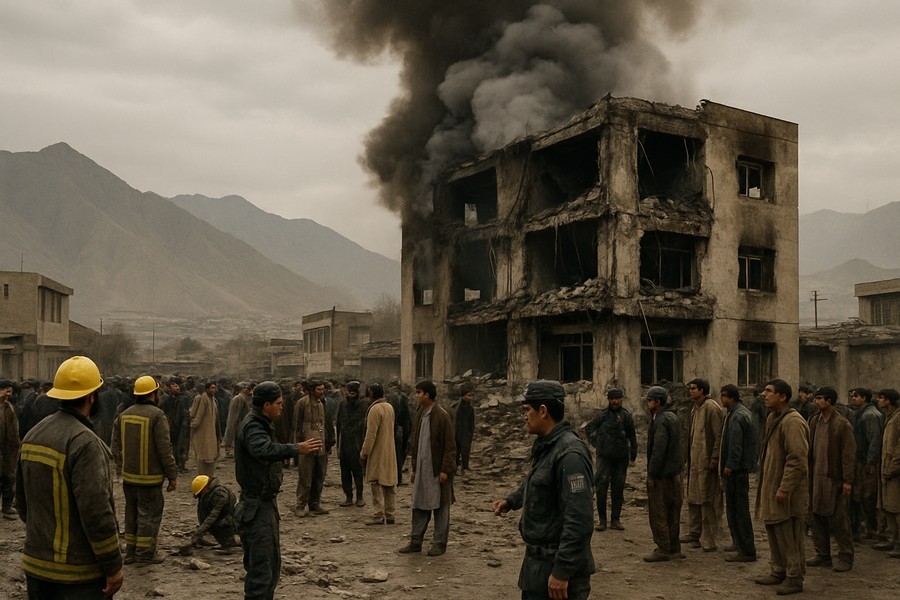
Recently, the Taliban leadership in Afghanistan pointed fingers at Pakistan for an airstrike that claimed hundreds of lives at a drug rehab center in the country's capital, Kabul. The attack, which struck the large rehab facility in the evening hours, resulted in significant damage and a high number of casualties, marking a serious intensification of the ongoing border conflict between the two countries.
Denial and Accusations
Islamabad denies targeting civilian structures, asserting that their armed forces executed precise airstrikes aimed at military establishments and terrorist support infrastructure in Kabul and the eastern Nangarhar province. The Information Minister of the nation further corroborated this claim.
Blame for the latest round of the enduring conflict is being tossed back and forth between Islamabad and the Taliban government in Kabul. Islamabad alleges it's merely responding to assaults from the Tehreek-e-Taliban Pakistan (TTP), who are reportedly operating from Afghan territories, a claim the Taliban government adamantly denies.
Targeting Afghan Military Sites
Recently, the focus of Pakistani airstrikes shifted from suspected TTP targets to Afghan military sites. One of these attacks targeted a former U.S. military base in Bagram. Despite images suggesting significant damage to the base, the Taliban maintains that the attack was thwarted and the base remained unscathed.
The Symbolism of Bagram
The attack on Bagram is significant, as it used to serve as the operations center for the U.S. military presence in Afghanistan. The strategic importance of Bagram, due to its proximity to China, has been underscored by the U.S. President on several occasions. The Taliban have firmly opposed any return of U.S. forces to the base.
The attack on Bagram by Pakistan, executed amidst coordinated U.S.-Israeli assaults on Iran, underscores the complexity of the regional conflicts unfolding simultaneously, even though they might not be directly interconnected.
The Shifting Relationship between Pakistan and the Taliban
The Taliban have traditionally maintained close relations with Pakistan. During their first stint in power in Afghanistan, Pakistan was one of the very few nations to diplomatically recognize the regime in Kabul. However, the once close strategic partnership has recently taken a turn for the worse.
Pakistan accuses the Taliban of not taking adequate measures against the TTP. The Taliban, in response, deny any active support for Pakistani insurgents and object to large-scale military operations against the TTP.
The Threat of the TTP to Pakistan
An international relations expert in Pakistan argued that the Pakistani strikes on the Taliban were a security necessity, describing Pakistan as facing an "existential threat" due to the rise in TTP attacks. The expert added that despite the absence of direct military aid from the U.S., Pakistan definitely has Washington's support to continue its operations.
The expert also highlighted the geopolitical significance of Bagram. If the U.S. were to reestablish a military presence there, it would be in close proximity to Pakistan, Iran, Russia, and China. Iran's unofficial ambassador to Afghanistan publicly praised the Taliban for their decision not to allow the U.S. to use the base, demonstrating the sensitivity of the regional balance.
The Conflict in the Shadow of the Iran War
An Afghan researcher in international relations sees the timing of these events as a strategic advantage for Pakistan. Pakistan is economically and militarily vulnerable in its conflict with the Taliban. Without tacit U.S. support or an international guarantee, it cannot continue the war against the Taliban.
Some experts believe that the timing of the airstrikes, coinciding with developments in Iran, resulted in less international attention. Some even suspected a coordinated effort between Pakistan and the U.S., citing meetings between high-ranking Pakistani military officials and the U.S. president.
However, others argue that Pakistan's motivations are more complex, aiming to weaken the TTP while simultaneously diverting attention from its own domestic political and economic issues. They also believe that Pakistan's long-term goal is not necessarily to overthrow the Taliban, but rather to weaken any forces that resist Pakistani influence.