
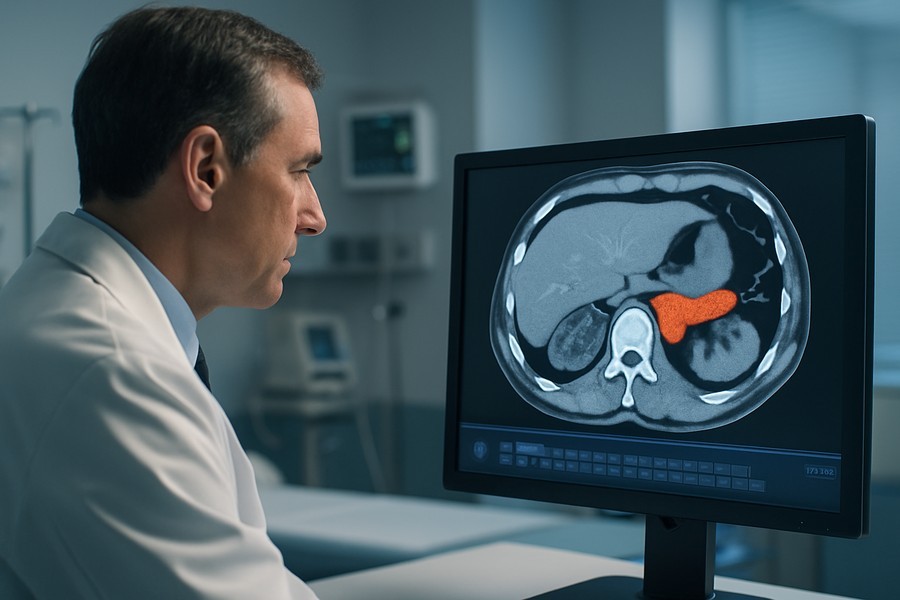
Revolutionizing Pancreatic Cancer Detection with AI
Often, by the time pancreatic cancer gets diagnosed, it's quite advanced, making effective treatment difficult. However, the latest research reveals that a new artificial intelligence model can potentially detect the disease before a tumor is even visible.
Developed in a renowned medical clinic, the AI model was able to identify irregularities in patients' CT scans up to three years before pancreatic cancer was formally diagnosed. This exciting development was published in a well-known medical journal recently.
How Does the AI Model Work?
The AI model was trained using CT scans from patients who had been checked for other health issues but were later diagnosed with pancreatic cancer. This data helped the AI model to learn and recognize early signs of the disease. Radiologists then analyzed the same scans, and their results were compared with the AI model's findings. The AI model proved to be three times more efficient in identifying early signs of pancreatic cancer.
One of the study's leading authors, a radiologist, expressed that they always knew the disease signals were there, but the challenge was finding a way to detect them. The AI model seems to have provided the solution.
The Severity of Pancreatic Cancer
Pancreatic cancer is a serious disease with a five-year survival rate of only 13%. It's estimated to become the second leading cause of cancer deaths soon. Approximately 80% of patients are diagnosed when the disease is in an advanced stage.
Unlike other types of cancer, such as colon or breast cancer, there is no routine screening for pancreatic cancer in healthy individuals. Detecting it is difficult because the pancreas is located deep within the abdomen. Moreover, symptoms like stomach pain and sudden weight loss typically don't appear until the cancer has spread to other organs.
Early indicators of the disease are usually too subtle to be seen by the naked eye on a scan. In many cases, patients' scans seem normal just six months before they are diagnosed with cancer.
AI's Role in Cancer Detection
One of the early signs of cancer that the AI model can detect is abnormal cells in the pancreas that shield and guard cancer from the body's immune responses. Researchers were aware of the existence of such cells but struggled to identify them on scans.
The AI model could potentially prove beneficial for individuals who have risk factors for the disease, such as a family history or diabetes, but show no symptoms. In such cases, doctors could recommend further blood work and imaging. However, if symptoms are present and it's indeed pancreatic cancer, there would be no need for AI.
The AI model is a significant breakthrough in pancreatic cancer research. It comes on the heels of other promising developments, such as an experimental drug that has been shown to double patients' life expectancy and an mRNA vaccine that prolonged survival in a small group of patients. Both treatments are still undergoing testing and have not yet received approval.
The Future of AI in Pancreatic Cancer Detection
Despite the advances, the AI model may take some time before it is publicly available, as the clinical trial needs to follow participants for three to five years to observe who develops cancer and who does not.
Although this is a significant step forward in a disease that has seen little progress for decades, there is still a long road ahead. Regardless, this development provides hope and shows the potential of AI in revolutionizing medical diagnosis and treatment.