
Uproar Over Increased Power Lines Due to Tech Demands
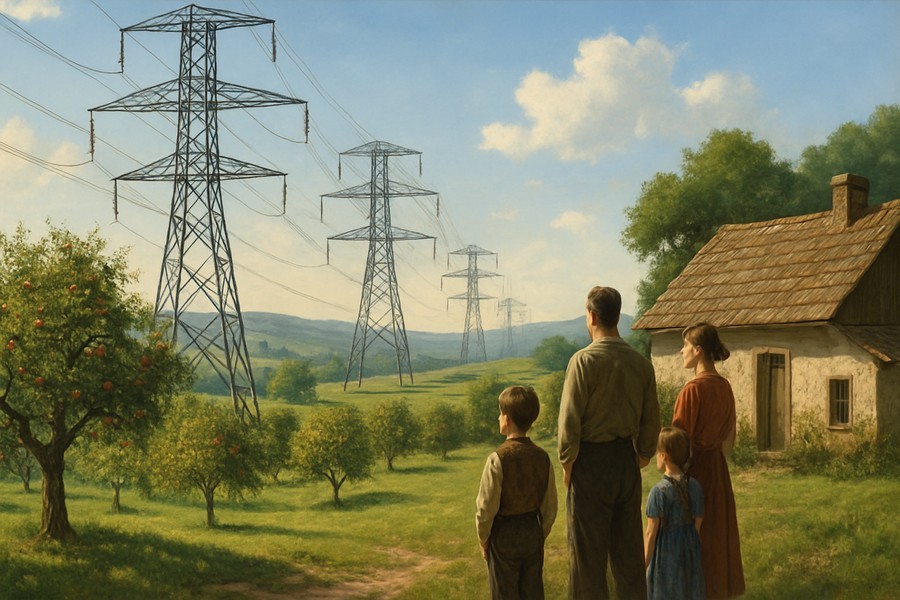
The peaceful life of John Zola and his family, nestled among apple orchards and rolling hills in northern Pennsylvania, was disrupted when they were informed that a 500-kilovolt power line was planned to cut through their property. This became a reality when a local utility contractor knocked on their door. The towering metal structures, standing at 240 feet, would dwarf their century-old apple trees and overshadow their home and recreational areas.
Such power lines are becoming increasingly common across the United States, as they are being utilized to supply power to gigantic data centers run by leading tech companies.
While technological advancements, particularly in artificial intelligence, are deemed crucial for economic growth and national security, the power requirements of these technologies are posing a threat to the power grid. Unfortunately, individuals like Zola are finding themselves stuck in the middle of this problem.
The Battle Lines are Drawn
High-voltage power lines have become the latest battleground in the dispute over the extensive operations of tech companies. Local communities are up in arms against the numerous mammoth data centers, fearing increased electricity costs and irreversible damage to their communities.
Those opposing transmission projects share a similar sentiment. They argue that these power lines are an invasion of private land and pose a significant threat to public lands, farms, property values, and pristine waterways. They believe they are not benefitting in any way from the electricity being transported through these lines.
Transmission projects have always been met with challenges and lengthy permitting processes. However, the urgency has increased due to a spike in demand and the power grid's inefficiency and aging infrastructure, which could lead to widespread blackouts during extreme weather conditions.
The Realities of Transmission Projects
These transmission projects are not your typical local power lines on wooden poles. Instead, these are power lines on towering steel structures, carrying power over long distances. Some projects, like the one proposed for Zola's property, would require corridors as wide as 200 feet.
Utility companies anticipate that their spending growth will be primarily driven by transmission projects. They project a doubling of transmission spending to nearly $50 billion a year from 2019 to 2028. However, this expansion is being met with resistance from various quarters, including landowners, conservationists, local officials, consumer advocates, and even states.
Caught in the Crossfire
There have been numerous instances of local resistance against these projects. For example, in Texas' Hill Country, a coalition was formed to oppose the construction of one of the three 765-kilovolt lines, the highest voltage used in the United States. The coalition is urging state regulators to consider an alternate, slightly longer path that follows existing highway corridors to minimize potential damage.
There is also opposition against a pair of proposed transmission lines in West Virginia that would connect coal-fired power plants to northern Virginia, home to a large number of data centers.
Meanwhile, in the Midwest, a $22 billion transmission package is embroiled in a lengthy battle, with utility regulators across multiple states urging federal regulators to block it.
No Price Tag on Peace
In eastern Pennsylvania, where there is a significant increase in data center projects, utilities predict that peak electricity demand will more than triple by 2030. This has led to utilities offering payment to property owners to access their land. However, the threat of eminent domain, which could force a settlement, looms if they refuse.
Despite receiving a significantly increased cash offer, Zola remains adamant. "My offer went from $17,000 to $85,000," Zola said. "Just like that. And there's no amount of money for me. And when you come here, you'll understand why."