
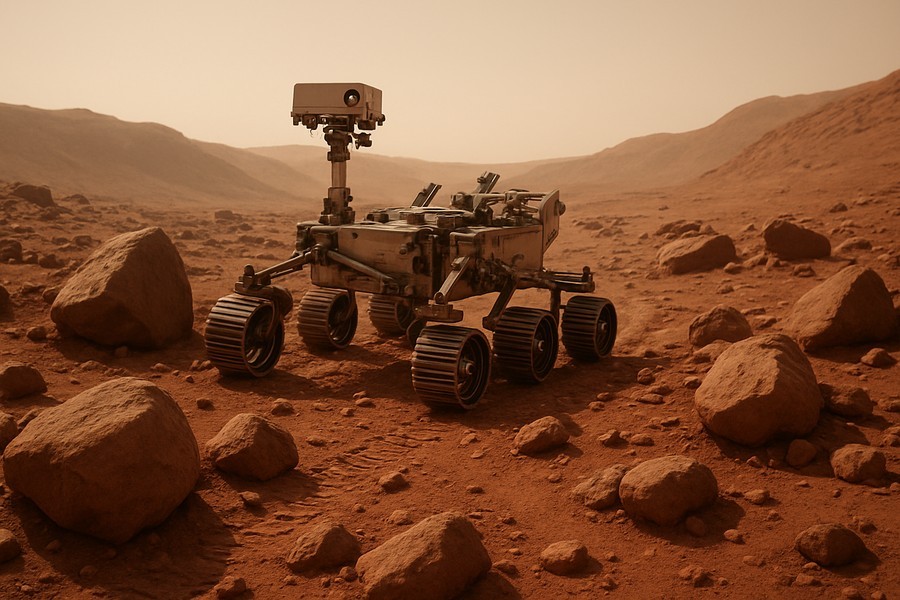
Artificial Intelligence Takes the Wheel on Mars
The future of extraterrestrial exploration has been redefined by the rise of artificial intelligence. Even the role of Martian Rover Driver is now being delegated to AI technology. The Perseverance rover recently embarked on two expeditions on the Mars surface, both meticulously planned and executed by AI rather than human controllers.
It's worth noting that we're not discussing the concept of autonomous driving, which Perseverance has already demonstrated superior proficiency in when compared to terrestrial vehicles. The focus here is on the intricate planning required for the rover's movements. Without careful planning, the multi-billion-dollar rover could easily encounter a disastrous mishap, such as colliding with a boulder, tipping over on uneven terrain, or becoming trapped in a sand pit. This would be a significant setback given the budget constraints faced by the space exploration agency.
Interplanetary Communication Challenges
A real-time remote control of the rover is not an option due to the immense distance between Earth and Mars. Even at light speed, radio signals can take between four to 24 minutes to travel from Earth to Mars, and the same time again for return signals. Typically, human planners painstakingly analyze available photos and terrain data from the Martian surface to chart the safest route, then upload this route to the rover for execution. Recently, however, this process was handled through AI technology.
Precautions with AI Navigation
The agency didn't just blindly entrust the rover's route to AI. Given that AI models have shown a propensity for aggressive decision-making in war simulations, it was imperative to ensure that the proposed route wouldn't inadvertently lead the rover into a precarious situation. The agency employs a "digital twin" of the rover - a virtual replica of its programming - to test commands and predict outcomes before sending them to the actual rover. The AI program was rigorously tested, factoring in over half a million variables, to ensure effective functionality on the Martian surface.
AI Success on Mars
The Perseverance rover successfully traversed a 689-foot route planned by AI. Shortly after, it navigated another 807-foot path. While the rover's autonomous driving systems deviated slightly from the planned route based on real-time data collected, the routes proved successful overall.
Future Implications
"Visualize intelligent systems not just here on Earth but also being utilized in remote applications in our rovers, helicopters, drones, and other surface elements, all trained with the collective wisdom of our engineers, scientists, and astronauts," one manager said. "This is the revolutionary technology we need to establish the infrastructure and systems necessary for a permanent human presence on the Moon, and to propel us to Mars and beyond."
While there are inherent risks in exploring other worlds, human astronauts have successfully piloted rovers on the moon before AI became a trending topic. They were able to do this because they were physically present and could apply human driving skills to the task. However, robotic drivers on other planets don't have the same terrestrial concerns to contend with, such as traffic violations, school buses, or children running into their path (unless there are extraterrestrial children we're yet to discover).
Despite the humor about AI potentially taking over route planning jobs, it's logical for a rover to be capable of scanning its surroundings and using that information, along with existing map data, to plan its own route without requiring instructions from "drivers" on a distant planet. This approach could significantly expedite travel, as the agency claims.