
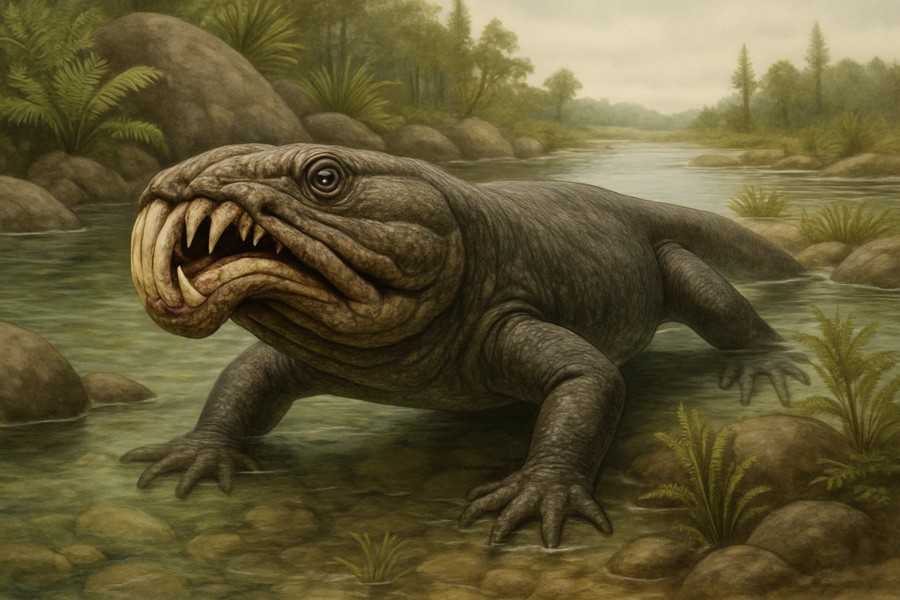
Ancient Aquatic Creature with Unusual Jaw and Teeth Unearthed
An unusual prehistoric water creature characterized by its twisted jaw and sideways teeth is making headlines. This ancient being, having existed approximately 275 million years ago, was already considered a 'living fossil' during its lifetime.
Introducing Tanyka Amnicola
The newly discovered species, Tanyka amnicola, is believed to be an early member of the tetrapods. The tetrapods are a broad group of four-limbed animals that currently includes reptiles, birds, mammals, and amphibians. This discovery was recently published in a recognized scientific journal.
Outliving Its Ancestors
Even though T. amnicola roamed the earth long before the dinosaurs, it was already deemed an evolutionary leftover during the Permian period. By this time, several of the earliest tetrapod groups, also referred to as stem tetrapods, had already ceased to exist. However, the lineage that T. amnicola belonged to endured, while the tetrapod group in general was expanding.
What makes Tanyka particularly interesting is its prolonged survival, despite the evolution of newer, more contemporary tetrapods. This has led some to compare Tanyka to a platypus, as both are considered 'living fossils' during their existence.
Fossil Discovery Sparks Intrigue
The unique species was identified from nine fossilized lower jawbones, all about six inches long. These were found in a dry riverbed located in northeastern Brazil. While these jawbones were unique enough for scientists to identify a new species, the absence of other fossilized parts leaves much about Tanyka still a mystery.
Possible Appearance and Lifestyle
From what is known about its close relatives, T. amnicola may have looked similar to a salamander with an elongated snout, possibly reaching approximately three feet in length. The nature of the rocks where the fossils were found suggests that Tanyka likely lived in lake environments, indicating it had aquatic habits.
An Unusual Feeding Mechanism
Upon closer examination of the jawbones, researchers found that they were twisted in a way that made the creature's teeth point sideways rather than upwards, a feature not seen in other tetrapods. Moreover, the inside of the lower jawbone had an upward rotation and was covered in small, teeth-like structures known as denticles, forming a grinding surface. These characteristics suggest that Tanyka had a unique method of feeding.
Dietary Habits of T. Amnicola
Scientists speculate that T. Amnicola might have been adapted to feed on small invertebrates or perhaps even plant material. Such dietary habits would be unusual, considering other stem tetrapods, believed to have been carnivores, show no signs of being plant-eaters or omnivores.