
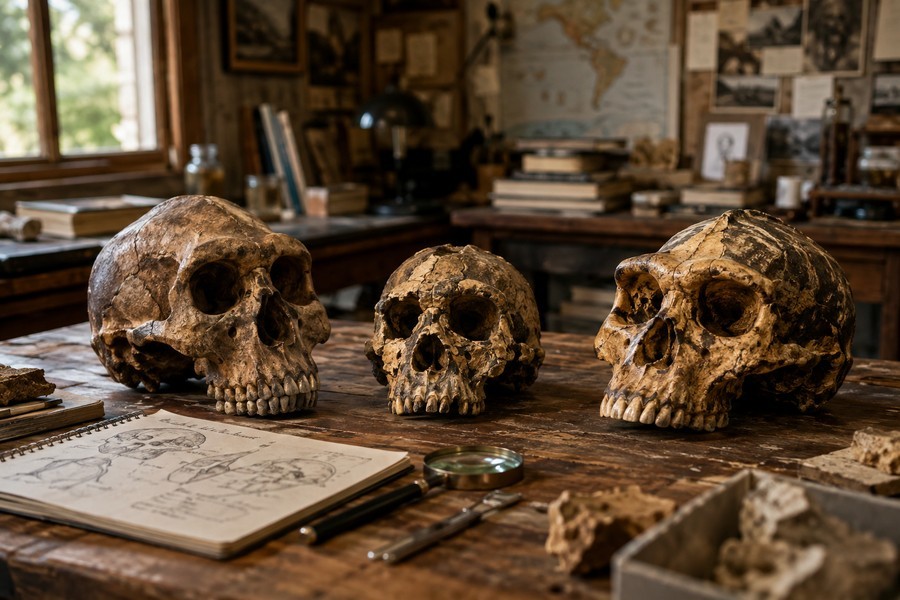
Redrawing the Human Family Tree: Why It Might Be Time to Combine Our Ancient Relatives
For a long time, science textbooks and museums have divided our ancient relatives into three main groups. But a new proposal suggests it is time to simplify how we view our ancestors. One researcher is calling for a major rewrite of the human family tree by combining these three separate groups into just one. Under this plan, nearly 5 million years of ancient fossils would all belong to our own group, known as the genus Homo.
The idea behind this change is that the old rules we used to separate species no longer work. As more fossils are discovered, the lines between different groups of ancient humans and their relatives have become very blurry. Combining them could give us a more stable and accurate way to understand our complicated past.
Why the Old Categories Are Breaking Down
In the past, scientists used simple features to decide where a fossil belonged. If an ancient creature had a large brain or used tools, it was put into our group, Homo. If it had a smaller brain or different physical traits, it went into other groups like Australopithecus or Paranthropus.
However, recent fossil discoveries have turned these old rules upside down. For example, scientists have found species like Homo naledi and Homo floresiensis. Both of these species had very small brains, yet they are still classified in our own genus.
At the same time, other ancient species show confusing physical traits. A species called Australopithecus garhi had teeth that were actually larger than those of some specimens in the Paranthropus group, which is famous for having massive teeth. Because of these overlapping features, the traditional boundaries between these three groups are becoming harder to defend.
The Problem of the "Wastebasket" Group
One of the biggest issues with the current system involves the group Australopithecus. In modern biology, a valid group of species should include one common ancestor and all of its descendants. However, studies of evolutionary relationships show that Australopithecus does not fit this rule.
Instead, it has become a sort of "wastebasket" category. Over the years, fossils that did not clearly fit into other categories were simply dumped into this group. To fix this, the new proposal suggests grouping all of these species under the single banner of Homo. This would include:
- Our direct ancestors and close relatives who lived over the last 5 million years.
- Fossils previously separated by brain size or tool use.
- Species that have confusing combinations of human-like and ape-like features.
What Modern Primates Teach Us
To support this new way of thinking, researchers point to animals that are alive today. For instance, genetic studies of baboons and their close relatives show that different groups often interbreed.
This kind of gene sharing is very common among closely related animal groups. When two groups first split from a common ancestor, they can still mate and share genes for millions of years. Because ancient human relatives likely did the same thing, drawing strict lines between them does not match how evolution actually works in the real world.
A New Way to Organize Our Ancestors
If this new plan is accepted, it would change how we organize and talk about our history. The group Homo would stretch back roughly 4 to 5 million years. It would start with an ancient species called Australopithecus anamensis, which is one of the few species that most fossil experts agree sits at a key branch of our family tree.
The proposal would also redefine some larger scientific categories:
- The tribe Hominini would be expanded to include both the human lineage and chimpanzees.
- A new subgroup, called Hominina, would be used specifically for the branch that leads directly to humans.
Why Some Scientists Might Disagree
Not everyone is ready to combine these groups. Collapsing three categories into one would erase differences that many experts think are biologically important. For example, some ancient groups had very different diets and evolutionary paths than our direct ancestors. Putting them all in the same category might make it harder to study these unique lifestyles.
However, supporters of the change argue that a single, larger group is much more stable. As we find more fossils, we will not have to keep changing the names of species or redefining our terms. Instead of a neat, straight line, our family tree is more like a messy bush, and our scientific naming system needs to reflect that reality.