
Moon-bound Astronauts Blast Off in Historic Event
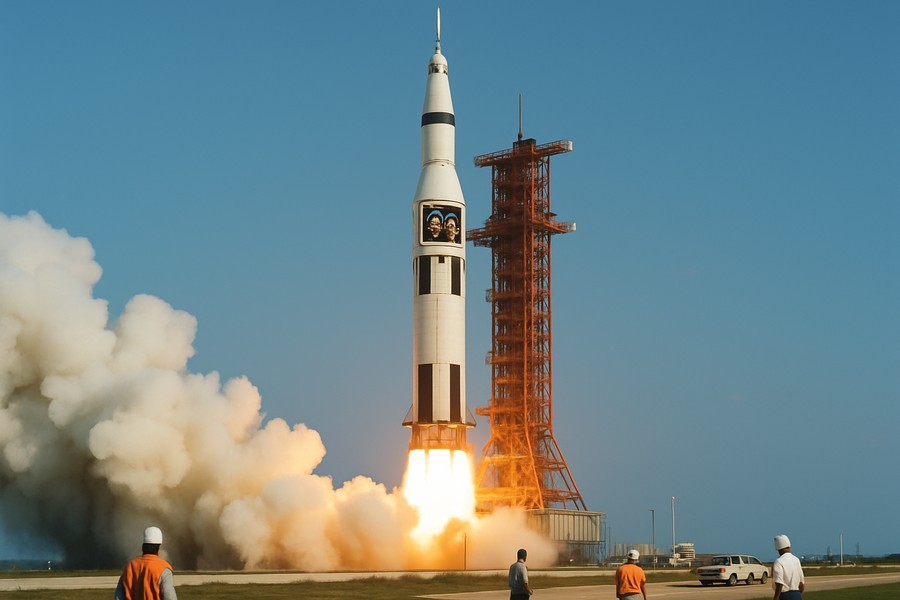
A team of four astronauts recently embarked on an unprecedented journey to the moon, marking the first such mission in over half a century. Launching from a sunny Florida site, the crew's powerful rocket painted thick white streaks across the clear blue sky. Now, the team faces the formidable task of readying themselves for the challenges that lie ahead.
Among the crew were three American astronauts and one Canadian, who took off inside an Orion capsule attached to a sturdy rocket. Their mission is not just significant for its historic value, but it also serves as a vital test flight for the Orion spacecraft. The crew will circle the moon and return, a journey of approximately 230,000 miles.
The 10-day mission will test crucial aspects of the spacecraft, including life-support systems and handling capabilities. Furthermore, it will pave the way for future deep space missions by conducting vital scientific research.
The Journey's Path
The spacecraft's flight path ensures it remains within Earth's gravitational pull even as it passes the moon, before eventually falling back to Earth. This route, known as a free return trajectory, conserves fuel and poses fewer risks than entering a lunar orbit.
A day after launch, the crew will execute a translunar injection, a maneuver that propels the spacecraft towards the moon. The crew will pass within approximately 5,000 miles of the moon's surface, a stark contrast to Apollo missions that orbited the moon at a distance of under 100 miles.
As one mission scientist described, when the crew passes the moon's far side, it will appear as if they are holding a basketball at arm's length.
Pre-Moon Testing
Before setting course for the moon, the crew conducted a series of tests on the Orion spacecraft. Shortly after entering high-Earth orbit, the crew performed a proximity operations test, manually controlling the vehicle to assess its space handling.
Understanding the spacecraft's handling is crucial for future missions, which will require docking with a lunar lander in orbit. Even though this process is likely to be automated, it's essential to understand how the vehicle behaves if astronauts need to take control.
After the maneuver, the pilot seemed pleased with the spacecraft's performance, stating, "This flies very nicely."
Space Science with a Human Touch
The crew members themselves will serve as subjects for scientific study. As they travel deeper into space than any human before them, researchers will seize this opportunity to study the effects on the human body. They will monitor physiological changes due to space travel and increased radiation exposure. The crew's cells have been distributed throughout the capsule on tiny chips to provide more detailed insights.
Additionally, the crew will contribute to geological research by observing the far side of the moon, an area previously unexplored by humans. Earth-based geologists have trained the astronauts to identify unique lunar features and photograph them for further study.
This mission's high-altitude moon flyby offers a unique viewpoint. As one mission scientist explained, the crew will view the moon from a distance, allowing them to observe a larger portion of its surface than previous astronauts.
Alongside the crew, the mission is also dispatching a set of miniature satellites, known as CubeSats, into high-Earth orbit. These tiny satellites will study the effects of space radiation on space hardware, monitor space weather, and observe how the lunar environment impacts electrical hardware.
The Homeward Journey
Upon the crew's return, their capsule will be traveling close to 25,000 miles per hour as it reenters the Earth's atmosphere. The friction caused by this high-speed reentry will heat the Orion capsule to temperatures near 3,000 degrees Fahrenheit. The capsule is equipped with a heat shield to protect the astronauts from this intense heat. After withstanding these harsh conditions, eight parachutes will deploy to further slow the spacecraft before it splashes down in the Pacific Ocean off the California coast. A recovery crew will retrieve the astronauts, marking the end of their mission.
What the crew learns from this mission is crucial for future lunar expeditions. Plans are underway to increase moon launches and establish a permanent lunar base. This new phase of space exploration begins with the current mission.
One astronaut expressed hope that this mission starts an era where every person on Earth can look at the moon as a potential destination.