
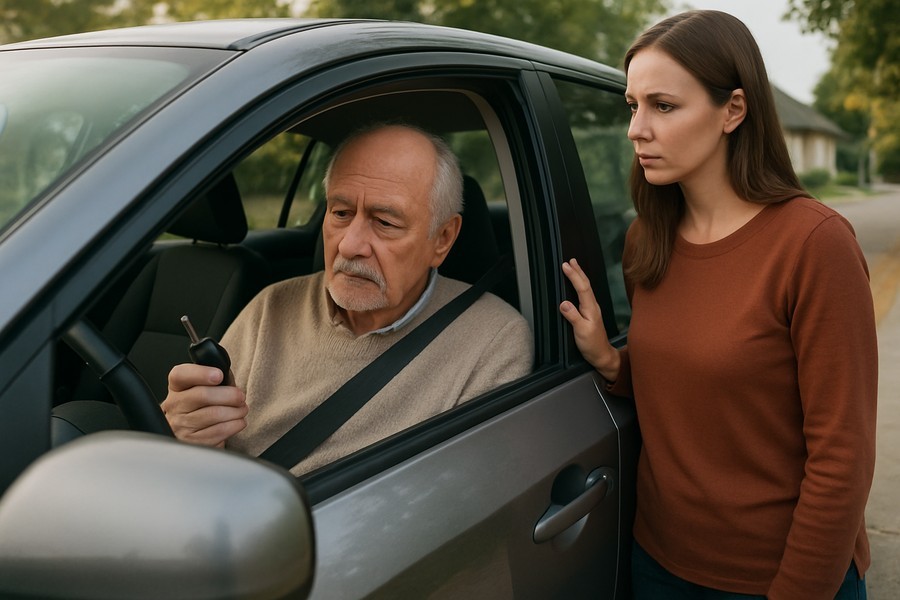
Challenges Faced By Adult Children in Deciding to Stop Elderly Parents from Driving
When Jacqueline Hamilton noticed her father's driving habits started to change, she became worried. Simple tasks like making a turn took longer, and he was driving at a slower pace. However, the incident that alarmed her the most was when he mistakenly drove on a pedestrian path instead of the road after a Christmas party.
Hamilton's father, James Stubbs, was 94 and loved to drive. His job as a fabric salesman had him traveling all across Minnesota and the neighboring states. He also worked as a shuttle bus driver. It was a tough decision for Hamilton to consider taking the keys away from her father, the man who taught her everything she knew about cars and driving.
Number of Older Drivers Increase As People Live Longer
Older drivers are increasing in number as people live longer and continue to drive well into their old age. There are numerous rules and policies in place to prevent high-risk older drivers from renewing their licenses. Some states require vision tests, while others require more frequent in-person visits to the department of motor vehicles (DMV). Some states also allow or require doctors and police to report drivers they deem unsafe.
But in most cases, it is the adult children who are faced with making the tough decision of whether or not their elderly parents should continue driving.
The Struggle to Convince Elderly Parents to Give Up Driving
After the incident with the pedestrian path, Hamilton attempted to persuade her father to stop driving. However, he disagreed. To ensure his safety, Hamilton filed paperwork with the Department of Public Safety in Minnesota to request a driver's exam for her father. This meant he had to pass several tests, including a cognitive test, to keep his license.
The results weren't promising. He struggled with basic details like the date and day of the week. Although he had a different recollection of the event, the state revoked his license. He, however, still held onto the physical card, which didn't indicate it had expired. Hamilton faced a dilemma - to take the keys or not.
Adult Children Taking Matters Into Their Own Hands
Many adult children, like Hamilton, have shared similar experiences of taking matters into their own hands when it comes to their elderly parents and driving. Alan Cunningham, for instance, noticed various scratches and dings on his parents' car every time he visited. Despite numerous discussions with his father and his father's doctor, he could not convince his father to stop driving. Surprisingly, his father managed to pass the driving test during license renewal.
Cunningham eventually found his own solution. He replaced his parents' car keys with old ones that didn't work. This allowed his father to feel he still had the ability to drive if needed while keeping him safe from actually getting behind the wheel.
Fear of Losing Independence
Driving is often seen as a symbol of independence, and many older adults fear losing that. Eldercare consultant David Condon confirms that this is a sensitive topic and can cause a lot of tension. It's a struggle between maintaining autonomy and ensuring the safety of not just the elderly driver, but others on the road as well.
Even after successfully having their parents' licenses revoked, adult children like Hamilton face emotional repercussions. Her father was angry and even told her he hated her. Despite this, Hamilton says she would do it again if needed. It was a difficult decision, but she believes it was the right one to ensure her father's safety and that of others.