
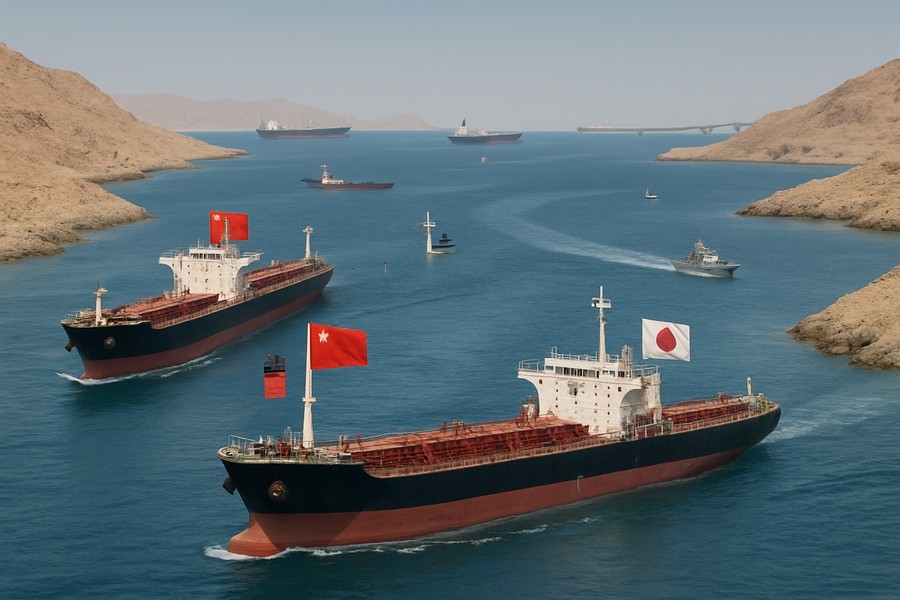
Asian Nations Negotiate Passage Through Vital Middle Eastern Shipping Route
Recent threats from the US President to block Iran's access to an essential waterway have not stopped Asian nations from securing agreements with the Middle Eastern country. Despite the President's threats, these nations have struck deals for their ships to utilize this critical route – the Strait of Hormuz.
Asian countries, including the Philippines, are making these deals as their economies heavily depend on the energy sourced from the Gulf region. This strategic waterway has become a global point of contention after Iran threatened to retaliate against US and Israeli airstrikes by targeting ships passing through the strait.
Following the disruption in the Strait of Hormuz, the global oil prices have soared. This narrow waterway is typically used for a fifth of the world's energy shipments. The US President has previously claimed that the US does not need oil from the Gulf. He has also called on countries dependent on the Gulf's energy to deploy warships to the strait and take the lead in ensuring the resumption of shipments.
Asian Nations Secure Passage Agreements
Several Asian countries, such as Pakistan, India, the Philippines, and China, have confirmed agreements with Iran to allow safe passage for some of their ships through the strait. However, the extent and duration of these agreements remain unclear. It's still uncertain whether the guarantees apply to all vessels or only those registered under a specific country.
Regardless of these uncertainties, countries relying on the Gulf's energy are starting to realize they need to negotiate with Iran if they wish to resume shipments.
The Successful Negotiations of the Philippines
The Philippines is the latest country to secure a safe passage agreement with Iran. Iranian officials have assured a "safe, unhindered and expeditious passage" for Philippines-registered ships through the waterway. This agreement is crucial for the Philippines as it imports 98% of its oil from the Middle East. In fact, the country was the first to declare a national energy emergency after petrol prices more than doubled following the onset of conflicts with Iran.
Despite Iran's claim that the strait is open to all countries except the US and its allies, there are doubts. The case of the Philippines, often considered a US ally, suggests that Iran might be distinguishing between a country's alliance and its active participation in the conflict.
Other Countries' Negotiations with Iran
Other countries, including Pakistan, India, and China, have also held successful talks with Iran. Pakistan recently announced that Iran agreed to let 20 of its ships pass through the Strait of Hormuz. The Iranian embassy in India has also assured the safety of India-flagged ships crossing the strait. China, the largest buyer of Iranian oil, confirmed that some of its ships had crossed the strait but did not provide further details.
Despite conflicts, millions of barrels of Iranian oil, which have been sanctioned by the US, have been delivered to China in recent weeks.
Unanswered Questions
There are still uncertainties about the conditions under which some ships have negotiated safe passage and whether they paid to cross the strait. For example, a Japanese vessel carrying liquefied natural gas recently passed through the Strait of Hormuz. However, it is unclear whether any tolls were paid and how the crew secured safe passage.
Malaysia has also reported that some of its tankers have been allowed by Tehran to pass through the strait. However, while these agreements present a "diplomatic breakthrough", they do not necessarily offer a solution to the problem. It is still unknown how long these assurances will last and how military operations in the area will impact them.
