
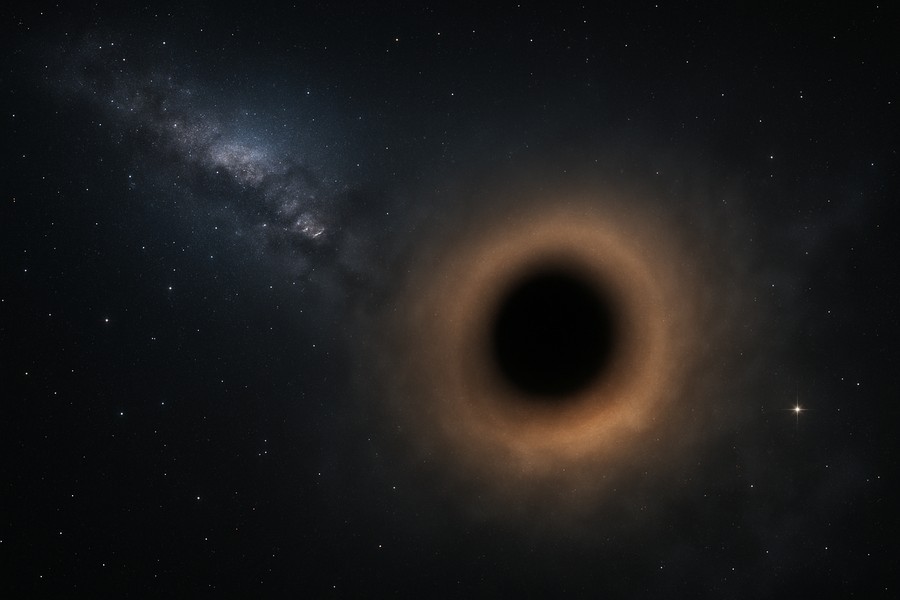
Quiet Transition: A Star Turns into a Black Hole
Usually, the birth of a black hole is a dramatic spectacle. A giant dying star explodes, and some of its remnants collapse into a super dense entity with gravity so intense that it traps light. However, recent observations reveal that sometimes, this process can be eerily silent.
Scholars have been following a large, radiant star that seemed to disappear into thin air as it transformed into a black hole, not through a supernova explosion, but quietly. The only hint of its existence now is a faint glow caused by the heating up of residual gas and dust being pulled in by the strong gravitational force of the newly-formed black hole.
A Faraway Star
The star in question, M31-2014-DS1, was located in the Andromeda Galaxy, our Milky Way's neighboring galaxy, about 2.5 million light-years away from our planet. A light-year is the distance light covers in a year, which is roughly 5.9 trillion miles or 9.5 trillion kilometers.
Black Hole Formation Sans Supernova
M31-2014-DS1 provides the most compelling evidence yet of a black hole’s creation without a supernova. Scholars tracked the star's luminosity over four decades until 2014, observed a sudden brightening in 2015, and then watched it nearly vanish, consistent with the transformation into a black hole.
This breakthrough offers observational proof of black hole formation in real time, suggesting that many black holes might form without supernova explosions. It also indicates that stars with masses as low as about 13 times that of our sun can form black holes.
While black holes have been known to exist for over half a century, there is limited observational evidence of how stars become black holes. This discovery, hence, provides valuable insight into that process.
The Life of the Star
The star was at least 13 times more massive than our sun at the onset of its existence. Throughout its relatively short life of 15 million years, its strong stellar winds expelled about 60% of its mass.
The explosion of a large star typically results in a highly compact object called a neutron star, which is not as compact as a black hole. However, depending on the star's mass and other factors, a supernova can generate a black hole. It’s challenging, though, to confirm this through observations.
The Collapse and Creation
In a process known as thermonuclear fusion, stars transform hydrogen into helium in their cores. This process generates an outward pressure that counterbalances the incessant inward pull of gravity. When the nuclear fuel runs out, this balance is disrupted, and gravity causes the core to collapse.
For M31-2014-DS1, the shockwave produced by the core collapse wasn't energetic enough to detonate the star. The gravitational force took over, leading to the creation of a black hole. The star's outer layers were gently ejected instead of being explosively expelled. As these materials expanded and cooled, they produced a temporary infrared brightening. Afterward, the star lost its central power source and faded from view across wavelengths.
The expulsion of the star's outer layers is about a thousand times less energetic than a supernova. For a star to implode as 'quietly' as this one did, it's crucial that it isn't spinning too fast before the collapse. Most of its mass falls straight in, and only the outermost layers are shed off in the process.
The resulting black hole has a mass approximately five times greater than that of the sun.
How Common is This?
Scientists are curious about how frequently black holes form in such a quiet manner. They have already identified another star that seems to have morphed into a black hole without an explosion. However, there are currently too many theoretical uncertainties to determine what percentage of core collapse deaths of massive stars lead to black hole formation.