
Unveiling the Mysteries of the Milky Way's Core
The heart of our galaxy, often called the "Bulge" due to its densely packed stars and cosmic dust, has kept its secrets well hidden from astronomers. Its inner workings have been hard to view clearly. Yet, thanks to the evolution of radio astronomy, which can capture blocked light at visible wavelengths, we have made some incredible discoveries in this region. Among the most notable is the presence of a supermassive black hole, Sagittarius A*, and chemistry that might help us understand the beginnings of life in our galaxy.
Shining Light on the Galactic Center
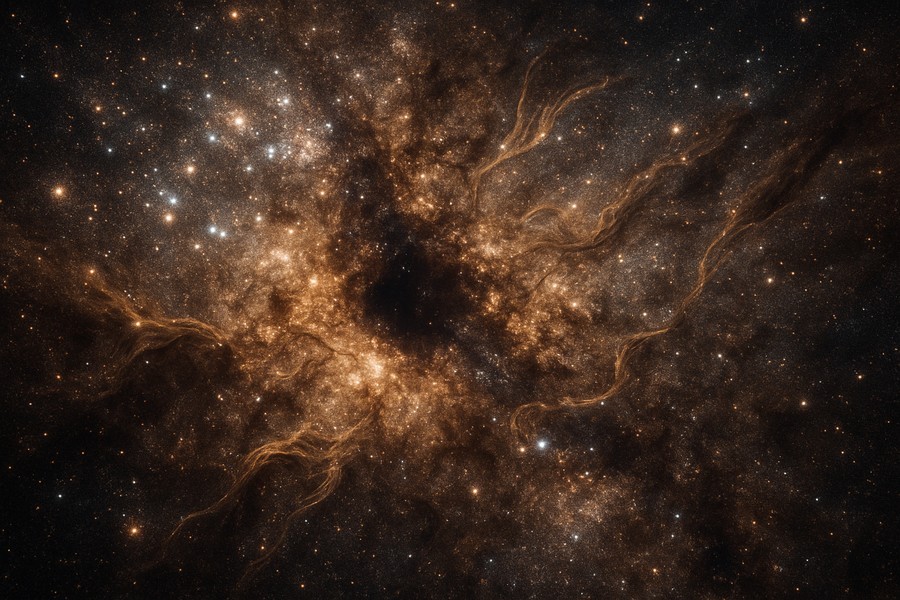
An international group of astronomers has used advanced technology to capture the Milky Way's central region in extraordinary detail. The image reveals a 650 light-year diameter area filled with a complicated network of filaments made of dense cosmic gas, known as the Central Molecular Zone (CMZ). As the largest image of its kind, this data-rich snapshot will enable astronomers to study the complex chemistry and star evolution within our galaxy's most extreme region.
Collaboration for Greater Understanding
The research leading to this data collection was carried out by over 160 scientists from more than 70 institutions worldwide, as part of the CMZ Exploration Survey. This group is committed to studying the cold gas in the CMZ and identifying chemical signatures, ranging from simple compounds to complex organic molecules. Their findings have been described in a series of papers published in an esteemed scientific journal.
This project stands as the most extensive survey of its kind, creating a mosaic of radio images covering a section of the night sky equivalent to three full moons side by side. The research team was led by an eminent scientist, supported by co-PIs from each participating institution. One such collaborator described their observations of the CMZ as a place of extremes, now revealed in extraordinary detail. They added that the dataset provides a unique view of the cold gas — the raw material from which stars form — within the CMZ. This is the first time this region has been explored in such depth.
From Cosmic Gas to New Stars
The image captures cold molecular gas flowing along filaments, forming into clumps from which new stars are born. While we understand how this process works in the outer disk of the Milky Way, the conditions in the center are far more extreme. The way new stars form and evolve under such conditions is still a mystery to astronomers. However, with this new dataset, astronomers hope to test whether theories of star formation still apply in extreme environments.
The CMZ is home to some of the most massive stars known in our galaxy, many of which have short, intense lifespans, ending in powerful supernova explosions. By studying star formation in the CMZ, we can get a clearer picture of how galaxies grow and evolve. It's believed that this region shares many features with galaxies in the early Universe, where stars formed in chaotic, extreme environments.
A Step Towards Greater Discoveries
The observations also yielded unexpected surprises. Although the team expected their observations to provide a high level of detail, they were still amazed by the complexity and richness revealed in the final mosaic. This detailed survey will likely pave the way for more detailed observations when advanced telescopes become operational.
Future upgrades and next-generation telescopes will allow us to delve even deeper into this region — resolving finer structures, tracing more complex chemistry, and exploring the interaction between stars, gas, and black holes with unprecedented clarity. This is just the beginning of a new era of galaxy exploration.