
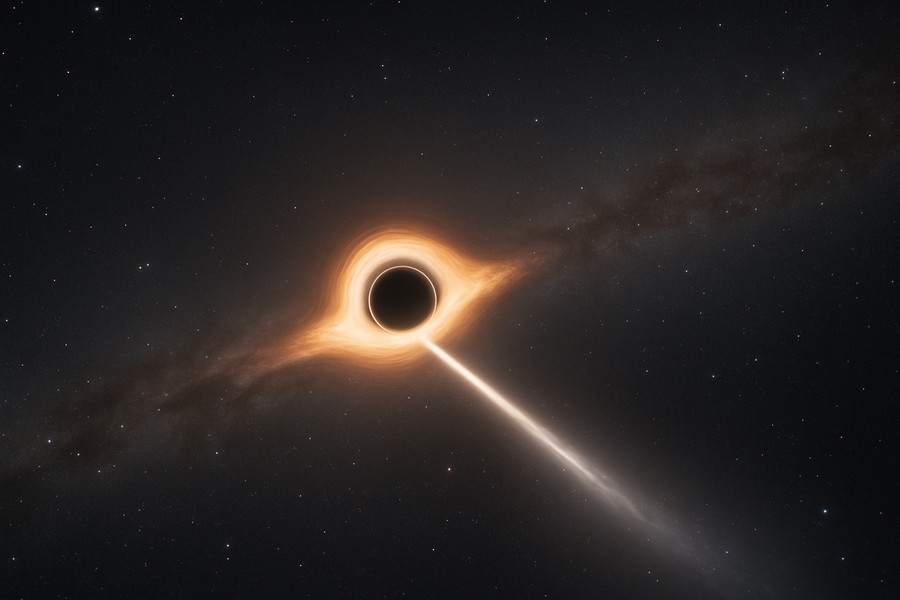
Active Black Hole Spotted Spewing Cosmic Jet
Scientists have made a significant breakthrough in the study of black holes by tracing a 3,000 light-years-long cosmic flare back to its origin. This incredible cosmic event was emanated from the supermassive black hole named M87*, a celestial body that holds the honor of being the first black hole ever captured in a photograph by humans. This discovery offers insights into the creation of these potent jets of charged particles that zoom across space at speeds close to the speed of light.
M87* is positioned at the center of Messier 87, a galaxy situated around 55 million light-years away from our planet. A historic picture of this supermassive black hole, which has a mass comparable to about 6.5 billion of our suns, was first taken in 2017 and shared publicly two years later.
The Monstrous M87*
The black hole at the center of the Milky Way, Sagittarius A*, pales in comparison to M87* with a mass of around 4 million suns. M87* is not just larger but it is also an active black hole. This means it continuously swallows the gas and dust around it while simultaneously ejecting powerful jets from its poles. The exact origin of these jets and the mechanism that powers them are still somewhat of a mystery to scientists.
Unveiling the Mysteries
To gain a better understanding of the jet of this supermassive black hole, scientists resorted to observations of M87* taken using a method known as Very Long Baseline Interferometry (VLBI). This method allows scientists to observe structures around supermassive black holes at a minute scale, such as the glowing golden ring of super-hot matter that dominated the 2019 image of M87*. This ring acts like the "shadow" of the black hole. With these newer observations, the team was able to link the glowing ring of material around M87* to the base of the jet spewing out from the black hole, suggesting a likely starting point for the jet.
The researchers asserted that this study is an initial step in aligning theoretical concepts about jet launching with direct observations. Pinpointing the possible origin of the jet and its connection to the black hole's shadow brings us a step closer to understanding how the core engine of the black hole works.
Modeling the Black Hole
Upon modeling the supermassive black hole, it was discovered that radio emissions that were absent in prior observations of M87* but present in the most recent ones likely originate from a compact region less than a tenth of a light-year away from the black hole. This region is associated with the base of the M87* jet and aligns with the southern arm of another jet seen in radio waves.
Scientists have been observing the inner part of the jet of M87* for many years, with each observation yielding higher resolution. The excitement among the scientific community is palpable as we inch closer to combining these breakthrough observations across multiple frequencies and completing the picture of the jet launching region.
Future Observations
The scientists now plan to conduct further observations of M87* to gain a better understanding of the structure of its jet and to capture more detailed images of the jet. This could lead to improved understanding of how supermassive black holes influence the space around them. As we continue to explore and understand these stellar phenomena, the future looks promising for black hole imaging.