
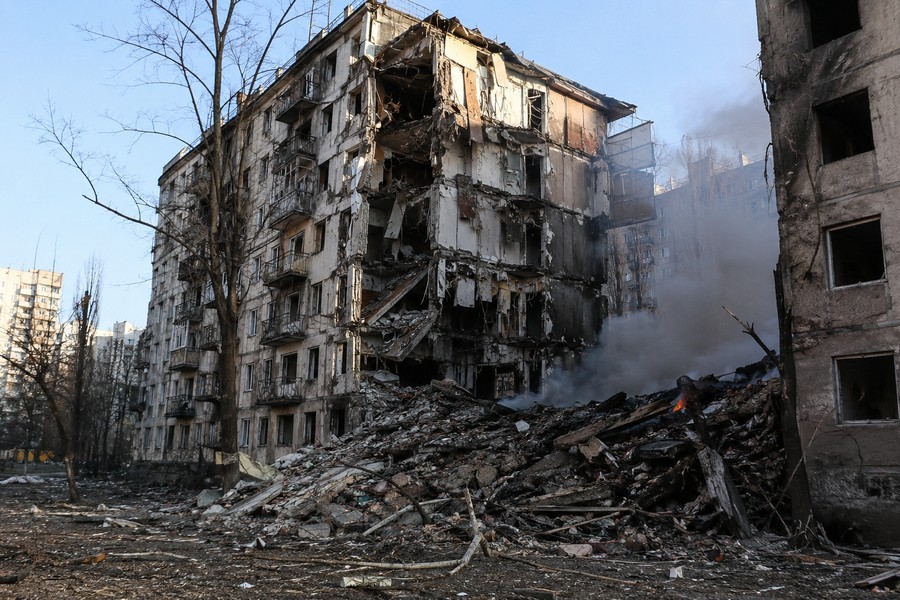
Tragic Overnight Aerial Assault Strikes Capital, Damaging Homes and a Children’s Hospital
A massive, hours-long aerial assault involving dozens of missiles and drones struck the capital city, leaving at least 15 people dead and dozens more injured. The bombardment, which began in the middle of the night and continued well into the next morning, targeted multiple locations across the city and surrounding areas. Among the damaged structures were residential buildings, a kindergarten, and a children’s hospital, sparking fires and filling the air with heavy smoke.
In response to the tragedy, local leaders declared the following day as an official day of mourning to honor those who lost their lives. Emergency workers spent hours searching through the rubble of damaged buildings to assist survivors and secure the affected neighborhoods. Early estimates indicated that around 40 people suffered injuries during the strikes, with at least 14 victims requiring immediate hospitalization.
An Exhausting Night of Continuous Blasts
The assault began shortly after midnight, waking residents with loud explosions that shook homes and set off car alarms across the capital. This first wave of strikes was followed by hours of tension as air raid sirens echoed throughout the city. Another major round of explosions shook the area early in the morning, keeping families in shelters as the sun rose.
The timeline of the attack shows how difficult the night was for local residents:
- Shortly after midnight: The first explosions begin, shaking residential neighborhoods and starting fires.
- 6:17 a.m.: A second major wave of strikes hits the city after hours of continuous tension.
- 8:36 a.m.: A temporary all-clear signal is given, offering a brief moment of relief.
- 9:06 a.m.: New sirens sound, warning of incoming high-speed missiles heading toward the city.
- 11:10 a.m.: The final all-clear is declared, ending the immediate threat after many hours.
The prolonged nature of the attack left the city covered in a thick smell of smoke, with the sound of drone engines buzzing overhead even after sunrise.
Hospitals and Homes Caught in the Path of Destruction
The damage from the strikes was widespread, affecting at least 28 different locations. One of the most severe targets was a local children's hospital. The blast blew out the hospital's windows and set nearby cars on fire in the parking lot. A kindergarten and another educational facility also suffered damage during the raids.
In residential areas, the destruction was highly visible:
- In one neighborhood, falling metal debris hit a five-story apartment building, causing a fire and shattering windows.
- Another apartment building was damaged high up, between the eighth and ninth floors.
- Several warehouses and storage facilities were also struck and damaged.
Outside the main city, in a nearby community, the violence claimed another life. One man was killed and eight other people were injured there. An industrial building in that suburban area was also heavily damaged by the strikes.
A Look at the Weapons Used and Intercepted
Military defense teams worked constantly to protect the skies during the attack. The assault involved a massive number of weapons designed to overwhelm local defenses. In total, the attacking forces launched:
- 168 attack drones, of which defense teams successfully shot down 145.
- 44 cruise missiles, with 39 intercepted by defense systems.
- Two advanced high-speed missiles, both of which were successfully destroyed.
Despite these successful interceptions, several highly advanced ballistic and hypersonic missiles were also fired from nearby border regions. Because of defense rules, the exact number of these specific missiles shot down was not shared. The threat was so severe that a neighboring country even sent its own fighter jets into the air to protect its airspace from any stray weapons.
The Critical Need for Better Air Defenses
This latest tragedy highlights a major challenge for the country's defense. Local forces are currently facing a serious shortage of the specialized ammunition needed for their most advanced air defense systems. These systems, known as Patriot defense systems, are among the very few in the world capable of stopping fast-moving ballistic and hypersonic missiles.
While other defense systems provided by global partners can stop drones and standard cruise missiles, they are not strong enough to stop ballistic missiles. Without enough ammunition for these advanced shields, the capital remains highly vulnerable to large-scale attacks. Leaders warn that as long as these defense gaps exist, the conflict is likely to continue, as there is little pressure on the attacking nation to consider peace seriously.