
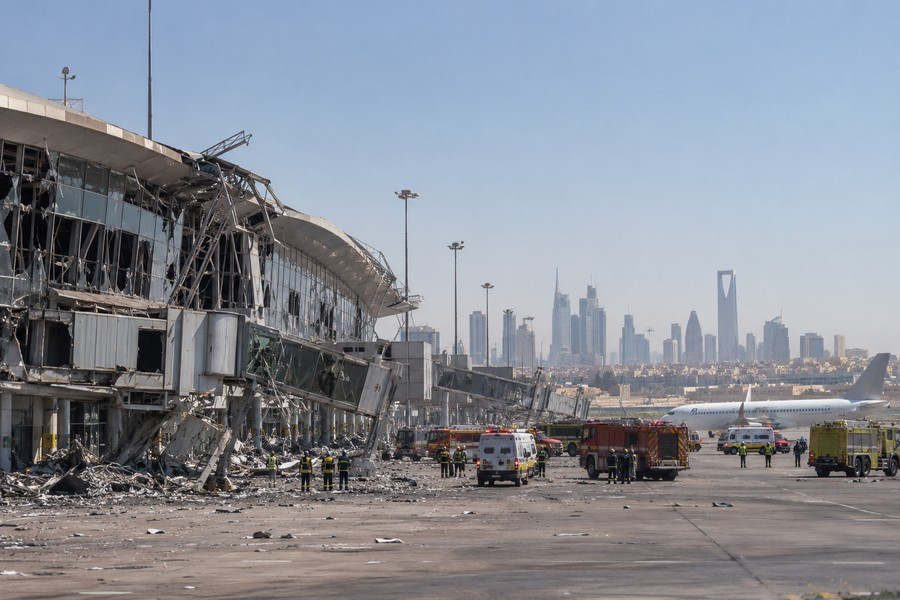
Riyadh Airport Attack Raises New Fears Across the Middle East
An attack on King Khalid Airport in Riyadh has added a serious new danger to a region already facing deep conflict. The strike showed that armed groups in Yemen can reach important targets inside Saudi Arabia, including parts of the country’s main civilian infrastructure.
A Direct Threat to Saudi Arabia
The Houthi movement has increased its attacks on Saudi territory in recent weeks. The latest strikes have focused on key sites, including Riyadh’s main airport. The attacks appear to have passed through Saudi air defenses with little trouble.
The damage to the airport can likely be repaired. The larger problem is the harm to Saudi Arabia’s image as a safe and stable country. Riyadh has worked for years to present itself as a secure center for business, travel, and investment. Repeated attacks could weaken that reputation.
The airport strikes are only part of the wider campaign. Houthi forces have also tried to gain control of important locations along the Red Sea coast and near the Bab al-Mandeb Strait. This narrow passage is a major route for ships traveling between the Red Sea and the Gulf of Aden.
The Yemeni government says the strait is secure. Still, the fighting has raised new concerns about the safety of ships using the waterway.
A War With Regional Effects
Yemen’s civil war has continued for more than a decade. It is a conflict between the internationally recognized government, which receives support from Saudi Arabia, and the Houthis, who receive backing from Iran.
The war has killed many thousands of people and pushed Yemen into one of the world’s most serious humanitarian emergencies. Millions of people have faced hunger, disease, displacement, and a lack of basic services.
The conflict is also tied to a larger struggle involving Iran, the United States, Israel, and other powers in the Middle East. That wider tension makes every new attack more dangerous because a local battle can quickly affect other countries and international trade.
Saudi Arabia Faces a Different Kind of Challenge
Saudi Arabia has not faced such a serious internal security threat since an armed campaign linked to al-Qaeda during the middle of the previous decade. The Saudi government eventually weakened that movement through a security effort combined with a campaign aimed at winning public support.
The country also survived the wave of protests and political unrest that swept through several Arab nations. Governments in Tunisia, Libya, Egypt, and Yemen were changed or removed during that period.
The current danger is different. Saudi Arabia has one of the strongest air forces in the Middle East and has carried out heavy airstrikes against Houthi targets. Even so, Houthi forces have taken large parts of Yemen, especially in the north and west.
Because the Houthis cannot match Saudi Arabia’s military power in a traditional battle, they have focused on vulnerable points. Their main targets include airports, oil facilities, shipping routes, and other parts of the Saudi economy.
Missiles and Drones Target Vital Sites
The Houthis are an important strategic partner for Iran and are part of a wider group of forces that oppose Israel and the United States. Their attacks stretch across a broad area, from Jizan on the Red Sea coast to the petrochemical facilities near Khurais.
Missiles and explosive drones have been used against these locations. The strikes are designed to cause physical damage, but they also send a wider message: Saudi Arabia’s economic system can be reached and disrupted.
The Red Sea has become even more important because another major waterway, the Strait of Hormuz, has not fully returned to normal. The passage remains affected by the failure of the United States and Iran to reach an agreement that would end their conflict.
Attacks on ships in the Red Sea give the Houthis another way to pressure their opponents. Disrupting shipping can increase costs around the world and create economic problems far beyond Yemen and Saudi Arabia. That broader impact gives Iran and its partners an important source of leverage.
The United States May Face a Hard Choice
The United States initially said it would not take a direct role in Yemen’s war. It did, however, offer intelligence support to Saudi Arabia. The United States later confirmed that it was sharing intelligence and had sent military experts to assist the Saudi government.
The latest attack on Riyadh may force Washington to reconsider how deeply it should become involved. The strike killed a US citizen, adding pressure to an already difficult situation.
The US president said a decision would be made quickly after learning about the attack. The comment suggested that further American action remained possible.
The president had promised to reduce America’s role in overseas wars after returning to office. Yet the United States remains involved in three unresolved Middle East conflicts involving Gaza, Lebanon, and Iran.
The airport attack now creates another test. Any response must protect American citizens and support regional allies while avoiding a wider war that could spread across the Middle East.