
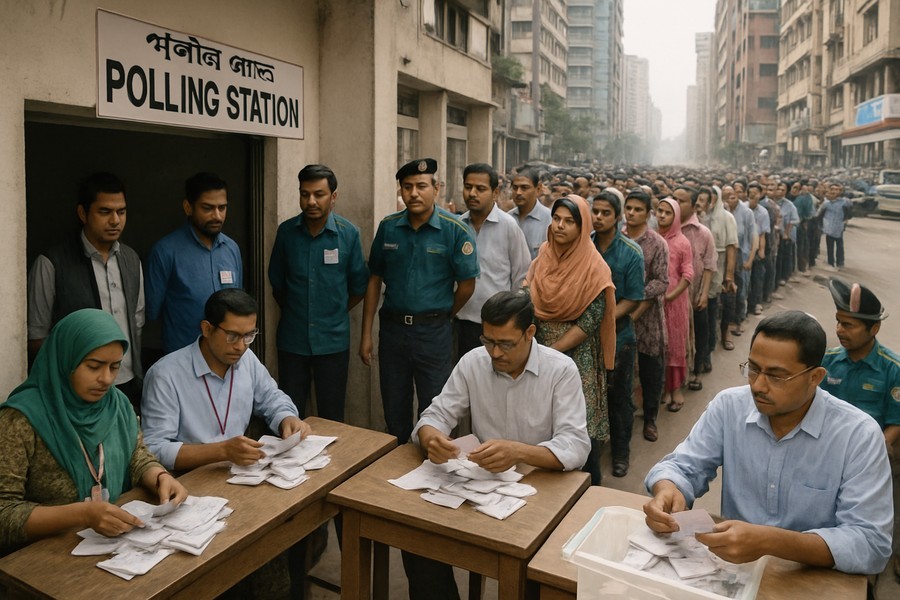
First Election Since Landmark Political Protests Takes Place in Bangladesh
For the first time since a massive public outcry led to the removal of the government, Bangladesh has conducted a national election. This peaceful voting process is seen as a pivotal moment for the nation's democracy, which has experienced years of political upheaval.
Throughout the day, citizens flocked to the voting booths in the capital city and other regions. By mid-afternoon, almost half the voters had cast their choices. The voting ended in the late afternoon, and the count began immediately, with results expected the following day.
At one voting site in the capital, votes cast on black-and-white paper ballots were manually counted by officials. Each vote was thoroughly checked for validity before the results were tallied. Representatives from various political parties were present as observers, and security officials ensured the process remained secure.
Over 127 Million People Cast Their Votes
More than 127 million citizens were eligible to vote in this landmark election, which is the first since the government was overthrown following widespread protests largely driven by the nation's younger generation. The former leader is now living in exile in India and her party has been banned from participating in the election.
The Bangladesh Nationalist Party's Tarique Rahman, son of a former Prime Minister, is a leading candidate for the next government. After spending 17 years in self-imposed exile in London, Rahman returned to Bangladesh in December. His campaign promises include rebuilding democratic institutions, reinstating the rule of law, and bolstering the economy.
An Alliance of 11 Parties Challenges the BNP
Posing a challenge to the Bangladesh Nationalist Party is an alliance led by the country's largest Islamist party, which was previously banned but has gained prominence since the previous government was overthrown. There are concerns, especially among women and minority communities, that social freedoms may be threatened if this group gains power. The country's population is largely Muslim, with a Hindu minority making up about 8%.
The head of the leading Islamist party expressed optimism after casting his vote, stating that the election marked a turning point and that people were ready for change.
Interim Leader Expresses Confidence
Bangladesh’s interim leader, a Nobel Peace Prize laureate, expressed positivity about the election, describing it as a moment of national celebration.
The interim government, led by the laureate, has committed to delivering a credible and transparent election. To ensure this, around 500 international observers and foreign journalists were present, including delegations from the European Union and the Commonwealth.
Parliament Seats Up for Grabs
There are 350 seats in the Parliament of Bangladesh, 300 of which are directly elected from single-member constituencies and 50 reserved for women. The parliament serves a five-year term. Voting in one constituency was deferred following the death of a candidate.
This election follows a period marked by mob violence, attacks on minorities and press freedom, the rise of Islamist influence, and a weakening of the rule of law. The outcome could significantly impact the domestic stability of Bangladesh, a country with a history of political instability and allegations of vote rigging since gaining independence.
Referendum to Determine Future Changes
This election is not only a test of leadership but a measure of trust in the democratic future of Bangladesh. Voters are given the opportunity to endorse major reform proposals that emerged from a national charter signed by major political parties last year.
If the majority of voters support the referendum, the newly elected Parliament could establish a constitutional reform council to implement changes within 180 working days from its first session. These changes could include creating new constitutional bodies and changing the structure of Parliament to a two-house legislature with the upper house having the power to amend the constitution.
Despite some initial disagreements, both the Bangladesh Nationalist Party and the leading Islamist party signed the document. However, the former ruling party and its allies, now banned from the polls, were excluded from the discussion. The former leader, now in exile, criticized the election for excluding her party. Critics have also said that the referendum has limited the options available to voters.