
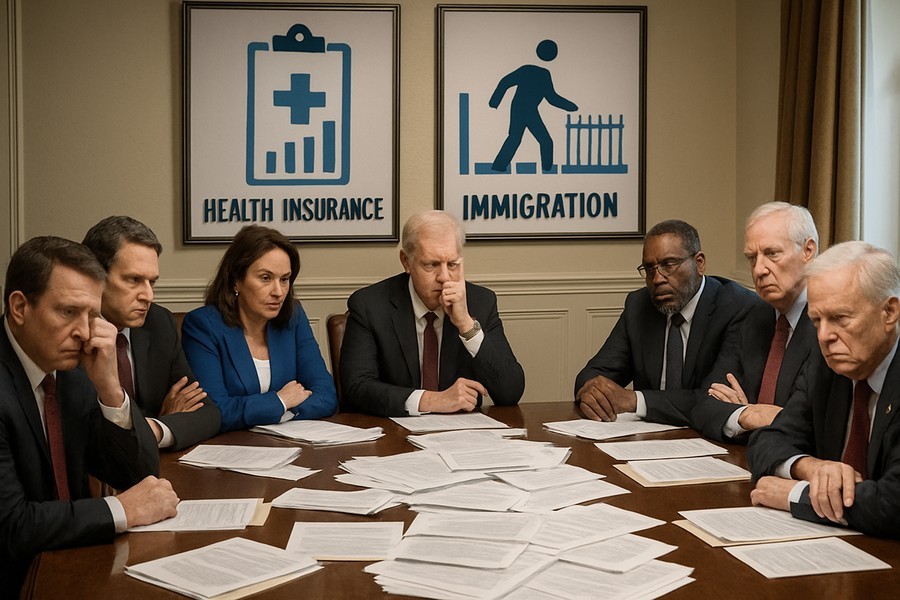
Efforts to Reform Health and Immigration Policies Struggle Amidst Political Differences
Efforts to bridge the gap between opposing political parties concerning health subsidies and immigration enforcement reforms are proving to be challenging. There seems to be a common pattern of pledges made towards finding a middle ground followed by a breakdown of negotiations.
Health Insurance Subsidies in Limbo
Not long ago, a confident senator from Ohio believed a deal was near to revive expired health insurance subsidies. Despite public support for the renewal of these subsidies, negotiations failed. The Ohio senator placed the blame on the Senate Minority Leader from New York, accusing him of prioritizing political points over problem-solving for the upcoming election.
However, this perspective was countered by Democrats, who argued that the negotiations fell apart due to Republicans introducing contentious language regarding abortion into a provision on health savings accounts. A senator from Connecticut expressed his belief that the failure of the effort was not due to an unwillingness to compromise, but rather a lost bargaining position when several Democrats voted to end a shutdown last fall.
Changes to Immigration Enforcement Tactics Remain Uncertain
The legislative branch's ability to make decisions is once again being put to the test, this time in response to the tough measures taken by immigration enforcement officers. Public outrage has propelled both Republicans and Democrats to pledge action, such as requiring officers to wear body cameras, to curb aggressive enforcement.
Despite initial signs of optimism, the cooperative spirit quickly faded. Democrats are now considering withholding their votes for the measure unless Republicans and the White House agree to their proposed reforms. This could potentially lead to a shutdown of the department.
The Majority Leader in the Senate, from South Dakota, has pointed fingers at Democrats, accusing them of procrastinating and then presenting a list of unrealistic demands. In response, the Minority Leaders from New York insisted that their proposals are reasonable and targeted.
The Impact of Politics on Negotiations
A senator from Maine, who has participated in both health subsidy and immigration negotiations, defended Congress, citing successful collaborations such as the negotiation and passing of bipartisan government funding bills. Meanwhile, a former senator from North Dakota commented on the difficulty of bipartisan negotiations, especially during national crises.
She remarked that once the initial shock of a crisis subsides, politicians often retreat to their established positions. She mentioned failed attempts at comprehensive immigration reform in 2013 and policing reform after the 2020 murder of George Floyd.
She also noted that lawmakers are less inclined to compromise as politics become more tribal. The rewards for finding a middle ground are diminishing as people are more willing to adhere to party lines, according to her.
Public Trust in Congress Wanes
When Congress fails to deliver on its promises, public trust in the institution's ability to address issues declines. According to a survey conducted in September, 66% of Americans have little to no trust in Congress. In a recent focus group discussion, only two out of 14 swing voters expressed confidence in Congress's ability to act on the discussed immigration proposals.
An Alabama senator emphasized the importance of maintaining public trust while leading the current discussions on immigration enforcement. She stressed the need to find solutions and engage in difficult conversations with respect and dignity. Talks are ongoing, and unlike the health subsidies dispute, the White House is actively involved and negotiating directly with Democrats.
Despite the challenges, a senator from Virginia believes bipartisan action is possible but acknowledges the difficulty in finding a common ground on contentious issues such as healthcare and immigration. He went into the negotiations with high hopes but low expectations.