
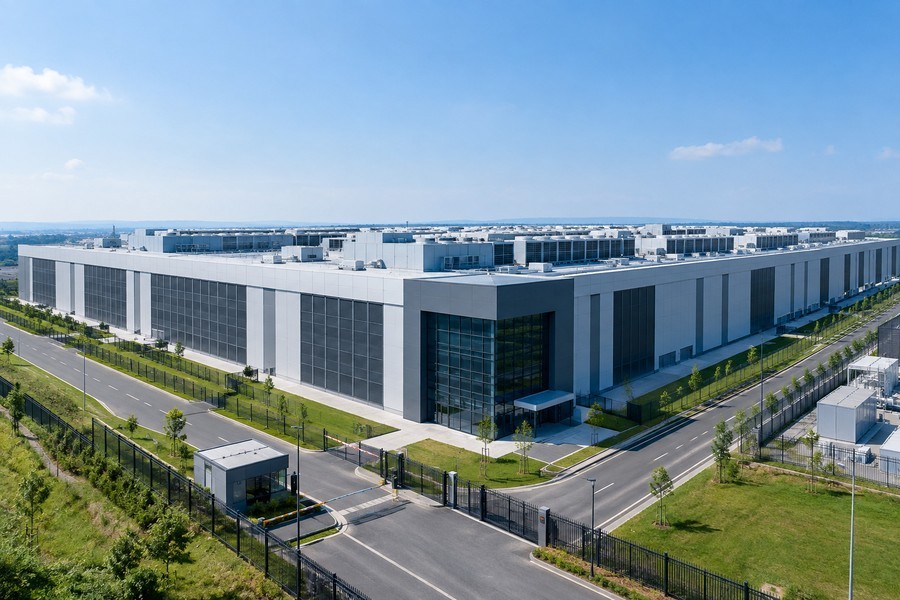
The New Battleground in Local Elections: Giant Computer Warehouses
In political campaigns across the United States, candidates from both major parties have found a common target. They are focusing their attention on the massive, energy-hungry data centers that power the modern artificial intelligence boom. From the Midwest to the South, politicians are spending millions of dollars to warn voters about these giant computing facilities.
A close look at political advertising shows that campaigns and outside groups have spent more than $45 million on television and digital ads mentioning these facilities. This spending spans major races for governors, the House of Representatives, and the Senate.
Surprisingly, both political parties are using very similar arguments. They warn that these massive buildings receive too many tax breaks, cause local electricity bills to rise, and require much stricter rules.
An Equal Split in Campaign Spending
While the two parties often disagree on major issues, their spending on this topic is remarkably close. Candidates and groups on both sides have poured nearly equal amounts into these advertisements:
- Republican campaigns and supporting groups spent over $22 million on ads criticizing these facilities.
- Democratic campaigns and their supporters spent more than $21 million on similar messages.
- Independent candidates made up the remainder of the total spending.
Even though the total money spent was nearly equal, the strategies differed. Democratic candidates ran almost twice as many individual ads as their Republican rivals—127 compared to 67—spreading their message across a wider variety of states and local races. Most of these advertisements have aired in highly competitive swing states like Wisconsin and Michigan.
The issue has also grown rapidly as election day approaches. Early in the year, only a few ads mentioned these computing hubs. Within a few months, the number of ads airing each month jumped into the hundreds.
Why Voters on Both Sides Are Worried
This shared political focus is driven by widespread public concern. Public opinion surveys show that 77% of Americans worry that these massive computing hubs will drive up their personal utility bills. Furthermore, two-thirds of Democrats and half of Republicans say they would oppose building one of these facilities in their own neighborhoods.
This shared anxiety gives both parties a powerful talking point, though they approach the issue from different angles:
- Democrats use the issue to highlight environmental worries and protect consumers from rising utility bills.
- Republicans use it to attack giant corporations and portray themselves as defenders of regular citizens against powerful systems.
This unique issue has brought voters from opposite ends of the political spectrum together in their opposition to these facilities.
How the Battle is Playing Out Across the Country
Candidates in several states have made these computing hubs a central part of their campaign promises:
- Wisconsin: A political action committee spent $634,795 on ads supporting Democratic gubernatorial nominee David Crowley. The ads promised Crowley would lower costs and stop these facilities from driving up energy bills.
- Florida: A political action committee spent over $2.5 million on ads for Republican gubernatorial nominee Byron Donalds, who promised to protect families from facilities that increase utility rates.
- Iowa and Kansas: Similar advertisements have run in support of Democrat Rob Sand in Iowa and Republican Ty Masterson in Kansas.
The issue has become especially intense in two key states:
Georgia: This state has seen more than half of all Republican spending on this issue, capturing about 30% of the national total. In the race for governor, campaigns spent $12.8 million on ads mentioning the facilities. Six ads discouraged voters from backing Republican Lieutenant Governor Burt Jones, who lost a primary runoff to healthcare billionaire Rick Jackson, by using the facilities to allege corruption.
Ohio: In a major Senate race, supporters of Democratic nominee Sherrod Brown spent millions of dollars labeling his opponent, Republican Jon Husted, as the main supporter of these facilities. The ads accused Husted of giving tech companies over $2.5 billion in tax breaks while causing electric bills to spike. Husted, who previously supported the facilities, has since backed laws to protect rate payers and require tech companies to hire local workers and pay local taxes.
Why Local Officials Feel the Pressure
The fight over these facilities is mostly happening at the state and local levels. Gubernatorial races saw the highest amount of ad spending at around $32 million, compared to $8 million in House races and $5.3 million in Senate races.
This is because state and local governments, rather than the federal government, have the power to approve or deny construction permits for these massive projects. Governors are facing intense pressure from local residents to slow down construction.
This local opposition has created a difficult situation for some conservative politicians. While many in the party traditionally support big business, candidates are pulling back because their own voters are strongly opposed to the projects. This local pushback even puts some candidates at odds with national party leaders like Donald Trump, who has encouraged states to keep building the facilities to stay competitive globally, even while noting they could use better public relations.