
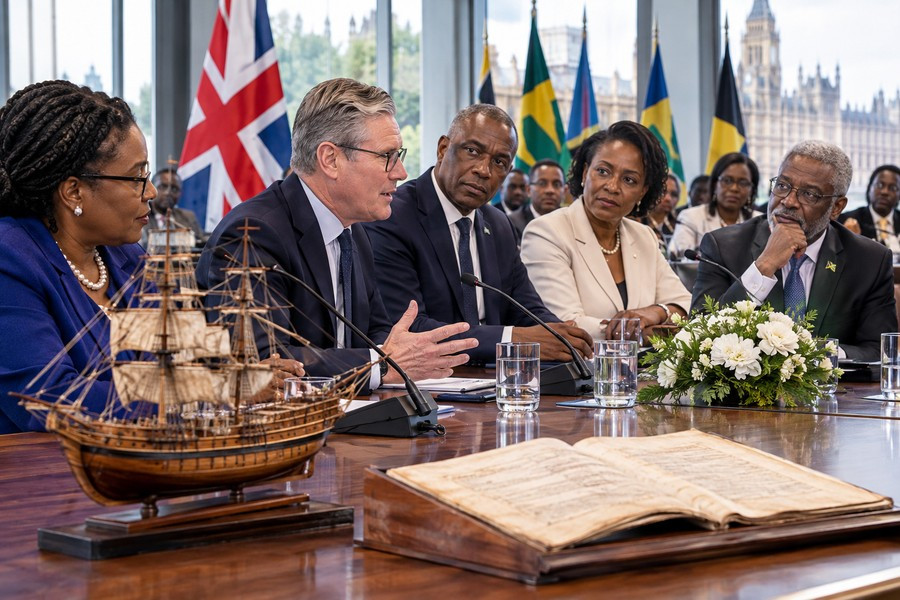
Britain Signals Willingness to Apologize for Slavery, but Rejects Reparations
A Change in Britain’s Position
United Kingdom Prime Minister Andy Burnham has said Britain is willing to consider a formal apology for its role in the transatlantic slave trade. However, he has rejected calls for direct financial reparations, a demand that Caribbean leaders and campaigners have made for many years.
Burnham also said Britain would support longer repayment periods for some of the world’s poorest countries. He presented the idea as part of a wider effort to strengthen relationships with Commonwealth nations and improve trade and economic cooperation.
In a personal statement, Burnham expressed sorrow and regret for the suffering endured by millions of enslaved people. He also recognized that the effects of slavery continue to shape the modern world.
The statement came as more than 50 Commonwealth countries prepared to meet in Antigua and Barbuda. King Charles was hosting the gathering in the country’s capital, St John’s.
Britain’s Role in the Slave Trade
The transatlantic slave trade lasted from the 16th century through the 19th century. Around 12 million Africans were taken from their homes and forced onto ships bound for the Americas. Many were captured with the help of local rulers and warlords before being sold to European traders.
Enslaved people were forced to work on plantations, in homes and in other labor-intensive jobs. Their work produced goods and wealth that helped build economies in Europe and the Americas.
Britain and Portugal were responsible for about 70 percent of the Africans transported to the Americas. France, Spain and the Netherlands also played major roles in the trade.
Britain transported about 3.1 million Africans to colonies in the Caribbean, the Americas and other regions. About 2.7 million reached their destinations. Many others died during the dangerous sea voyages because of disease, hunger, violence and terrible living conditions on the ships.
British groups began organizing against slavery in the late 18th century, including activists in cities such as Manchester. Parliament later banned the trading of enslaved people, and slavery itself was eventually outlawed throughout the British Empire. Even after the ban, the system continued in some places for several years.
A previous British prime minister expressed deep sorrow over the country’s involvement in slavery but stopped short of issuing a formal apology or supporting reparations.
Why the Issue Has Returned
Burnham’s statement came during Black History Month and as Commonwealth leaders gathered in the Caribbean. He said Britain wants to protect its diplomatic and commercial relationships with countries that were once controlled or colonized by Britain.
He described the Commonwealth as important at a time of global division and danger. He also said its members could create new opportunities for trade and economic partnerships.
As part of the proposal, the poorest and most vulnerable countries would receive more time to repay their debts. Former Chancellor of the Exchequer Gordon Brown would help lead the debt-relief effort.
Caribbean governments and campaigners have argued that debt relief alone does not address the full damage caused by slavery. They want Britain and other nations involved in the trade to accept responsibility and provide financial and practical support.
What Reparations Campaigners Want
The Caribbean Community has called for recognition of the role played by Western countries in slavery and for financial reparations. Barbados Prime Minister Mia Mottley has become one of the strongest voices supporting the campaign.
Ghana has also supported the movement. The country played a major role in the slave trade, and about 10 to 15 percent of enslaved people were taken from the region or transferred through it.
A United Nations resolution later described the trafficking of enslaved Africans as the gravest crime against humanity. The measure received support from 123 countries. European nations abstained, while the United States, Israel and Argentina voted against it.
Campaigners say reparations are supported by both moral and legal arguments. They point to the lasting effects of slavery, including:
- Economic inequality in countries whose people were taken or exploited
- Damage caused by the loss of millions of people and their labor
- The destruction of communities and the loss of cultural traditions
- Colonial theft of art, land and other valuable resources
- Racism and unequal access to global financial systems
- Debt, weak infrastructure and continuing development challenges
Mottley has proposed a broad plan that includes a full formal apology, financial payments from governments and institutions, technology sharing, education support, health funding, debt relief and long-term economic investment. The plan also calls for action from corporations and churches that benefited from slavery.
Why Britain Rejects Direct Payments
Britain and other European countries argue that people living today should not be held personally responsible for crimes committed many generations ago. Some European leaders also point to the involvement of African rulers who helped capture and sell people to European traders.
Burnham said modern British citizens should not be held financially liable for actions carried out in a different period under different laws. Instead, he proposed continued discussion with affected countries, along with debt restructuring.
France has recognized slavery as a crime against humanity and has considered whether reparations should be examined. The Netherlands has issued an apology for its role in slavery.
The Church of England, whose clergy and institutions owned enslaved people, created a fund worth 100 million British pounds, or about $134 million, for affected communities and research into slavery’s long-term effects.
Mixed Reaction to the Proposal
Saint Lucia’s Prime Minister Philip J. Pierre, who chairs the Caribbean Community, rejected the argument that modern Britain cannot be responsible for slavery. He said reparations are not about blaming individual citizens. Instead, they concern the continuing responsibility of governments and institutions.
Ghana’s President John Dramani Mahama welcomed Burnham’s statement but urged caution. He said Britain should issue a formal apology, invest in key sectors and help fight systemic racism and hostility toward people of African descent.
Denis O’Brien, founder of an organization supporting reparations, said Britain should stop avoiding the issue and provide a complete formal apology.
Conservative Party leader Kemi Badenoch opposed Burnham’s position. She questioned whether African rulers who participated in the trade would also be expected to pay reparations. She argued that British taxpayers should not be responsible for events that happened before they were born.
Bell Ribeiro-Addy, who leads a parliamentary group supporting reparations, welcomed the willingness to discuss an apology but said the proposed action did not go far enough.