
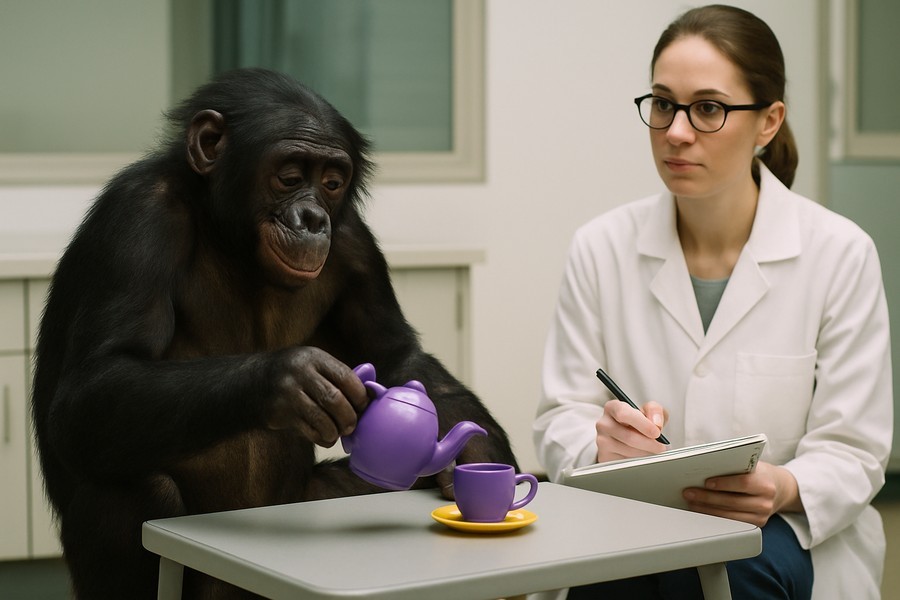
Could Primates Have an Imagination? A Unique Experiment Investigates
Children as young as two years old often have vivid imaginations. They convert their bedrooms into magical kingdoms and host fanciful tea parties. This unique ability to create something from nothing is often seen as a trait that sets humans apart, enabling us to invent new forms of art, music, and more.
However, an intriguing experiment suggests that this capability to imagine may not be exclusive to humans. In fact, there's a possibility that an ape in captivity might also possess an imagination.
The Ape with a Mind of its Own
Meet Kanzi, a bonobo raised in a lab setting, who has demonstrated impressive communication skills with humans through the use of pictograms. He has learned to merge different symbols to create new meanings and even picked up how to craft basic stone tools.
Researchers were curious to find out if Kanzi had the ability to pretend, which essentially means acting as if something is real, while aware that it isn't. This curiosity stemmed from observations of female chimpanzees in the wild treating sticks as if they were offspring, and captive chimps pretending to drag invisible blocks on the ground after playing with actual ones.
However, imagination is a complex concept, making it challenging to understand what is going on in the minds of these apes. It could be possible that they are merely copying the scientists or confusing imaginary objects with real ones.
An Imaginary Juice Party Experiment
To explore this question, scientists arranged a pretend juice party for Kanzi, using the same techniques used to study young children's ability to pretend. The researchers acted out pouring imaginary juice from a pitcher into two cups and then pretended to drink from one. When asked to choose a cup, Kanzi pointed to the one supposedly still containing the pretend juice 68% of the time.
To rule out the possibility that Kanzi was confusing reality with make-believe, a similar test was run using real juice. Kanzi chose the genuine juice over the pretend one nearly 80% of the time. This suggests that he can differentiate between the two, according to one of the researchers involved in the study.
A third experiment with faux grapes in two jars also yielded promising results.
Not All Scientists are Convinced
Despite these findings, not all experts in the field are convinced that Kanzi is truly pretending in the way humans do. Some argue that there is a difference between visualizing juice being poured into a cup and sustaining the pretense that it's real.
One expert suggested that to be convinced, he would need to see Kanzi pretend to pour water into a container himself.
Further Research Needed
Kanzi spent his life among humans, which makes it hard to determine if his abilities are typical of all apes or if they are a result of his unique upbringing. Sadly, Kanzi passed away last year at the age of 44.
Many species of great apes in the wild are critically endangered, and it will take more research to fully understand what their minds are capable of. "Kanzi has paved the way for many future studies," said one researcher.