
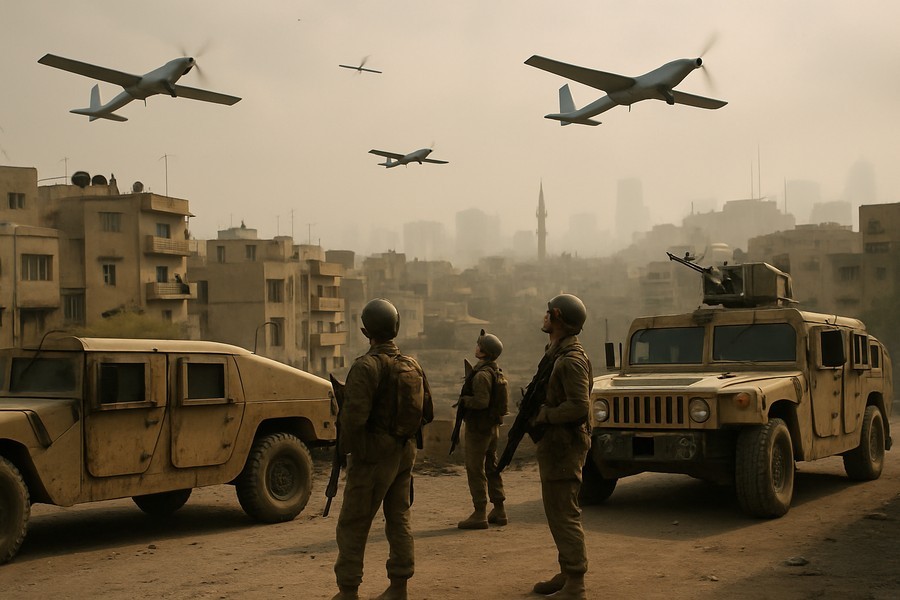
Modern Warfare Transformed by Affordable Drones: US Struggles to Adapt
Standing in a residential area in Erbil, which is part of the Kurdistan region of Iraq, a journalist reports on the drones in the sky. The drones, deployed by Iran to strike U.S. facilities, have become an everyday sight above the city, but most are intercepted before reaching their target.
The Drone Threat Underestimated
As Operation Epic Fury enters its third week, two pressing questions arise: for how long can U.S. defense systems fend off these drone assaults, not only in Iraq but across the Middle East, and did the U.S. initially undervalue the threat of Iran's drones?
In the Gulf region, inexpensive Iranian drones are being shot down by high-priced U.S. interceptor missiles. The disparity in cost has enabled Iran to escalate the financial burden of the conflict for the U.S.
The U.S. may soon exhaust its supply of interceptors, as the drone attacks remain unrelenting. The U.S. operations center in Kuwait, the U.S. embassy in Riyadh, and numerous petroleum facilities in the UAE have all been hit by drones, demonstrating the persistent nature of these attacks.
The Impact of Drones on Warfare
Nothing has revolutionized warfare in recent years quite like drones. Their cost and capabilities vary widely, from high-end surveillance drones used to gather intelligence and track targets over large areas, to inexpensive quadcopters modified for use in warfare. Drone technology has enabled smaller nations and less technologically advanced entities to compete with adversaries boasting extensive and sophisticated air forces.
Drones have been used extensively by Israel in Gaza, primarily for surveillance, but increasingly for combat operations. Additionally, drones have become a staple of Sudan's ongoing civil war, where Iranian-made drones have been supplied to government forces for use against rebels.
Ukraine's Unique Drone Warfare Strategy
Perhaps no conflict has demonstrated the power of drone technology more than Russia's full-scale invasion of Ukraine. Using inexpensive commercial drones equipped with cameras to target and drop simple munitions on Russian tanks and armored vehicles, Ukraine's forces have had significant success.
In response to the thousands of drones launched by Russian forces throughout the war, Ukrainians have developed a variety of methods for shooting down these drones. They claim to have achieved about a 90% success rate, and have even offered to assist the U.S. with countering similar drones.
U.S. Defense Systems Struggle Against Drone Attacks
Despite deploying sophisticated missile-defense systems across the region, the U.S. has struggled to stop all of Iran's drone attacks. The relentless drone attacks have led to a 'bunkerization' phenomenon, where civilians have to take shelter from this onslaught of drone attacks.
The Pentagon has cited a reduction in the rate of fire as an indicator that the U.S. is eliminating the threat of these drones, primarily by destroying their launchers and factories. However, experts warn that this doesn't necessarily mean the threat has been eliminated.
Experts Warned of Drone Threat
Many experts had warned the U.S. of the potential threat posed by drones, particularly given their recent history in Ukraine. The effectiveness of inexpensive drones had been a topic of considerable attention from U.S. military planners, with numerous conferences, workshops, and working groups focusing on the issue.
However, the U.S. and its allies in the Gulf have so far failed to deploy a truly multi-layered defense, which could combine interceptor missiles and even missile-equipped jet fighters with simple ground-based defense systems.
As drones continue to evolve and proliferate on the battlefield, experts suggest that they could take over some of the combat functions currently performed by humans, freeing up human labor for tasks that require a human eye.
The Future of Air Power
While the spotlight is currently on the Shahed drone, experts believe that it is not any particular drone that is transformative. The widespread use of drones on the battlefield represents a new chapter in air power and air defense, underscoring the need for nations to adapt to this rapidly evolving technology.