
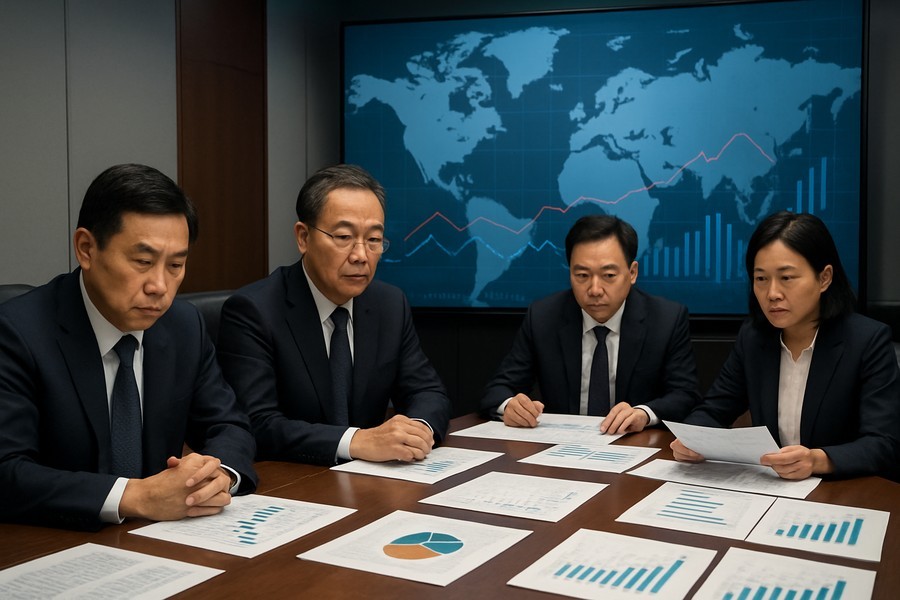
China Rebukes US Trade Inquiry Amid Approval of Five-Year Economic Strategy
China has expressed strong disapproval of a recent US investigation into the trading practices of several countries, alleging that it's a disguise for political maneuvering. The US is probing the alleged "excessive production and capacity in manufacturing sectors" in various countries, including China, Mexico, and the European Union.
The inquiry was announced after the Supreme Court nullified tariffs imposed by the president on imports from various countries worldwide. This ruling could potentially allow the government to impose tariffs on goods if it's determined that these countries are unfairly treating US companies.
A spokesperson for the Chinese Foreign Ministry conveyed the country's opposition to unilateral tariff measures. The spokesperson denied the existence of 'China's overcapacity' and stated that it should not be used as an excuse for political manipulation.
High-Stakes Summit on the Horizon
This development comes just a few weeks before a crucial summit meeting between the president of the US and his Chinese counterpart. The news coincided with the Chinese lawmakers' approval of a strategy for economic growth that continues practices that have irritated some of its partners.
The Five-Year Economic Roadmap of China
The Chinese legislature approved a five-year plan, an economic and social blueprint, that includes strategies around technological independence and industrial manufacturing. This plan does not specifically mention the US but is aimed at managing what China refers to as its 'great-power competition' with the US.
Here are the key elements of China's plan:
- Scientific and Technological Independence
The plan seeks significant advancements in China's self-reliance and calls for strengthening its science and technology sectors. China has always been uneasy about depending on foreign suppliers for high-end technology. Its determination for self-reliance was further solidified after the US imposed restrictions on the sale of advanced tech and high-end semiconductors to Chinese firms. It plans to increase its spending on research and development by more than 7% annually.
- Global Leadership in Technological Innovation
China aims to not only match the US and Europe in semiconductors and aerospace but also to lead in these areas along with future industries such as intelligent robotics, biomedicine, quantum technology, and the "low-altitude" economy, which includes everything from drones to flying taxis. Past ambitions of similar nature have worried American and European business groups that operate in China, fearing limited opportunities for them.
- Focus on Industrial Manufacturing
China intends to innovate like the US and manufacture what it innovates. The plan encourages manufacturers to leverage the advancements China has made in robotics and artificial intelligence to build a "modern industrial system with advanced manufacturing as its backbone." However, the plan does not address the issue of "involution," a phenomenon where intense competition among manufacturers leads to price wars and oversupply, affecting profits and causing trade friction abroad.
- Stimulating Consumption
The plan also encourages a significant boost in consumption. Most of the household wealth in China is invested in real estate, and a prolonged property slump has made Chinese consumers spend more cautiously. US and European leaders have urged China to address its overcapacity issue by stimulating its domestic consumption. The new plan identifies consumption as a key task but does not provide details on how this gap may be addressed.