
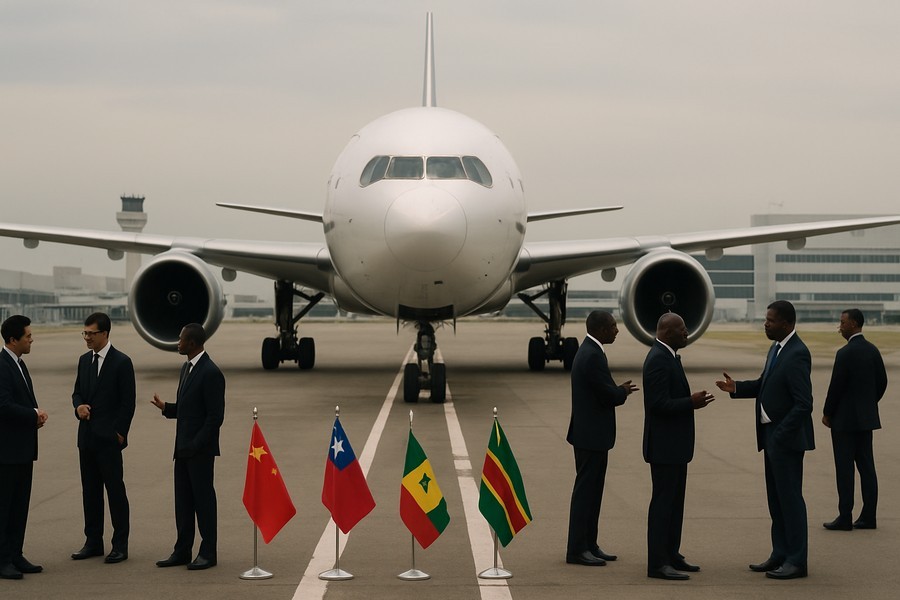
China Commends Nations for Foiling Taiwan President's Journey
Chinese authorities have expressed their appreciation for the African nations that prevented the Taiwanese President, Lai Ching-te, from crossing their airspace, resulting in the cancellation of his planned visit to Eswatini.
China, which regards Taiwan as part of its territory, is opposed to the self-governed island establishing diplomatic ties with other countries.
Lai's Canceled Visit to Eswatini
President Lai had intended to visit Eswatini, the last remaining ally of Taiwan on the African continent, for a few days. However, this plan had to be abandoned when three countries - Seychelles, Mauritius, and Madagascar - surprisingly revoked flight permits under alleged economic pressure from China, as stated by a Taiwanese official.
China's Response to the Blocked Trip
China denied exerting economic pressure to prevent Lai's journey. Nonetheless, the Chinese authorities expressed their "high appreciation" for the actions taken by the three African nations. The Chinese Foreign Ministry issued a statement applauding these countries for upholding the one-China principle, which aligns with the basic international relations norms.
China's firm belief in its inevitable reunification was emphasized in the statement. A spokesperson from China's Taiwan Affairs Office further stressed this point by quoting the ancient Chinese philosopher Mencius, saying, "A just cause enjoys abundant support, while an unjust cause finds little support."
Eswatini Expresses Disappointment Over Canceled Visit
Seychelles and Madagascar revealed their decision was motivated by their non-recognition of Taiwan. Taiwan's Foreign Ministry responded by condemning these countries for being subservient to China. They asserted that Taiwan, officially known as the Republic of China, is a sovereign state with an undeniable right to engage with the world, and no country has the authority to hinder this.
Eswatini, a small kingdom in southern Africa formerly known as Swaziland and one of the few countries with diplomatic ties to Taiwan, expressed regret over Lai's canceled visit. However, an Eswatini government spokesperson emphasized that this situation does not impact their longstanding bilateral relations.
Reactions from Other Parties
This incident occurred after the Taiwanese opposition leader, Cheng Li-wun, who heads the Kuomintang (KMT), met with the Chinese President in Beijing. The opposition party, often at odds with Lai's government, advised China to show restraint and give Taiwan diplomatic space.
A senior KMT lawmaker, Lai Shyh-bao, expressed his opinion in Taipei, deeming mainland China's pressure as unwise, especially following the meeting between Cheng and the Chinese President.
Some US lawmakers also expressed their concern over the occurrence. They criticized China's move as an act of economic pressure aimed at isolating a democratic partner, rather than a diplomatic maneuver.