
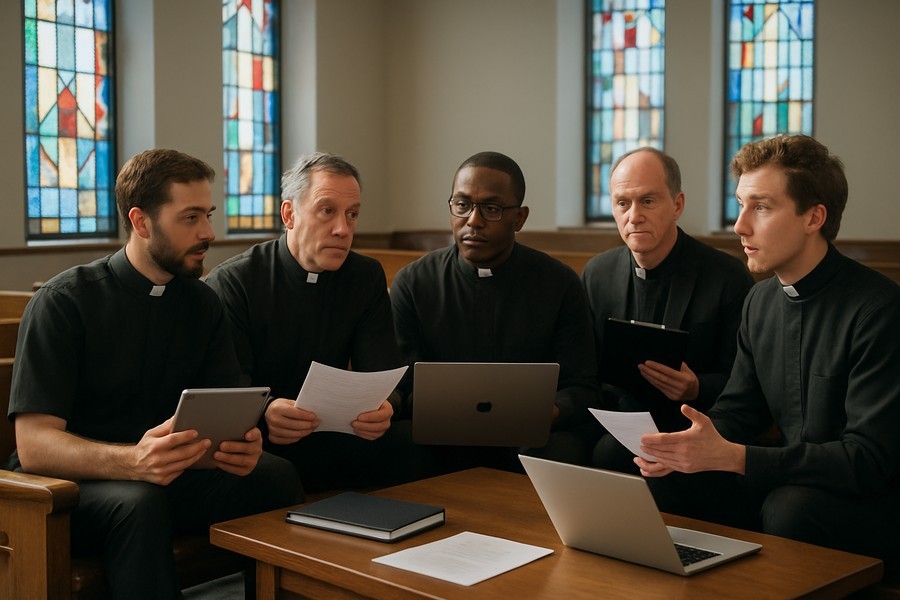
The Dilemma of the Divine: Balancing Tradition and Modern Technology
During a recent religious gathering, a group of clergy members were found to be discussing the use of advanced technology. They were not using it for sermon preparation or religious teachings, but found it useful for condensing lessons and structuring bulletins. They found comfort in knowing they were not the only ones utilizing such advancements.
The church is always in a balancing act between preserving its past and meeting the demands of the present. The question is how to effectively deliver the word of God in today's world. One clergy member shared an interesting finding from a study he had read, suggesting that coders were slower when using AI than without it. This was met with skepticism as they all felt it helped them work faster.
The technology has reportedly become quicker over time, but the emphasis on speed and the fascination with the latest tech brought up some concerns. The relationship between the church and AI is not limited to this group. A popular AI chatbot versed in the Book of Common Prayer has been created and gained quite a following. The developers believe chatbots could provide a new way to reach younger generations.
Online Services and the Impact on Church Attendance
However, it has been suggested that online services do not bring in new attendees, but are mostly watched by those who already attend church. This implies that this technology was not as effective as initially thought, especially during the pandemic.
It's also worth noting that AI is not a brand new technology. It is an advancement of our current media ecosystem. Many key players in the AI industry are social media or major tech companies. AI technology is built upon existing forms of web search, blogs, and social media algorithms.
Attention Economy and Its Effects
The concept of attention economy is becoming more prevalent. The idea is that attention is a finite resource and there is an ongoing battle to capture and retain it. The more attention a platform can hold, the more advertising revenue it generates. Even though social media platforms seem free, they are not. We are the product and our attention is being sold to the highest bidder.
This battle for attention tends to disregard future implications. As algorithms adapt to individual preferences, users become more isolated. Interactions become devoid of context, distorting even the world outside the internet. This lack of context shifts our attention away from the future and encourages competition for attention in the present.
One consequence of this fragmentation is what some refer to as "clannish hostility". As people become more isolated, they tend to interact with those who think like them. We become both consumers and producers of media. Social media tends to bring out the worst in us because it promotes our most divisive posts. And that's just when we're dealing with other humans. Now, we might even be interacting with AI chatbots, leading to absolute social isolation.
Real-World Implications
These negative impacts are not just restricted to the online world. It has been found that a quarter of young people believe AI can replace human romantic relationships. There have even been incidents where individuals have tragically ended their lives, supposedly urged by an AI chatbot. This is a high price to pay for technological advancement, a cost we never intended to bear when we embraced the information age.
Scriptural Insights
Reflecting on scriptural teachings, it can be seen that humans have always been tempted to form alliances with entities we do not fully understand, entities that could potentially harm us. The church, where the spiritual and earthly realms overlap, needs to continuously assess whether a particular strategy to spread the Gospel is compatible with the current culture or is being manipulated by it. If AI is just an extension of the attention economy that diverts our focus from the future, then we have enough evidence to draw a conclusion.
The attention economy, along with its latest developments in social media algorithms and AI, appears more harmful than beneficial, and we don't make deals with harmful entities. We need to resist them.