
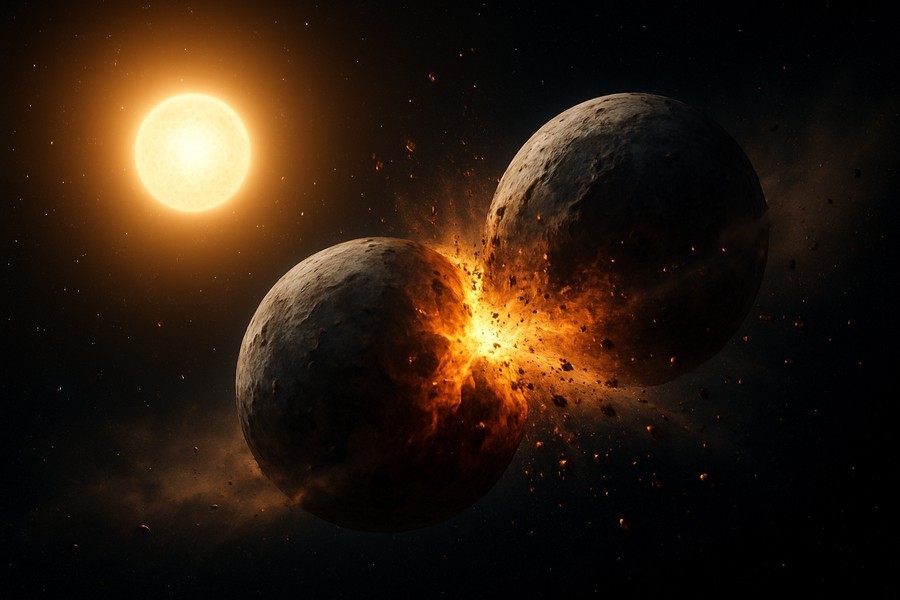
Outer Space Collision: A Spectacular Clash between Two Planets Observed
Space enthusiasts and scientists recently stumbled upon evidence of a monumental crash between two planets orbiting a distant star. This unusual occurrence was detected when a normally predictable star started behaving in an extraordinary manner. This cosmic collision might be similar to a significant event in our planetary history, where an object crashed into Earth, leading to the formation of the moon.
A particular star, located about 11,000 light-years away from us, was the center of this activity. This star, much like our sun, was known for its steady light output until it started acting strangely in 2016.
"The star's light was previously consistent, but in 2016, it experienced three significant dips in brightness. Then, around 2021, it went haywire," explained the team leader of the research group. "I must stress that stars like our sun don't typically behave this way. So, when we observed this, we were intrigued."
The Culprit behind the Star's Flickering
The research team found that the cause of the star's peculiar flickering was not due to the star itself. Instead, it was the result of large amounts of rock and dust passing in front of it as it orbited the star. And where did this rock and dust come from? The collision of two planets orbiting the star.
"The fact that various telescopes captured this impact in real time is astounding," said the team leader. "There are only a handful of recorded planetary collisions, and none that share so many similarities with the impact that created Earth and the moon. Observing more moments like this could provide valuable insights into the formation of our own world."
Planetary Collisions: A Universal Phenomenon
Planets are formed from a series of collisions and mergers between increasingly large chunks of material, known as planetesimals, surrounding young stars. Such impacts are common during the tumultuous infancy of planetary systems. However, after hundreds of millions of years, these chaotic conditions stabilize, leading to the formation of a tranquil solar system like ours.
While such planetary collisions are likely quite frequent, observing them in distant star systems is a difficult task, requiring immense patience and a great deal of luck. The colliding planets also have to orbit their star directly between it and our line of sight for the debris from a collision to cause dimming events, which can unfold over many years.
"A unique approach was used to leverage decades of data to identify events that unfold slowly over the course of a decade," said a team member. "Not many researchers are looking for phenomena in this manner, which means that numerous discoveries are potentially waiting to be made."
Unraveling the Mystery
Spotting such an event is indeed extraordinary. When the team first observed the fluctuation in the brightness of the star, they couldn't account for the brief dimming periods, followed by chaotic fluctuations. This was something entirely unprecedented.
The researchers were only able to solve this mystery when they analyzed the star using different telescopes that utilized infrared light.
"The infrared light curve was the complete opposite of the visible light," explained the team leader. "As the visible light began to flicker and dim, the infrared light spiked. This could imply that the material blocking the star is hot - so hot that it's glowing in the infrared." Two planets crashing into each other could generate this level of heat, and the right kind of collision could create enough material to cause dips in brightness.
Similarities to Earth's History
There are some hints that this collision bears a resemblance to the impact our planet experienced around 4.5 billion years ago, which created the debris that would eventually come together to form the moon. This cloud of dust orbits the star at a distance of about 93 million miles, which is roughly the distance between the Earth-moon system and the sun. Therefore, there's a chance that when this matter around the star cools, it could form a moon and a planet-moon system similar to ours.
However, this process could take a few million years to take place. While astronomers may not get the chance to study this process to its conclusion, the search is on for other similar collisions. This could aid in determining how common the events that led to the creation of the moon are. And since our moon is considered to have been crucial to the development of life on Earth, understanding the frequency of such events could shed light on the possibility of life existing elsewhere in our galaxy.
"How uncommon is the event that formed the Earth and the moon? That question is vital to astrobiology," said a team member. "It seems like the moon is one of the factors making Earth a suitable place for life. It can help protect Earth from some asteroids, it creates ocean tides and weather that enable chemistry and biology to mix globally, and it may even play a role in driving tectonic plate activity.
"At the moment, we don't know how widespread these dynamics are. But if we capture more of these collisions, we'll start to figure it out."