
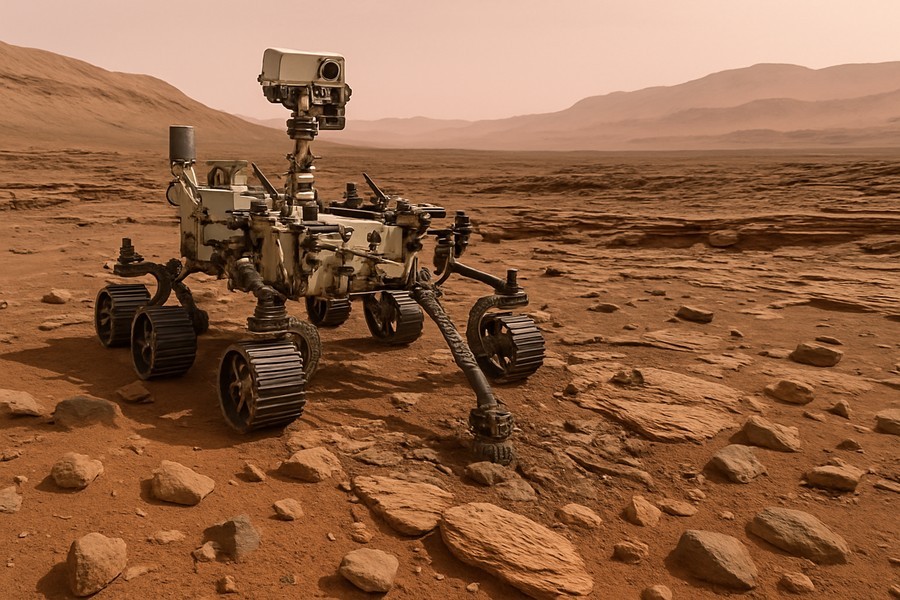
Mars Rover Uncovers Life's Ingredients in Historic Test
Scientists have recently announced an exciting discovery: a rover on Mars found more of life's basic components. This discovery came about through a unique chemistry experiment that had never been run on any other planet before.
However, these organic molecules don't necessarily prove that life existed on Mars. The team of researchers made it clear that these molecules could have formed on Mars or arrived via meteorites. Nevertheless, the discovery does confirm that these key markers of Martian history have been preserved for over three billion years.
Mars: A Different World Billions of Years Ago
Believe it or not, Mars was quite different billions of years ago. It was full of massive lakes and rivers of liquid water - a crucial element for life as we know it. The rover that made the recent discovery landed in what used to be a lake bed, known as the Gale crater, in 2012. Since then, it has been searching for any signs of past life.
This unique experiment was a high-pressure situation for the team. They had only "two shots to get it right," said the leading scientist behind the study. And they did get it right. The experiment, conducted in 2020, identified over 20 organic molecules, some of which had never been confirmed on Mars before.
Discoveries: Building Blocks of Life
Among the molecules discovered was benzothiophene, also found in meteorites and asteroids. "The same stuff that rained down on Mars from meteorites is what rained down on Earth, and it likely provided the building blocks for life as we know it on our planet," explained the lead scientist.
Another molecule containing nitrogen is a precursor to DNA. "We're seeing the building blocks for life – prebiotic chemistry on Mars – preserved in these rocks for billions of years," she added.
The Quest for Evidence of Life Continues
Despite these exciting discoveries, they don't confirm that life, even microscopic organisms, ever thrived on Mars. To make such a significant claim, scientists would need to bring Martian rocks back to Earth for a closer examination.
Already, a rover has collected several rocks for such a mission. However, the mission was unfortunately scrapped following a vote in January.
Yet, future missions could still learn from this rover's success in using a specific chemical in experiments on other worlds, the new study suggests. Another rover with a much longer drill will carry this chemical to Mars. And despite a few setbacks, it's now slated to head towards Mars in late 2028.
The chemical will also be onboard a rotorcraft planned for launch in 2028, aiming to explore Saturn's moon Titan.
These findings suggest that Mars organics are hard to explain without the existence of life, but only further exploration and study can provide definitive answers. So, the quest for evidence of life on Mars continues.