
A New Perspective on Mars: Unveiling the Planet's Dark Side
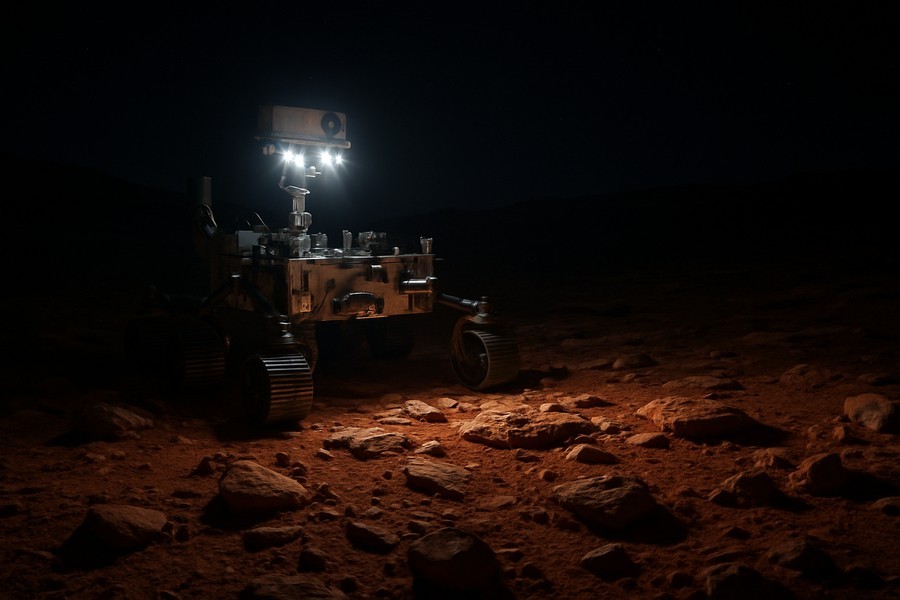
A unique nocturnal view of Mars has been revealed, courtesy of an exploratory rover's innovative use of onboard LED lights. This nighttime visualization focused on a drill site known as Nevado Sajama, presenting scientists with a novel method of studying the Red Planet after sundown.
Beyond the Ordinary: Breaking New Ground on Mars
The rover's mission on Mars has primarily depended on sunlight to investigate rocks, soil, and various geological formations in a region known as Gale Crater. Nighttime operations are a rarity, largely due to the limited scientific value of imaging without the aid of natural light. This particular observation, however, defied the norm. Engineers utilized LED lights attached to the rover's robotic arm to create a synthetic light source potent enough to disclose intricate details of the surface typically concealed in the dark.
The rover's Mast Camera was used to capture the scene, while the LEDs from an attached examination tool lit up the drill hole. This setup enabled scientists to study the way light interacts with freshly unearthed layers of rock, offering a contrast and texture that daylight imaging alone cannot achieve.
Unlocking the Secrets of Nevado Sajama
Nevado Sajama, the rock target of this mission, was drilled in an area characterized by peculiar geological structures known as boxwork. Appearing like vast spiderwebs from space, these formations are thought to originate from mineral-rich fluids seeping through crevices in ancient rock.
Following the drilling, the scientific team observed that the hole's walls were unusually smooth. This observation was significant as previous nighttime LED imaging had contributed to identifying layering within drill holes, hinting at how Martian rocks are formed. Recent changes in drilling techniques often resulted in holes too rugged or dusty for such analysis, making Nevado Sajama a unique opportunity to revisit this method and determine if subsurface layering could still be observed under controlled lighting conditions.
The Power of Artificial Light in Uncovering Mars
The LEDs used in this experiment were not typical floodlights designed for widespread views. These are precision instruments built into the examination tool, meant to light up small targets at close range. These lights are occasionally used during daytime operations to peer into shadowy areas, instrument inlets, or deep cavities unreachable by sunlight.
Their use at night, however, brings a new dimension. In the absence of solar glare or shifting shadows, the rover can establish consistent lighting angles. This allows scientists to evaluate grain size, texture, and subtle color variations within the rock. Furthermore, this method also minimizes visual interference caused by dust reflecting sunlight, thus making it easier to discern authentic geological features.
The Long-Term Vision Behind Nighttime Observations
This nighttime test was not a routine operation but a deliberate choice influenced by geological factors. The team continues to adapt the rover’s tools as it ages, finding innovative ways to derive valuable data from familiar instruments.
This strategy is a reflection of a broader philosophy of flexibility within the Mars exploration program. Despite being on Mars for over a decade, the rover is still capable of surprising scientists by creatively reusing hardware. Every successful experiment broadens the operational playbook for future rovers that may be equipped with similar imaging systems.