
Planets Beyond Our Solar System May Help Us Understand Dark Matter
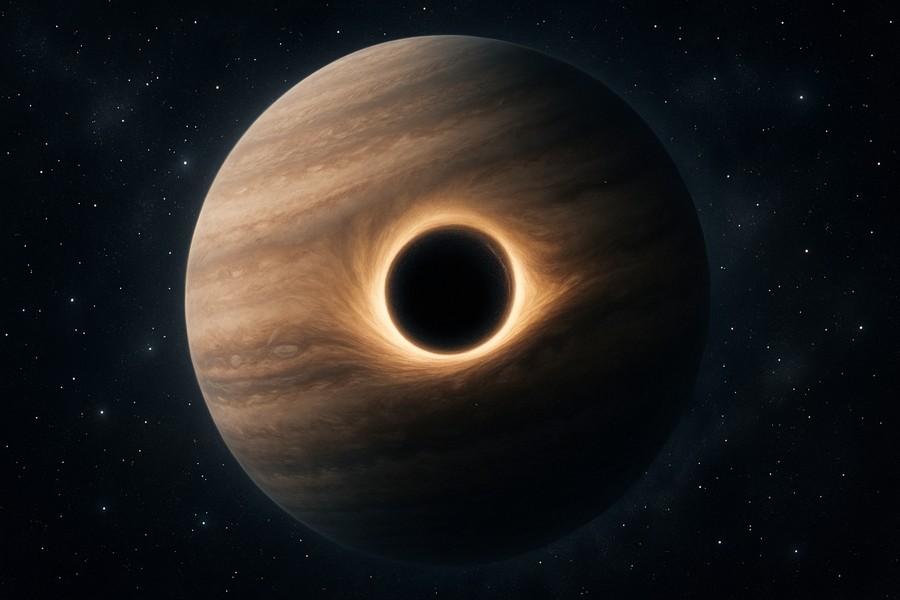
Planets far away from our Solar System might hold the key to understanding the mysterious dark matter in the Universe. A recent study suggests that a specific model of dark matter could lead to accumulation of this elusive mass in the centers of giant planets, eventually causing them to collapse into tiny black holes. These black holes would then consume the surrounding matter over time.
If this resulting planet-mass object could be detected, it might confirm the existence of a particular type of dark matter - a heavy type that does not self-annihilate.
"If the particles of dark matter are heavy enough and are not self-annihilating, they could eventually collapse into a tiny black hole," explains a leading astrophysicist. "This black hole could then grow and consume the entire planet, turning it into a black hole of the same mass as the original planet. This scenario is only possible under the model of superheavy non-annihilating dark matter."
Understanding Dark Matter
Dark matter is believed to make up about 85 percent of the Universe's matter. We are aware of its existence because the amount of gravity we observe is much more than what can be accounted for by normal matter alone. However, so far, we have not been able to detect dark matter directly.
This means we are still unsure about what dark matter is, but scientists are trying to narrow it down. There are a few leading theories, and all suggest slightly different behavior for dark matter. Understanding these behaviors and how they might manifest in the Universe could help scientists develop experiments to identify the lesser-known characteristics of dark matter.
The Role of Giant Exoplanets
The discussion on dark matter brings us to its accumulation in the cores of giant exoplanets. As per the recent study, heavy dark matter that does not self-annihilate could be captured by giant planets, lose energy, and sink towards the core where they concentrate. Over time, these accumulations could become dense enough to collapse under gravity and form tiny black holes.
"In gaseous exoplanets of various sizes, temperatures, and densities, black holes could form on observable timescales, potentially even generating multiple black holes in a single exoplanet's lifetime," the astrophysicist explains. "These results indicate how surveys of exoplanets could be used to search for superheavy dark matter particles, particularly in regions believed to be dense in dark matter, like the center of our Milky Way."
Challenges and Future Prospects
There are several hurdles to finding evidence of this process. The primary obstacle is that our current technology is not sensitive enough for the task. For instance, a black hole with the mass of Jupiter would only be about 18.4 feet across.
However, advancements in space observation technology are being made continually. It's not entirely impossible that one day, we will have instruments powerful enough to detect a planet-mass black hole.
"If astronomers were to discover a population of planet-sized black holes, it could provide strong evidence supporting the model of superheavy non-annihilating dark matter," says the astrophysicist. "As we continue to gather more data and examine individual planets in more detail, exoplanets may offer crucial insights into the nature of dark matter."
