
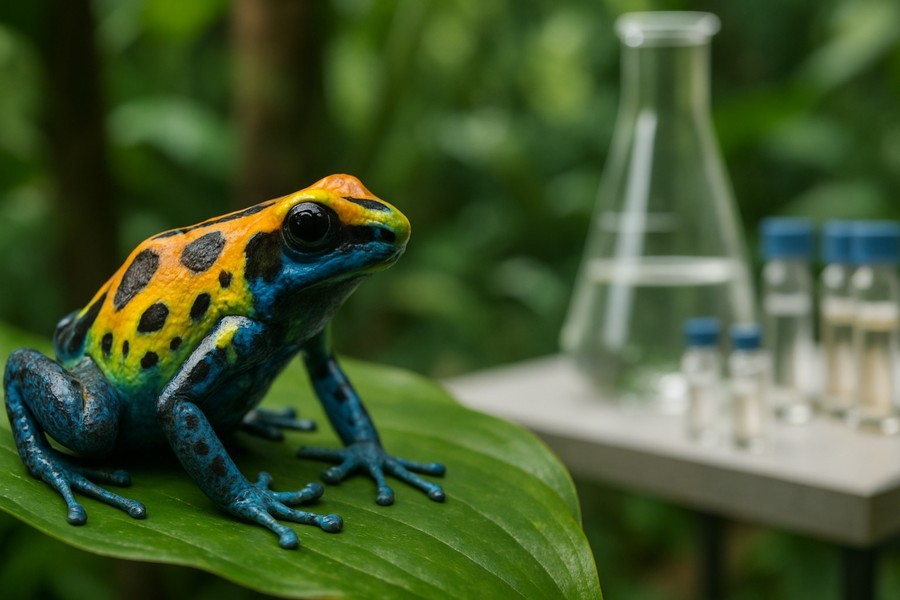
The Mystery of the Deadly Dart Frog Toxin
Reports have emerged that Alexei Navalny, a prominent figure opposing the government, lost his life due to the lethal toxin found in South American poison dart frogs. This lethal substance turned up in Navalny's system, and it is believed to have caused his demise while he was in a Siberian prison.
According to recent revelations, it seems that the only plausible entity with the ability, motive, and opportunity to employ such a rare and deadly poison would be the Russian state. However, these claims have been brushed off as mere propaganda by the Russian authorities.
Understanding the Toxin
The lethal substance in question is called epibatidine, a natural neurotoxin obtained from the skin of the Ecuadorian poison dart frog. Top toxicology specialist, Jill Johnson, has revealed that this toxin is a staggering 200 times more potent than morphine.
Epibatidine is naturally found in certain species of dart frogs in South America, and it can also be synthesized in labs. However, it is important to note that this toxin is not present in dart frogs that are kept in captivity and it is not naturally found in Russia.
The Anthony's poison arrow frog and the Phantasmal poison frog are among the few species known to excrete this toxin onto their skin. Despite its immense potency, epibatidine has been investigated for its potential medicinal uses, such as pain relief and treatment for inflammatory lung conditions. However, its extreme toxicity has barred its clinical use.
The Effect of Dart Frog Poison
Epibatidine works by acting on the nicotinic receptors in our nervous system. Overstimulation of these nerve receptors can lead to muscle twitching, paralysis, seizures, slow heart rate, respiratory failure, and eventually death. Alastair Hay, a renowned environmental toxicology professor, notes that the lethal effects of this toxin can lead to suffocation.
The presence of this toxin in a person's bloodstream indicates deliberate administration. Furthermore, the toxicity of epibatidine can be significantly increased when combined with certain other drugs, making it an even more dangerous weapon.
How Rare is Epibatidine?
Epibatidine is an extremely rare toxin, only found in one specific geographic region, and even there, it is present in trace amounts. The dart frog species that are known to produce this toxin, such as Anthony's poison arrow frog, are native exclusively to Ecuador and Peru.
These frogs create epibatidine by consuming specific foods that allow them to produce certain organic compounds known as alkaloids, which in turn enable them to accumulate epibatidine in their skin. If the diet of these frogs changes, their reserves of epibatidine would naturally deplete.
According to Johnson, finding a wild frog in the right location, consuming the exact diet required to produce the necessary alkaloids, is nearly impossible, making this an incredibly rare method of human poisoning. The only other known instances of epibatidine poisoning were non-fatal and occurred in a laboratory setting.
Russia's Response
While European laboratories have confirmed Navalny's death from this obscure, lethal toxin, the Russian government insists that Navalny died of natural causes. Navalny's widow, Yulia Navalnaya, has consistently claimed that her husband was deliberately poisoned and lost his life as a result.
The Russian embassy in London vehemently denies any involvement in Navalny's demise and has dismissed these allegations as fabrications by the West. Similarly, a spokesperson for the Kremlin has stated that these claims are part of an information campaign designed to divert attention away from the West's own problems.
On the other hand, Hamish de Bretton-Gordon, a former senior officer and chemical weapons expert, cautions the public to take the Kremlin's statements, including those about Navalny's death, with a healthy dose of skepticism.