
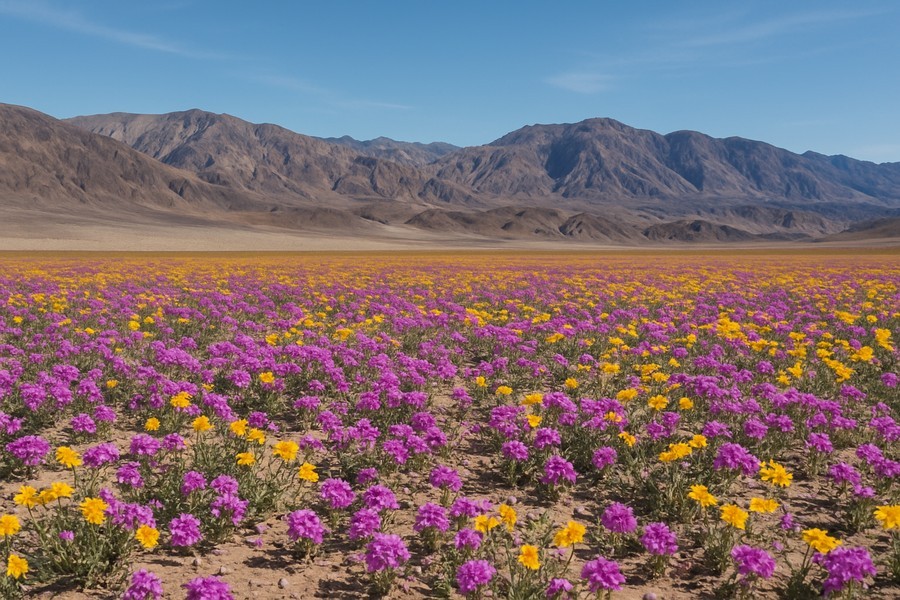
Breathtaking Blossoms Transform Death Valley
Imagine a place known for its blistering heat, harsh sand, and endless dirt suddenly bursting into a canvas of vibrant colors. This is the incredible transformation currently unfolding in Death Valley National Park. The usually arid and desolate landscape is now blanketed in beautiful hues of pink, purple, and yellow, thanks to a phenomenon known as a superbloom.
A Rare Spectacle of Nature
A superbloom takes place when a usually dry region experiences more rainfall than usual, allowing a plethora of wildflowers to bloom all at once. This year's superbloom in Death Valley is considered the most magnificent in the past ten years. Such an event is a result of wetter-than-average conditions that prevailed in the region during the last fall and early winter.
Death Valley, known as the hottest and driest place in North America, typically receives a mere 2 inches of rainfall each year on average. But this year, the region had a rain surplus. In just two and a half months, from November through early January, there was about two and a half inches of rain.
The Magic of the Superbloom
While wildflowers do bloom in the park each spring, a superbloom only occurs after exceptionally wet fall and winter seasons. The most extensive blooms—those that can be seen at low elevations almost everywhere in the park—need the "right" type of rain. This means several days of drizzly, foggy, gentle rain that can soak into the ground without washing out roads or causing other destruction. Following this, mild temperatures are needed going into the spring. Once the flowers bloom, their biggest threats are wind and heat.
The wildflowers that bloom in this desert are known as ephemerals. These plants can stay in a dormant state - in seed form in the soil - for long periods, waiting for the right conditions to bloom. This can be thought of as a survival strategy to evade drought.
When the conditions are right, the seeds germinate, the flowers bloom and get pollinated, then turn back into seeds, and the cycle repeats. If the rains don't come for several years, the seeds have the ability to wait it out in the soil.
Catch the Superbloom While You Can
For those who want to witness this year's superbloom, timing is crucial. The wildflowers at lower elevations are only expected to last until mid- to late March. At higher elevations, blooms are forecast to appear from around April to June. However, these predictions depend heavily on the weather.
While some of the best viewpoints require a hike, most visitors will be able to see the blooms along popular routes, particularly at the southern end. There are also less crowded viewpoints such as Mud Canyon or along Beatty Cutoff Road for those seeking a more tranquil experience.
It's worth noting that the park has seen a significant increase in visitors recently, eager to take in the stunning spectacle. However, everyone is reminded that picking the park's wildflowers is strictly forbidden. They are encouraged to appreciate the blooms while respecting and protecting the area's fragile environments.
So, if you're hoping to witness this year's superbloom, plan your journey soon. In the words of one park official, "The next few weeks will be the peak of the bloom. The higher elevations will also be beautiful, but it doesn't create the same visually stunning landscape that you can see right now at low elevations, where a rocky landscape has transformed into a wildflower field."