
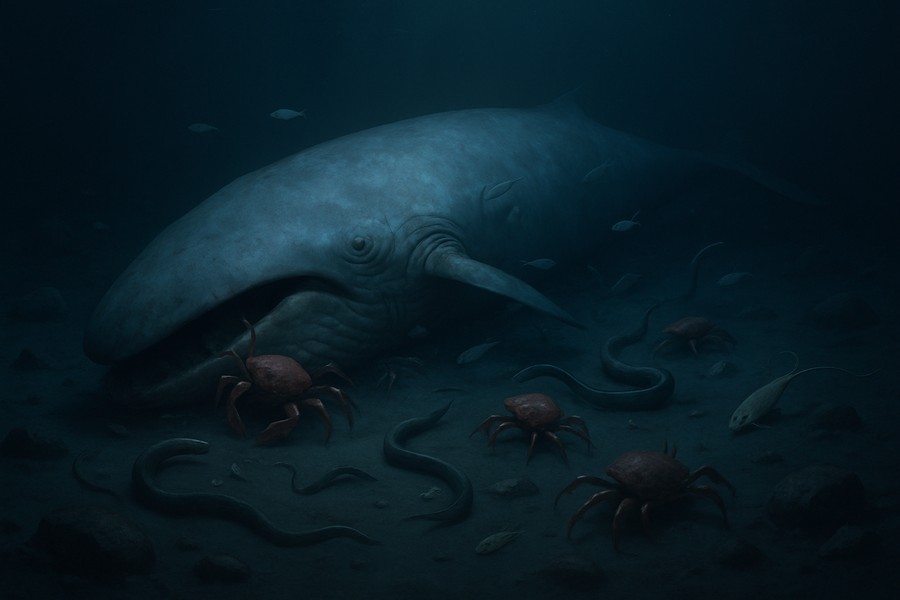
The Bizarre Sea Life That Thrives on Whale Remains
Whales, the ocean's heavy haulers, can carry up to 150 tonnes of food - including a mix of flesh, blubber, and bone - across the world's seas. Their bodies are a feast waiting to happen. When a whale dies, it becomes a tremendous source of nutrients, attracting a variety of unusual deep-sea creatures.
The Whale's Journey to the Deep Sea
Typically, whales die far from land, along their extensive migration routes. Initially, gases within the carcass cause it to bloat and float. Eventually, the whale's body descends through the sunlight, twilight, and midnight zones of the ocean, ultimately sinking into the abyss's darkness, its final resting place.
In death, a whale becomes a massive nutrient island. Usually, the deep sea is fed by tiny particles of organic matter, referred to as marine snow. But a sunken whale is like a colossal banquet hitting the ocean floor all at once. A single whale carcass can provide a feast equivalent to thousands of years' worth of marine snow, fueling an entire ecosystem for many years.
The First Diners: Scavengers of the Deep
The "deep-sea scavenging community" are the first to show up at this marine feast. This includes strange creatures like hagfish, sleeper sharks, and various scavenging crustaceans similar to shrimps. These creatures devour the flesh, exposing the whale's bones. This initial feeding frenzy can last for years.
Among these strange creatures, hagfish stand out. They are the only known living animals with a skull but no spine. These fish burrow into their food face-first, eating it from the inside out. When threatened, a hagfish produces a slimy substance so overwhelming it can cause a predator to retreat or even suffocate.
Rattail fish, another scavenger, are equipped to thrive in the deep sea's darkness. They can grow up to a meter long and live at depths of up to 4,000 meters. Their large blue eyes can detect even the smallest glimmers of bioluminescence, the only light source in these depths. Additionally, their chin barbels sense the movement of potential prey hiding under the ocean floor's surface.
The Opportunistic Feeders
Once the larger scavengers have had their fill and the whale's bones are exposed, smaller diners move in. Among these are "Osedax," or bone-eating worms. These worms belong to a diverse and abundant group known as bristle worms. These segmented worms swarm a whale carcass in their thousands. Some of the species in this "enrichment-opportunist" stage are found exclusively at the site of a whale fall.
One such worm, sometimes referred to as the "bone-eating snot-flower," was discovered in 2005 on a whale carcass. These worms inject acid into the bone, essentially putting their gut inside the bone and directly absorbing it.
Over a decade, an entire community of these worms can grow, live, and die on a single whale carcass. When the skeleton has been fully consumed, the worms release larvae that will drift on ocean currents, hoping to find another whale carcass to settle on and start the cycle anew.
The Final Feast
As these worms break down the whale's bones, the bones become spongy and can be easily torn apart by other scavengers. Organic matter spills out from the carcass, enriching the surrounding seabed with nutrients. Tens of thousands of opportunistic worms, molluscs, and crustaceans arrive to vacuum up any remaining scraps of blubber or flesh and to sift through the seafloor sediment.
Among these creatures, the Japanese spider crab, believed to live up to 100 years, is noteworthy. Its body can grow up to 30cm wide, but its legs keep growing and can span up to 3.8m from claw to claw, almost the length of a small car.