
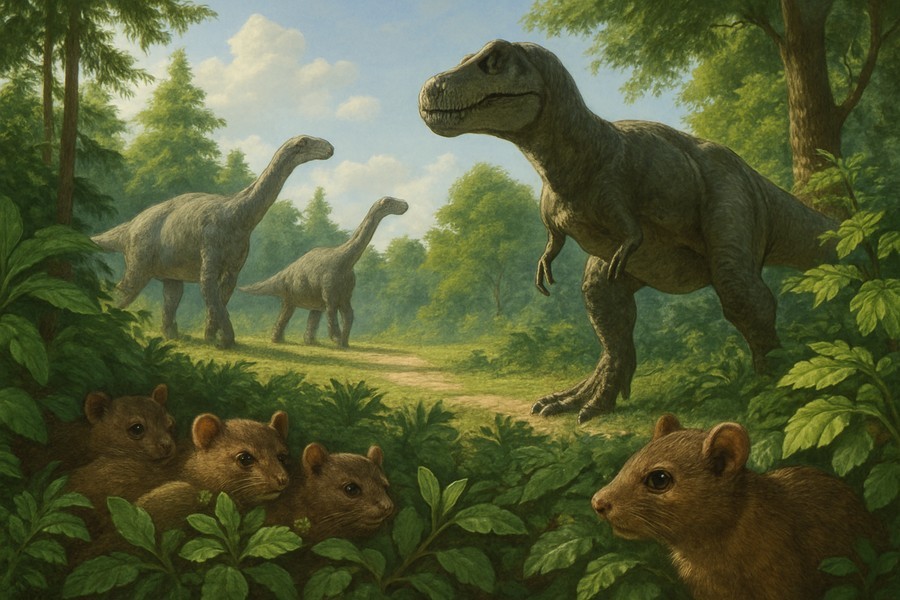
How Dinosaurs May Have Influenced Human Longevity
It's an intriguing thought: Could ancient creatures like dinosaurs have shaped the way we humans age today? That's the question at the heart of a fascinating theory presented by a well-respected microbiologist.
The expert, known for his groundbreaking research and innovative ideas, suggests that the dinosaurs' dominance might have compelled mammals, including our early ancestors, to prioritize rapid reproduction over longevity, leading to the loss of certain genes linked to long life.
The Longevity Bottleneck Hypothesis
This theory has been named the "longevity bottleneck hypothesis". It suggests that, to survive in a world dominated by dinosaurs, mammals may have been forced to evolve away from long life. This was a dramatic shift in evolutionary focus, prioritizing quick breeding over extended lifespans.
According to the hypothesis, there wasn't much point in living a long time when a dinosaur could just eat you. Therefore, the most efficient survival strategy became rapid reproduction to keep the species alive.
The microbiologist explains, "Such a long evolutionary pressure on early mammals for quick reproduction may have led to the loss or inactivation of genes and pathways related to long life. This is what I refer to as the 'longevity bottleneck hypothesis', an idea that is further supported by the absence of regenerative traits in mammals."
The Dinosaurs' Lasting Legacy
Despite humans, elephants, and whales having the potential to live longer than most other mammals, the researcher argues that every mammal is still living with genetic limitations that date back to the dinosaur era. He wrote, "The reign of the dinosaurs has left a lasting legacy in mammals."
During the millions of years when dinosaurs were the apex predators, mammals were generally small, nocturnal, and short-lived. The need to survive led to the elimination of genes necessary for long life. Comparing mammals to reptiles and other animals that age much slower biologically, the expert theorizes that mammals either lost or deactivated genes associated with long life during the Mesozoic Era.
He explains, "The earliest mammals were likely positioned at the bottom of the food chain and spent millions of years during the age of the dinosaurs evolving to survive through rapid reproduction. This prolonged period of evolutionary pressure, I propose, has influenced the way we humans age."
The Loss of Regenerative Abilities
Digging further into his research, the microbiologist believes that the loss of certain enzymes during the Mesozoic Era might limit many mammals' ability to repair damage. For instance, mammals lack enzymes that can heal skin burned by ultraviolet light and don't have continuously growing teeth like reptiles.
He points out that the animal kingdom provides amazing examples of repair and regeneration. However, such genetic abilities would have been "unnecessary for early mammals that were fortunate enough not to end up as dinosaur food."
Although this is still a hypothesis, the microbiologist believes it could provide a substantial explanation for many unsolved questions. For instance, it might offer insights into why cancer is more prevalent in mammals than in other species, possibly due to the rapid aging process.
So, if we're aging faster because of the dinosaurs, we can take solace in the fact that we outlasted them. It seems we had the final say after all.