
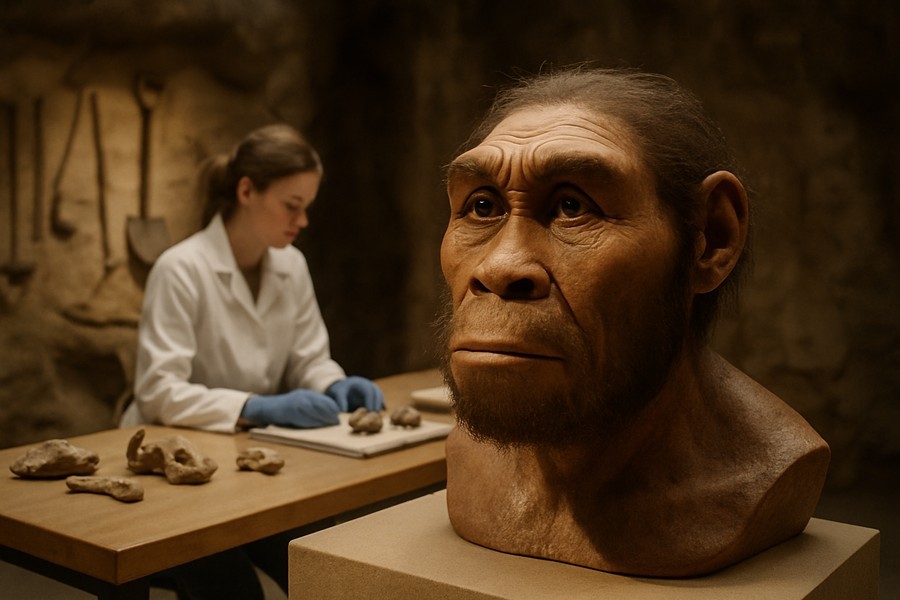
Unveiling the Face of Our Ancestral Past
Thanks to advancements in digital technology, scientists have been able to reconstruct the face of an ancient human relative known affectionately as 'Little Foot.' This remarkable individual lived a staggering 3.67 million years ago.
The Discovery of Little Foot
Little Foot was discovered by a famous paleoanthropologist who spotted four small bones in a museum collection. This led to the discovery of the almost perfectly preserved fossil of Little Foot in a cave system located northwest of Johannesburg, South Africa. It took two decades to fully excavate the remains, but the outcome was well worth the effort.
With 90% of the skeleton intact, Little Foot has provided the most complete glimpse yet into our Australopithecus ancestors, who had the unique ability to both walk upright like humans and climb trees like chimpanzees. This skill set would have been invaluable for escaping predators, such as saber-toothed cats.
The discovery of Little Foot represents the oldest known evidence of human evolution in the southern region of Africa. However, studying Little Foot's skull, which was crushed under layers of cave sediment over the years, proved challenging. The damage was so severe that physical reconstruction was impossible.
Digital Reconstruction of Little Foot's Face
Thankfully, modern digital technology has allowed researchers to virtually rearrange the bones of Little Foot's face, revealing key features that could shed light on our own evolutionary history. Only a few Australopithecus fossils have preserved an almost complete face, making Little Foot a unique and valuable reference point for scientists.
Little Foot's fossil was transported out of South Africa for the first time to undergo high-resolution scanning in England. This process involved the use of bright, nondestructive X-rays, creating over 9,000 high-quality images and a wealth of data. These images were then processed by a powerful computer, allowing for the 3D digital reconstruction of Little Foot's face.
Comparisons and Findings
The reconstructed face of Little Foot was compared to other Australopithecus specimens and modern great apes. The size of Little Foot's face was found to be somewhere between that of a gorilla and an orangutan, but the shape was closer to orangutans and bonobos.
Interestingly, researchers found that the size and shape of Little Foot's face, as well as her eye sockets, were more similar to Australopithecus fossils found in East Africa, despite Little Foot being discovered in South Africa. This could suggest that Little Foot's lineage was more closely related to East African hominins, while South African hominins evolved distinct facial features at a later stage.
These findings support the idea of a connected evolutionary landscape across Africa, with populations adapting to ecological pressures while being linked through common ancestry.
Understanding Our Ancestors Through Their Faces
Studying the faces of our early human ancestors can provide valuable insights into how they interacted with their environment and with each other. Aspects of Little Foot's face, such as the size of her eye sockets, could reveal changes in visual acuity or environmental conditions and may even be linked to an extended visual area in her brain.
Little Foot's skeleton is 50% more complete than the famous Lucy fossil, which was discovered in Ethiopia in 1974. While there is ongoing debate about the exact species designation for Little Foot, her fossil continues to be a rich source of information that could unlock clues to our evolutionary history.
Future plans for the research team include using digital reconstruction methods to correct deformation on other parts of the skull, such as the braincase. This could reveal insights about the brain size of Little Foot and potentially unlock clues about the cognitive abilities of our early human ancestors.