
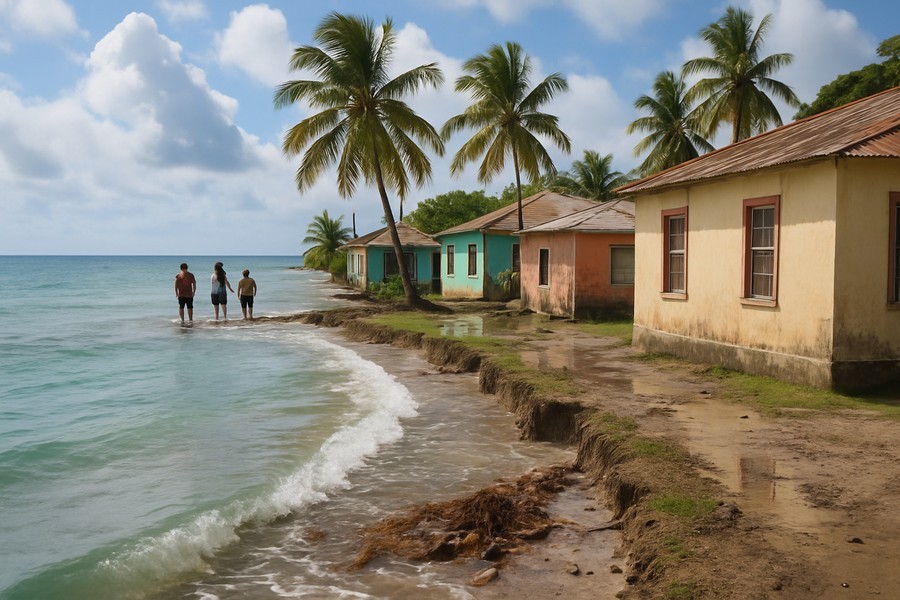
Court Mandates Dutch Government to Safeguard Bonaire Island Residents from Climate Change
The citizens of the small Caribbean island of Bonaire have scored an impressive win in their fight against climate change. A court ruling has mandated the Dutch government to formulate an effective plan to shield the island's residents from the impending consequences of global warming.
Notably, the court's verdict rebuked the government for its failure to take "prompt and appropriate actions" to protect Bonaire's 20,000 inhabitants from the looming climate crisis.
Bonaire Island's Climate Woes
The island is already experiencing the harsh realities of climate change. Flooding incidents due to tropical storms and heavy rainfall have become a frequent occurrence. Experts predict that these conditions will only worsen in the future. Even by conservative estimates, significant portions of the island could be submerged underwater within the next 25 years.
Climate Protection Targets
In addition to mandating a climate protection plan for Bonaire, the court has also ordered the Dutch government to establish legally binding targets to reduce greenhouse gas emissions. The targets are to be set within an 18-month timeframe and should align with the Paris Climate Agreement. This agreement aims to keep the global temperature rise below 2 degrees Celsius (3.6 degrees Fahrenheit) by 2100 and endeavours to restrict it further to 1.5 degrees Celsius.
The Lawsuit and Its Implications
The lawsuit was filed by eight residents of Bonaire with the support of a well-known environmental group. The suit demanded the government to better protect its citizens from the escalating temperatures and rising sea levels. This case could potentially open the floodgates for similar legal challenges across the globe.
Reactions to the Verdict
One of the plaintiffs, Jackie Bernabela, expressed her joy at the court's decision, saying, "We are no longer second-class citizens. Equality. I am very happy." The government has the option to appeal the comprehensive 90-page ruling.
A representative from the environmental group hailed the ruling as an "amazing victory," not just for the people of Bonaire, but for everyone. She emphasized that governments need to take more robust action to halt the climate crisis and protect those already feeling its effects.
Government's Response
Lawyers for the government countered that the Netherlands is already taking significant steps to fight climate change, including reducing greenhouse gas emissions and implementing mitigation measures. They argued that such issues should be addressed by national governments rather than courts.
However, the court disagreed, stating that the government's efforts were insufficient. It pointed out that the country's goal to reduce emissions by 55% by 2030 compared to 1990 levels was non-binding and did not fully consider emissions from air and sea transport. The court also indicated that it was "highly unlikely" for the Netherlands to meet its 2030 target.
Political Implications
The ruling comes at a time when a new Dutch government is expected to be formed following recent national elections. The new administration will have to tighten measures to align with the court's ruling.
Precedent for Climate Rulings
This isn't the first time that a court has issued a groundbreaking climate ruling. The same court issued a landmark ruling in favor of climate activists a decade ago, ordering the government to cut greenhouse gas emissions. This set the stage for similar legal challenges around the world.
Over the last ten years, global sea levels have risen by an average of around 4.3 centimeters (1.7 inches), with certain regions in the Pacific experiencing an even higher rise. The world has also warmed by 1.3 degrees Celsius (2.3 Fahrenheit) since the preindustrial era, primarily due to the burning of fossil fuels.