
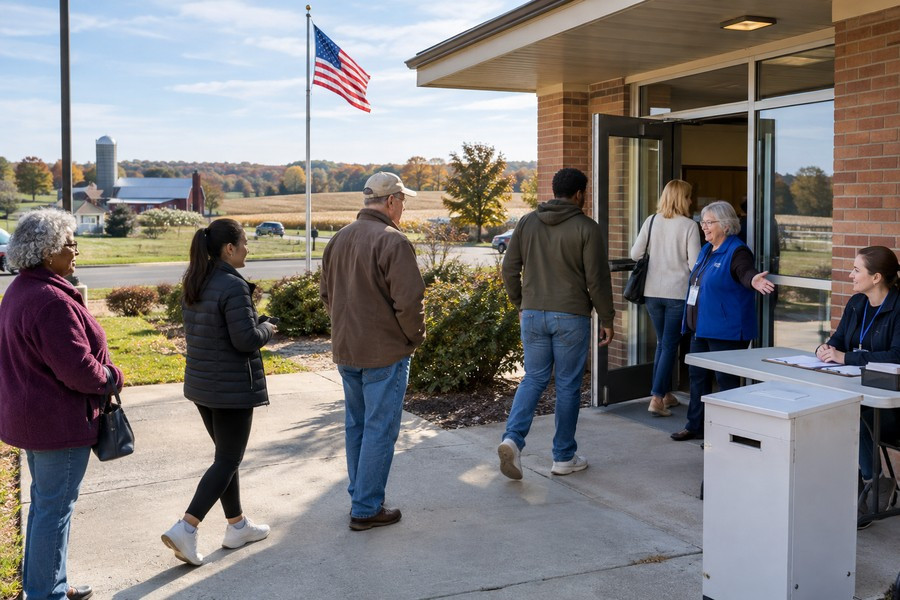
Early Voting Shows Stronger Democratic Turnout in Key Ohio Counties
Early voting in Ohio is showing a stronger Democratic presence than in the past, even in parts of the state that strongly support President Donald Trump. The pattern could matter in a close election that may help decide control of the U.S. Senate.
Democrats Narrow the Gap in Republican Areas
Democrats now make up a larger share of early voters than they did during the same stage of the last presidential election. The change is especially clear in Ohio counties where Trump won by at least 20 percentage points.
At the same point in the previous election, Republicans held a 30-point advantage over Democrats in those counties. That lead has now fallen to about five points.
The shift is not limited to strongly Republican areas. Counties that supported former Vice President Kamala Harris by the widest margins are also showing a more Democratic early-voting turnout. In those places, the voting pool is about 25 points more Democratic than it was at the same point during the previous election.
The latest statewide numbers include ballots counted after early voting on Thursday. In counties with newer information, Friday appeared to bring a small improvement for Republicans. Still, Democrats remain ahead of where they stood at this stage in the previous election.
A Positive Sign for Democratic Candidates
The early voting numbers offer encouragement to Democrats as former Sen. Sherrod Brown challenges Republican Sen. Jon Husted. A recent public poll gives Brown a six-point lead in the Senate race.
The governor’s race also shows a Democratic advantage. Democrat Amy Acton leads Republican Vivek Ramaswamy by eight points in the same polling.
Across Ohio, the early-voting electorate is about 27 points more Democratic than it was at the same stage of the previous election. That suggests Democratic voters may be more eager to cast ballots early this time.
However, the numbers do not predict the final result. Party information does not show which candidate a person supported. It only shows how a voter is connected to a party or which primary the voter joined in the past.
Republicans have also become more likely in recent elections to vote in person before Election Day or to wait until Election Day itself. Because of that, the current early-voting numbers could change as more ballots are cast.
Only a Small Share of Voting Is Complete
Ohio is still near the beginning of its early-voting period. The state has reached only about 11% of its total early-voting turnout from the previous midterm election.
That means the current party breakdown is only an early snapshot. More voters will cast ballots in person, mail ballots may arrive later, and Election Day turnout could alter the balance between the two parties.
Even so, the strongest Democratic counties are moving faster than the strongest Republican counties. Counties that backed Harris by the largest margins have already reached about 74% of their turnout from the same point in the previous presidential election.
The strongest Trump counties are at about 67% of their earlier turnout level. The seven-point difference suggests Democratic voters in Ohio’s most liberal areas are participating at a faster pace so far.
Similar Movement in Virginia and New Jersey
A similar seven-point difference has appeared in Virginia, where Democratic areas are also turning out more quickly than Republican areas. The gap is smaller than it was earlier in the month, but the overall pattern remains visible.
New Jersey is showing another version of the same trend. Unlike Ohio, New Jersey voters officially register with a political party. Ohio voters do not choose a party when they register. Instead, the state links a voter to a party based on which primary the person has taken part in.
Democrats performed unusually poorly in New Jersey during the previous presidential election. Harris won the state by less than six points, which was the narrowest Democratic victory there in decades.
This time, the largest shift toward Democrats is taking place in the New Jersey counties that supported Trump by at least 20 points. Among voters who have already returned ballots in those three counties, the party balance has moved nearly 11 points toward Democrats compared with the same point in the previous election.
The strongest Harris counties are also showing a more Democratic turnout, though the change there is less than two points.
In-person early voting has not yet begun in New Jersey. The current numbers may partly reflect a continued Republican move away from voting by mail rather than a complete change in overall turnout.
Voters Are Choosing Different Ways to Cast Ballots
Ohio’s numbers also show that voters are changing how they vote. Since the pandemic, fewer Americans have relied on mail voting, and more have returned to voting in person.
That trend is clear in Ohio’s early numbers. In-person early voting is running at about 72% of the level seen at the same point in the previous election.
Mail voting is much lower, at only about 25% of the earlier level.
The results remain incomplete, but they point to a clear early pattern: Democratic voters are participating more heavily in pre-election voting, while many Republican voters may be waiting to vote in person or on Election Day.
