
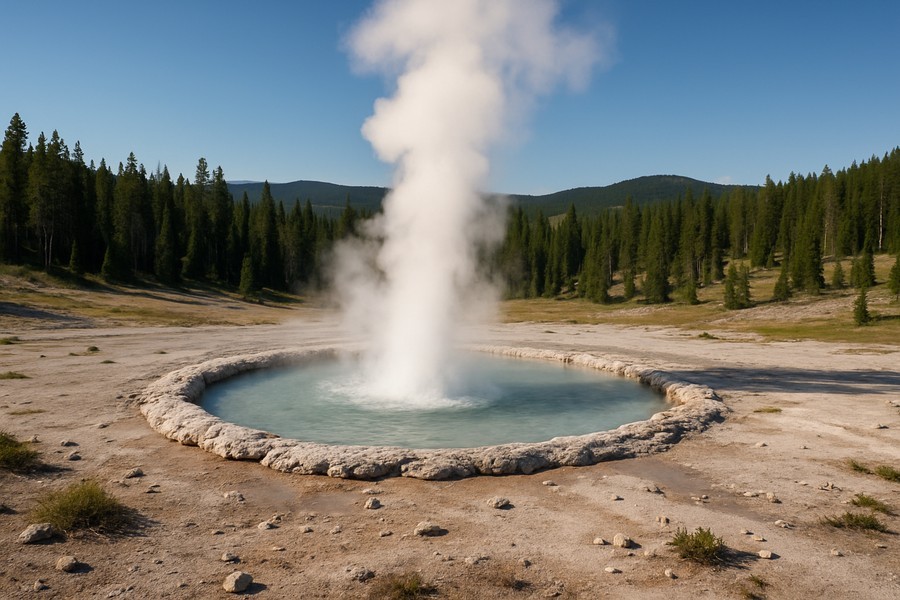
The Return of the Mighty Echinus Geyser
The Echinus Geyser, a remarkable natural wonder in a thermal region known for extreme heat and constant transformations, is once again active. Found within the expansive Yellowstone National Park, this particular area is a hotbed of geothermal activity, boasting the Earth's highest active geyser among other fascinating thermal features.
Located in the Back Basin, a short 660 feet away from the towering Steamboat Geyser, sits the Echinus Geyser. Its peculiar name can be traced back to a visiting mineralogist who, in 1878, thought the surrounding rock formations resembled sea urchins, also known as echinoderms.
Unique Chemistry Creates a Unique Spectacle
The geyser pool, which spans approximately 66 feet in diameter, is an interesting anomaly. Despite being the largest acidic geyser in the world, the acid concentration is rather mild, comparable to that found in orange juice or vinegar.
Acidic geysers are a rarity, as the acid water can usually erode a geyser's underlying rock structure. However, in the case of the Echinus Geyser, a unique mixture of acidic gases and neutral waters creates a chemistry that doesn’t harm the rock. This unusual water chemistry manifests in interesting formations and compositions, such as the geyser's reddish rim, derived from iron, aluminum, and arsenic, and the silica-coated spiny rocks which inspired the geyser's name.
A Historic Attraction
The viewing area around the Echinus Geyser is well-equipped with several benches and tiered platforms. Though eruptions have been infrequent in the 21st century, this was not always the case. In the latter half of the 20th century, the geyser was a reliable spectacle, and visitors could witness a geyser eruption closer than anywhere else in the park.
Historically, the geyser was largely dormant, with only occasional eruptions before 1948. In the 1970s, the geyser showed consistent activity with eruptions occurring every 40-80 minutes. The 1980s and 1990s saw even longer eruptions, some lasting more than one and a half hours. Eruptions varied in size, with some reaching 75 feet high. But by the early 2000s, the geyser’s activity started to wane.
Recent Revival
In 2010, a temperature monitoring system was installed to track any changes in the geyser. The system recorded 15 sporadic eruptions during the last quarter of 2010 and the beginning of 2011. There were a few isolated eruptions in the following years, and then in 2017, the geyser started showing signs of life again.
During this period, the temperature sensor recorded frequent spikes and decreases throughout the day. These fluctuations were not due to eruptions, but rather surges from the pool. True eruptions began in October, with more hot water being released. For about a month, eruptions occurred very regularly every 2-3 hours. After this period of activity, the geyser fell silent once more, with only a handful of eruptions in 2018, 2019, and 2020.
However, in early February, the geyser began showing signs of activity again. After the first eruption since 2020, additional eruptions occurred regularly every 2 to 5 hours. These eruptions, reaching heights of 20-30 feet, lasted for 2-3 minutes, after which the water level dropped significantly and took about an hour to return to normal. This pattern of activity resembles that seen in late 2017.
The Future of Echinus Geyser
Will this renewed activity continue into the summer? As the geyser has a pattern of waking up for a short while before going dormant again, it seems unlikely. However, given the ever-changing nature of the thermal area, there is always a chance for a summer spectacle. We can only wait and watch.