
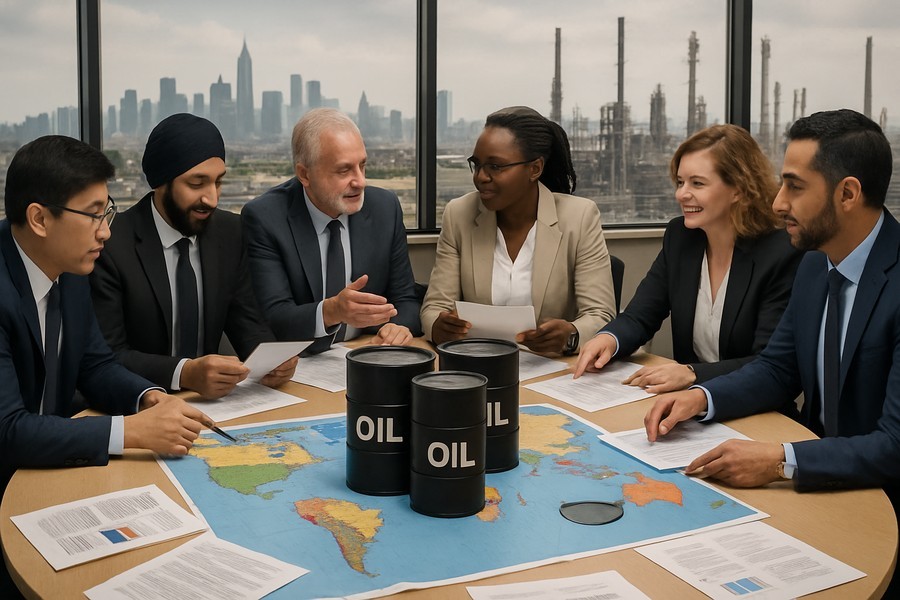
A New Approach to the Energy Crisis: Introducing a Buyers' Coalition
It's no secret that we're facing the biggest energy crisis in recent history. The situation has brought to light the need for a fresh, innovative response. While some believe in the free market approach, others argue for a new strategy in the face of this emergency. One such person is an economist from a well-known Massachusetts university.
He suggests that perhaps it's time to shake things up and take a different route. This economist proposes a bold and somewhat radical solution to ease the oil shock we're experiencing.
The Revolutionary Idea
The economist, along with a colleague, proposes the formation of a buyers' coalition, essentially a reverse of OPEC. The idea is for oil-importing countries to band together and demand more affordable prices from oil-exporting countries such as the U.S. They would do this by setting a price ceiling for oil, preventing a bidding war that could make oil too expensive for poorer nations.
This proposal flips the script on the norm we've known for the past 65 years. OPEC, a cartel of oil-producing nations, was itself a radical move when it was established in 1960. It was a way for these nations to take control of oil prices from Western oil companies and consuming nations. This new proposal is essentially the opposite: it's about giving control back to the consuming nations.
A New Control Mechanism
While OPEC controls how much oil is produced, this buyers' club would control the price at which oil is bought. This approach is not entirely unheard of. In fact, the International Energy Agency, established in 1974, was meant to serve as a counterbalance to OPEC. However, this new proposal would add a price ceiling to the existing structure.
It's important to note that the U.S. removed price controls on oil in 1981, a move that was a complete reversal of regulations from the 1970s after the oil shocks. This allowed oil to be priced not just as a commodity but also as an asset, which weakened the power of OPEC and allowed for increased independence for U.S. oil production.
The Current Situation
Supporters of the current free-trade oil market argue that it's an efficient system. They claim that prices aren't artificially determined and that it encourages less wasteful production and quicker distribution. This might be the case during peacetime, but with ongoing tensions causing restrictions in key areas, without change, wealthier countries will continue to outbid poorer nations, causing oil shortages and driving up global prices.
The economist argues that the solution is simpler than it sounds. Countries could agree together to acknowledge the supply shortage and the ongoing crisis, and decide that the market shouldn't be the only response to this unprecedented situation. Instead, governments should play a more active role.
Changes in Global Trade
Despite free trade dynamics being the norm in oil markets for decades, there has been a shift in mentality over the past several years. Some believe trade has become a "zero sum game." This shift mirrors the distribution of resources during the pandemic, where wealthier countries hoarded vaccines and personal protective equipment, leaving poorer nations in short supply.
Some argue that the U.S. has pushed away allies, and in certain cases, even disadvantaged itself. However, as a wealthy nation and a net exporter of oil, the U.S. is in a prime position to lead the charge in interventions to redistribute global oil, should it choose to do so. It could spearhead this proposed coalition of buyers, provided oil exporters also participate.
The U.S.'s Role in Oil Market Interventions
The U.S. has achieved a record energy surplus, largely due to oil and natural gas exports, creating a trade surplus of nearly $100 billion. With this wealth, the U.S. could also implement an excess profit tax.
However, excess profit taxes are not always as effective as hoped. For instance, the European Union raised much less than the projected revenue for such initiatives between 2022 and 2024.
Despite this, the economist's suggestion is clear: OPEC has shown over the last 65 years that a group of nations can reshape global energy markets. The question is whether consuming countries have the political will to do the same.
"Perhaps now is the time to think about creative solutions and ways to alleviate suffering for ordinary people," the economist said.