
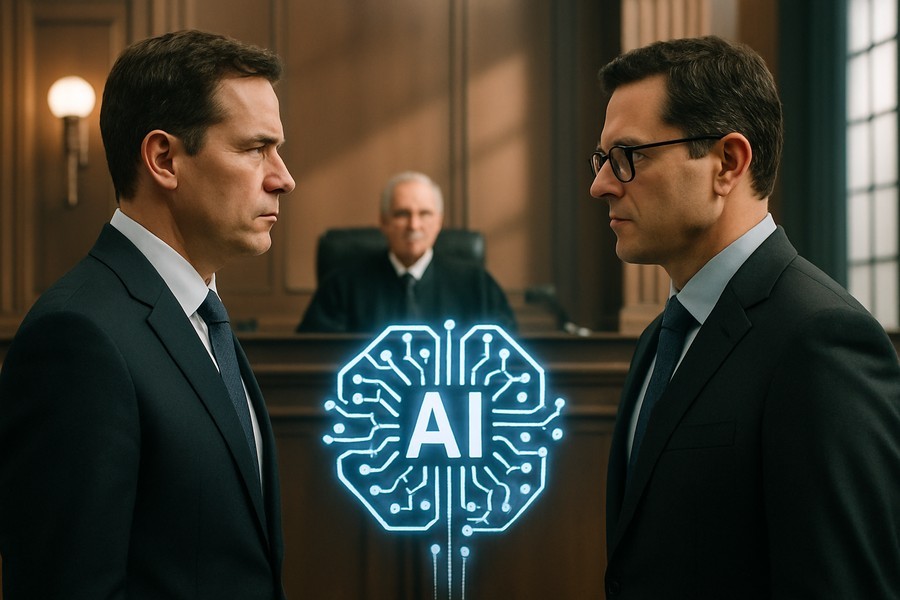
A Legal Battle Between Tech Giants Over AI Company's Future
Two tech heavyweights are set to square off in court. One, a well-known figure in the tech and space exploration industry, is taking legal action against the other, the head of a leading AI organization. The legal conflict is over the future of a prominent AI company that they both helped establish. The claimant alleges that he was tricked when the AI company was changed from a non-profit to a profit-focused enterprise.
Dispute Over Profit Change and Leadership
The AI company, which has become highly valuable through the success of a popular chat feature, is now worth close to a trillion dollars and is looking to go public. The complainant argues that the move from non-profit to for-profit was unethical and illegal. The battle between the two tech leaders is not just about personality conflicts, but also about the future direction of the company and AI development in general.
The AI company in question was initially created as a non-profit organization. It aimed to develop artificial intelligence for the good of humanity, without the pressure of shareholders and profit motives. However, to attract investors and gather the necessary funds for advanced computing power and chips, the founders decided to transform the company into a profit-making enterprise.
There was a struggle over leadership between the two tech giants, and the one who initiated the lawsuit ended up leaving the company's board. He later started his own AI firm.
Allegations of Illegal Actions
The lawsuit alleges that the transformation of the AI company into a profit-making entity was unlawful. The claimant's legal team has described the actions of the other party as deceitful and treacherous. The defendant, on the other hand, maintains that the claimant was fully aware of the need for the company to become a profit-making entity and participated in related discussions.
The complainant is demanding that the profits made by the company be returned to the non-profit section of the AI firm. He believes that the profits were made illegally, and he wants the court to order the return of the money. Moreover, he is seeking to overturn the transformation of the AI company into a profit-making entity and wants to restore it as a genuine public charity.
He also wants the defendant to be removed from his leadership roles in both the profit-focused and non-profit arms of the AI company.
The Impact of the Case
The complainant was a significant financial supporter of the AI company in its early stages, contributing millions of dollars that were vital to getting the project off the ground. Since he left, the company's profile has exploded, with a large user base and a high valuation. The company has recently secured substantial funding, and there are rumors of a potential public offering later this year.
Observers note that the lawsuit is complex, raising questions about the extent to which corporations can change, adapt, and reinvent themselves. The case also explores the limits of a company's ability to change its operating model, particularly when it had initially committed to a socially responsible approach.
Some believe that the complainant's primary motivation is not financial gain, but rather to defend his principles. He is asking the court to return the profits to the charity, not to himself.
If the court rules in favor of the complainant, it could dramatically change the structure of one of the world's top AI companies. This could have wide-ranging impacts on the entire AI industry. The case will be heard in a court in California, with jury selection taking place soon, followed by opening arguments. Both parties are expected to testify.