
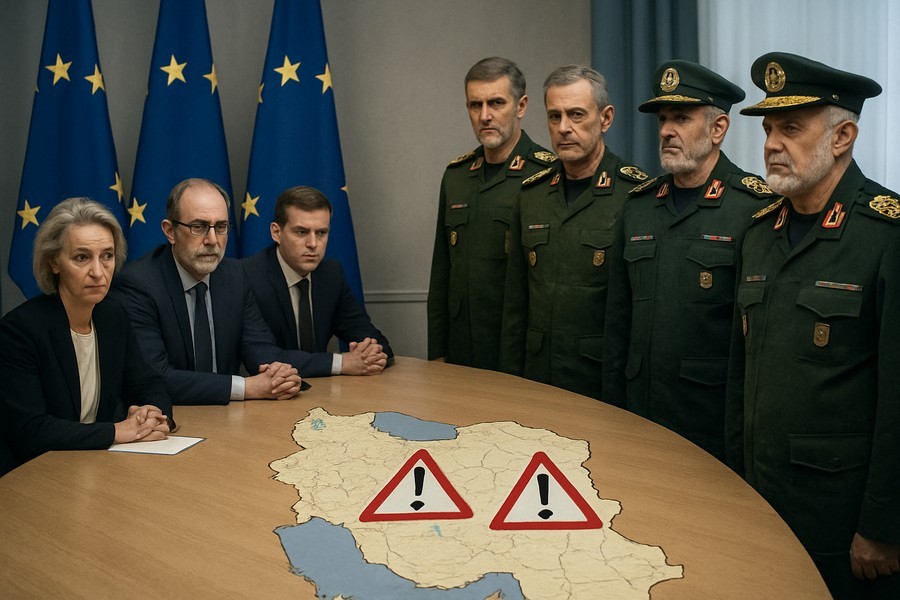
European Union Takes Action Against Iranian Officials
In a major development, the European Union (EU) has imposed sanctions on 15 officials from Iran. This decision comes in response to the country's severe response to national protests. The officials being sanctioned are key figures in Iran's Revolutionary Guard, which is expected to soon be classified as a terrorist group.
The sanctions serve to increase the ongoing pressure on Iran, which is currently under threat of military action from the U.S. This threat is a response to the reported killing of non-violent protesters and the potential for mass executions. The U.S. military has recently positioned several guided-missile destroyers and an aircraft carrier in the Middle East. The future actions of the U.S. remain uncertain as the death toll from the crackdown reaches 6,373, as stated by activists.
Iran's Response
In response to these developments, Iran has warned of a possible pre-emptive strike. Targets could potentially include American military bases in the Middle East and Israel. Iran has also alerted ships at sea of its intention to conduct a drill involving live firing in the Strait of Hormuz next week. This could disrupt traffic in a waterway which sees 20% of the world’s oil supply pass through it.
Revolutionary Guard's Role
The Revolutionary Guard has played a significant role in quelling the demonstrations in Iran. The EU’s chief diplomat stated that the Guard will likely soon join the EU’s list of terrorist organizations. This move equates the Guard with organizations such as al-Qaida, Hamas, and the Islamic State group.
Iran has not yet commented on these developments. However, it has recently been critical of Europe as it considered the move. Other countries, including the U.S. and Canada, have already designated the Guard as a terrorist organization.
Implications of the Terrorist Label
Initially, France was reluctant to label the Revolutionary Guard as a terrorist organization, fearing potential danger to French citizens detained in Iran and to diplomatic missions. However, France later indicated its support for the action. France’s Foreign Minister stated that more sanctions in Iran are necessary, and impunity for the committed crimes is unacceptable.
The Revolutionary Guard has extensive business interests throughout Iran, and sanctions could result in the seizure of any of its assets in Europe. The EU has also sanctioned six organizations in Iran, including those involved in monitoring online content. This is particularly significant as Iran is currently experiencing a three-week internet blackout enforced by authorities.
Iran is already dealing with the impact of multiple international sanctions from countries including the U.S. and Britain. The Iranian rial currency recently fell to a record low.
The Role of the Guard
The Guard was established during Iran’s 1979 Islamic Revolution to protect its government. It operates alongside the country’s regular armed forces and has gained prominence and power over time. The Guard's Basij force has likely been instrumental in suppressing the demonstrations.
However, sanctioning the Guard could be complicated. Iranian men are required to complete up to two years of military service once they turn 18, and many are conscripted into the Guard despite their political beliefs.
Upcoming Drill in Strait of Hormuz
Iran has warned of a planned “naval shooting” in the Strait of Hormuz. Although Iran has not yet acknowledged the drill, there are suspicions that Tehran could attempt to militarily close the strait. Such a move could trigger U.S. military intervention.
Current Death Toll
The U.S.-based Human Rights Activists News Agency reports that the violence in Iran has resulted in at least 6,373 deaths in recent weeks, with many more feared dead. More than 42,450 have been arrested. Due to the communication cutoff imposed by Iranian authorities, the full scale of the crackdown is yet to be revealed. The Iranian government's official death toll is significantly lower, at 3,117.